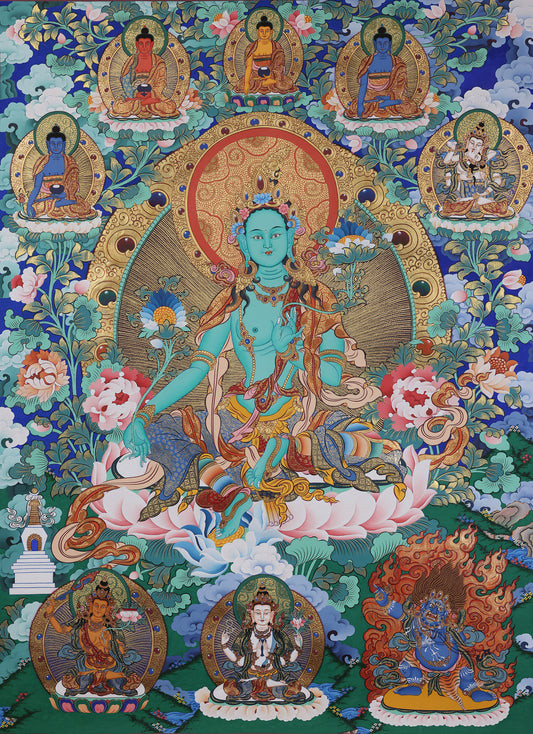
Kubera (Yellow God of Wealth): The Guardian of Prosperity and Wisdom in Tibetan Buddhism, Balancing Tangka Symbols with Modern Views on Wealth

When a vividly colored Tangka of Kubera unfolds before your eyes—this golden-bodied guardian deity holding a treasure-spitting rat, seated on a lotus throne with a conch under his foot, surrounded by jewels and flowers that seem to overflow with prosperity—he is far more than the "tool for attracting wealth" the secular world often perceives. In the belief system of Tibetan Buddhism, this deity, known as "Zambala Serpo," is a bridge between material abundance and spiritual cultivation, the tangible embodiment of the wisdom of "entering the path through wealth."
I. From Guardian of Vulture Peak to Leader of the Five Wealth Gods: Kubera’s Thousand-Year Origins
Kubera’s story begins with an act of protection during the Buddha’s teachings. According to the Great Prajñāpāramitā Sūtra, when Shakyamuni was expounding the wisdom of Prajñā at Vulture Peak, demonic forces stirred up chaos to destroy the Dharma seat. A golden-bodied guardian stepped forward to stabilize the mountain, saving the disciples from disaster. The Buddha, grateful for his merit, instructed him to protect the poor and needy—this guardian was the prototype of Kubera.
His roots trace back to Kubera, the god of wealth in ancient Hindu Brahmanism, who later integrated into Buddhism’s guardian system and merged with Tibetan mountain deity beliefs. He was fully localized during the Yuan Dynasty: in the murals of the Alxa Grottoes, Kubera first appeared as a main deity, with attendants replaced by patrons of Genghis Khan’s family, becoming a folk protector of "ethnic prosperity and career success."
In Tibetan Buddhism’s "Five Wealth Gods" system, Kubera occupies the central position (corresponding to the element of earth), leading the Red, Green, White, and Black Wealth Gods, each overseeing different dimensions of "wealth" such as merit, career decisions, and spiritual purification.
II. The Symbolic Code in Tangka: Every Detail is a Guide to Practice
Every detail of this colorful Tangka depiction of Kubera follows strict Buddhist ritual rules, hiding deep spiritual wisdom:
- Golden Body and Jeweled Crown: The all-golden form corresponds to "earth," symbolizing wealth as stable and vast as the earth; the five-Buddha crown represents the wisdom blessings of the Five Dhyani Buddhas, implying that wealth must be rooted in wisdom.
- Large Belly, Small Frame: This is not a sign of gluttony, but a compassionate heart that embraces the poor, aligning with the philosophy that "a broad mind brings good fortune."
- Treasure-Spitting Rat and Wish-Fulfilling Gem: The treasure-spitting rat (called "Nyule" in Tibetan) in his left hand, holding jewels in its mouth, symbolizes that wealth should be given to others rather than hoarded; the wish-fulfilling gem in his right hand represents "reasonable desire"—Kubera’s blessings are conditional on desires not being driven by greed.
- Foot on Conch: His right foot resting on a white conch symbolizes "retrieving treasures from the sea," meaning one must use wisdom to understand the laws of wealth, rather than chasing it blindly.
III. Practicing Kubera’s Dharma: Not "Seeking Sudden Riches," but "Breaking the Karmic Obstacles of Poverty"
In Tibetan Buddhism, the core of practicing Kubera’s Dharma is not "praying for overnight wealth," but "resolving the karmic obstacles of poverty"—here, "poverty" refers to both material scarcity and spiritual greed, anger, and delusion.
Two Core Principles of Practice:
- Generate the Bodhicitta: Practice must start with the intention to benefit others, vowing to use wealth to help sentient beings, not to satisfy personal greed. Those who are stingy and greedy will not only fail to receive blessings but will also create negative karma due to obsession.
- Good Karma as the Foundation: Buddhism holds that wealth is the result of good karma, not a goal. Practitioners must accumulate merit through giving and observing precepts; Kubera is merely a "guide to the conditions of wealth."
Simple Daily Practices:
- Chant the Mantra: Recite "Om Zambala Zalendraye Svaha" while visualizing Kubera bestowing blessings on all beings.
- Symbolic Offerings: Present offerings such as clear water, grains, or jewels (or their substitutes) to express the aspiration for "balanced wealth."
- Small Acts of Giving: Donate a small amount of money each month to practice the teaching of "flowing wealth."
IV. Contemporary Insights: Kubera’s Lessons on a "Balanced View of Wealth"
Today, Kubera’s image frequently appears in cultural and creative products and social media; young people even popularize "morning check-ins for Kubera practice." However, most overlook his core teachings— the modern value of Kubera worship is teaching us to maintain spiritual clarity in a material age:
- Anti-Materialism: It reminds us that wealth is a tool, not a purpose; true abundance is "peace of body and mind."
- Resource Circulation: The "treasure-spitting" imagery of the rat corresponds to the modern "sustainable wealth view"—wealth creates value only when it flows.
- Spiritual Liberation from Poverty: For modern people, "karmic obstacles of poverty" are more about spiritual anxiety and obsession. Kubera’s Dharma is actually a practice of "lightening the mind": letting go of obsession with wealth allows one to truly enjoy the peace it brings.
When we gaze at this Tangka of Kubera, we should see more than a "symbol of wealth"—we see the wealth wisdom Tibetan Buddhism leaves for the world: The true god of wealth is one’s own compassion and wisdom; the true wealth is the abundance of balanced body and mind.
#Kubera #TibetanBuddhism #TangkaSymbols #WealthView #SpiritualWisdom #FiveWealthGods #PathThroughWealth #Generosity #SpiritualPractice #TraditionalCulture
Schlagwörter:
Vorherige
Vairocana Buddha in Tibetan Buddhism: The Wisdom and Spiritual Symbol of the Dharmakaya Buddha in Color Thangka
Nächste
Amitabha Buddha in Tibetan Buddhism: Unlimited Light, Longevity, and Compassionate Guidance in Red Thangka Art