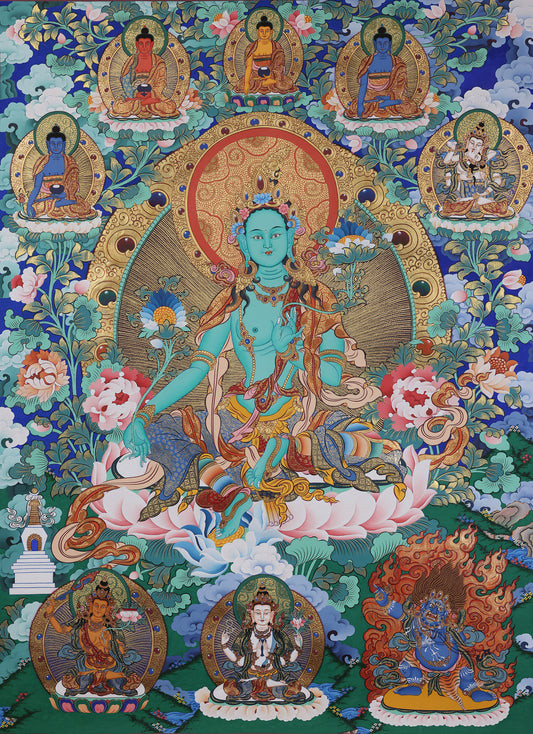
When you gaze at this vibrant Karma Gadri-style Thangka, the central deity with a red body sits serenely on a lotus throne, hands in the meditative mudra holding a longevity vase filled with nectar—this is the core 本尊 (yidam) of "endless life" in Tibetan Buddhism: Longevity Buddha. He is not merely a solemn icon on canvas, but a tangible symbol of "life’s perfection" in the Tibetan spiritual world.
Many confuse Longevity Buddha with Amitabha in Han Buddhism, but while they share a spiritual origin, their focuses differ.
In Tibetan Buddhism, Longevity Buddha’s full title is "Aparimita āyur jnāna su-vinisˊicita tejo rājāya Tathāgata," and his pure land is the "World of Boundless Merit," not Amitabha’s "Western Pure Land." According to scriptures like The Sūtra of the Great Vehicle Tathāgata Aparimita Āyur Jñāna Su-vinisˊicita Tejo Rājāya, his primary virtue is "eliminating short life and extending present-life longevity," whereas Amitabha’s core merit emphasizes "rebirth in the pure land after death."
This distinction reflects Tibetan Buddhism’s unique interpretation of life’s value: Longevity Buddha does not encourage clinging to samsara, but rather extends one’s present life to gain more time to practice the Dharma and benefit sentient beings. As the 8th Garchen Rinpoche put it: "Longevity is not for pleasure, but for more opportunities to practice compassion."
This Karma Gadri Thangka strictly follows Tibetan Buddhist iconometric texts (Tshon kye), with every detail carrying symbolic meaning:
-
Body Form: The red skin represents "the warmth and vitality of life," aligning with The Iconometric Canon’s description of Longevity Buddha as "having a body the color of coral."
-
Attire: Adorned with a five-Buddha crown, celestial robes, and jewel ornaments, this is the solemn regalia of a "sambhogakāya" (enjoyment body) Buddha, signifying the perfection of his virtues.
-
Mudra and Ritual Object: Hands in the meditative mudra hold a longevity vase (bumpa) filled with nectar, the "elixir of immortality," corresponding to the scripture’s teaching: "He who holds this vase grants sentient beings endless life."
-
Retinues: The White Tara (left) and Ushnishavijaya (right) at the bottom of the Thangka form the "Three Longevity Deities" (Tshe Lha Sum): White Tara governs healing and longevity, Ushnishavijaya dispels negative karma and obstacles, together embodying a system of protection for "blessing, health, and unimpeded life."
The Karma Gadri school’s artistic style brings this Longevity Buddha to life: Natural mineral pigments (cinnabar for the body, lapis lazuli for the halo) resist fading for centuries, while 24k gold lines outline the crown and lotus throne—both fulfilling the doctrine that "sambhogakāya Buddhas should radiate light" and making the Thangka a "worshippable work of art."
In Tibetan Buddhism, Longevity Buddha is never an isolated figure—paired with White Tara and Ushnishavijaya, the "Three Longevity Deities" reflect the Tibetan people’s holistic vision of life:
-
Longevity Buddha: The Length of Life
Scriptures state that worshiping or reciting Longevity Buddha’s mantra ("Om Amare Nitri Wandehi Svaha") can "remove the affliction of short life and extend lifespan to a hundred years." Tibetan herders often hang Longevity Buddha Thangkas in their tents; when family members fall ill or elders celebrate birthdays, they invite monks to chant
The Mantra of Longevity Buddha, praying for "extended life and growing good karma."
-
White Tara: The Quality of Life
As an emanation of Avalokiteshvara, White Tara—depicted with seven eyes to see all six realms—governs "relieving illness and increasing wisdom." In the Three Longevity Deities’ rituals, her presence transforms "longevity" from mere time extension into "a life of health and wisdom."
-
Ushnishavijaya: Unimpeded Life
Ushnishavijaya’s eight-armed form, holding ritual objects like a vase and Dharma wheel, symbolizes "overcoming all obstacles to longevity." In Tibetan
life-release ceremonies (tshe thar), Ushnishavijaya’s mantra is chanted to bless sentient beings, with the belief that "those who receive this blessing not only gain extended life but also avoid accidental death."
This vision of "length + quality + unimpededness" elevates the Three Longevity Deities beyond "blessing symbols" to become spiritual pillars for Tibetans facing birth, old age, sickness, and death. As The Epic of King Gesar states: "When the Three Longevity Deities abide atop one’s head, life remains unbroken like a snow-capped mountain."
Many misunderstand Longevity Buddha practice as "fear of death," but in reality, Tibetan Buddhist longevity practices center on "using longevity to practice compassion."
According to The Ritual of Visualization, Practice, and Offering for Aparimita Āyur Jñāna Tathāgata, practicing Longevity Buddha follows strict steps:
-
Purify the Altar: Set up an altar in a clean room, smear the ground with sandalwood paste, and place images of the Three Longevity Deities.
-
Visualization: The practitioner visualizes themselves as non-distinct from Longevity Buddha: "One’s mind is the Buddha’s mind; one’s body is the Buddha’s body."
-
Chant Mantras and Dedicate Merit: Recite Longevity Buddha’s short or long mantra (The Mantra of Aparimita Āyur Jñāna Su-vinisˊicita Tejo Rājāya) and dedicate the merit to "all sentient beings, that their lives be endless and they attain enlightenment."
High lamas’ longevity practice serves as a model: The modern master Kyabje Dudjom Rinpoche taught The Mantra of Longevity Buddha, emphasizing: "Practitioners of this Dharma should vow, ‘I do not seek longevity for myself, but wish all sentient beings to be free from the suffering of death.’" This is the essence of Longevity Buddha belief: using life as a vessel to practice boundless compassion.
Today, Longevity Buddha Thangkas are not only objects of worship in Tibetan monasteries but also cultural symbols:
- During Tibet’s Wangguo Festival (harvest festival), people parade with Longevity Buddha Thangkas through fields, praying for "long-lasting crops and healthy people and livestock."
- In modern Tibetan homes, Longevity Buddha Thangkas are often hung in living rooms—both honoring the tradition of "supporting spiritual fields at home" and conveying the wish for "peace and longevity."
- International Tibetan studies scholars use Longevity Buddha iconography as a case study for "Tibetan Buddhist art and social life," noting that it "transforms religious doctrine into tangible visual symbols, embodying the vitality of Tibetan culture."
When we look again at this colorful Longevity Buddha Thangka, his red body is no longer just a color, but the warmth of life; the vase in his hands is no longer just a ritual object, but a wish to "live well and practice well." Longevity Buddha in Tibetan Buddhism is not a "myth of immortality," but a life wisdom of "using limited life to perform infinite good deeds."
#Tibetan Buddhism Longevity Buddha #Three Longevity Deities #Karma Gadri Thangka #Tibetan Buddhist Art #Longevity Buddha Mantra #Tibetan Life Views #Thangka Culture #Aparimita Āyur Jñāna Tathāgata #White Tara #Ushnishavijaya