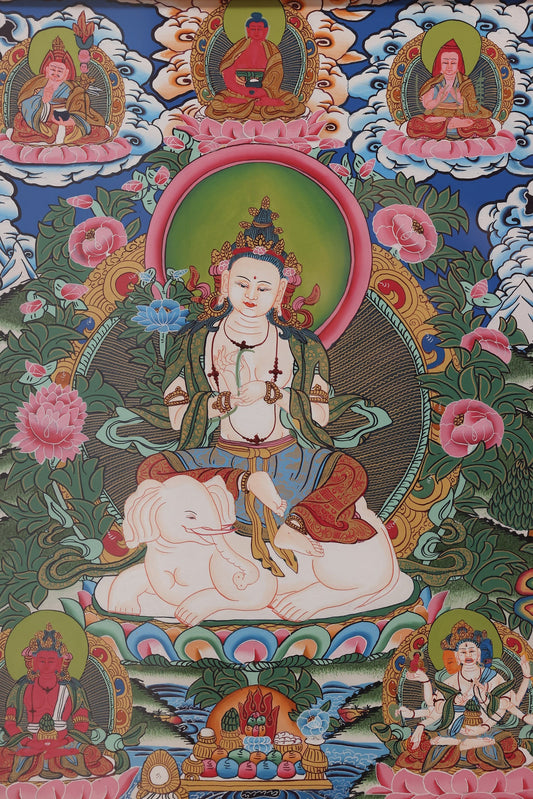
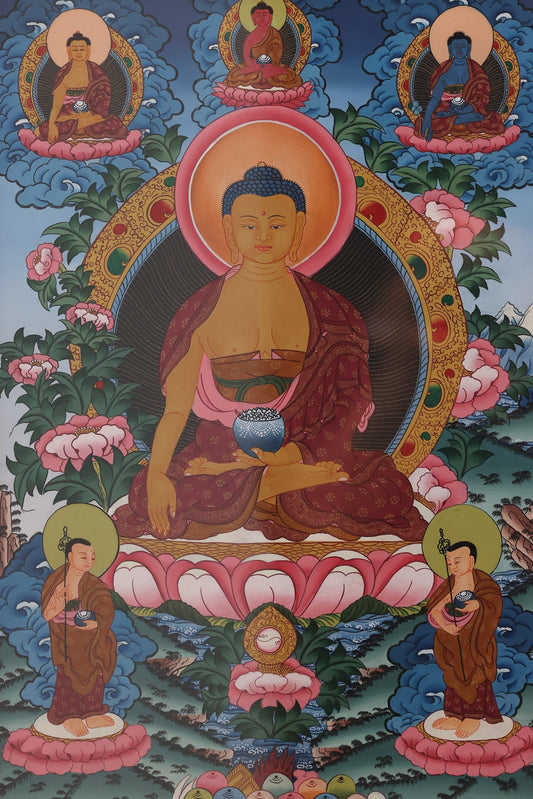
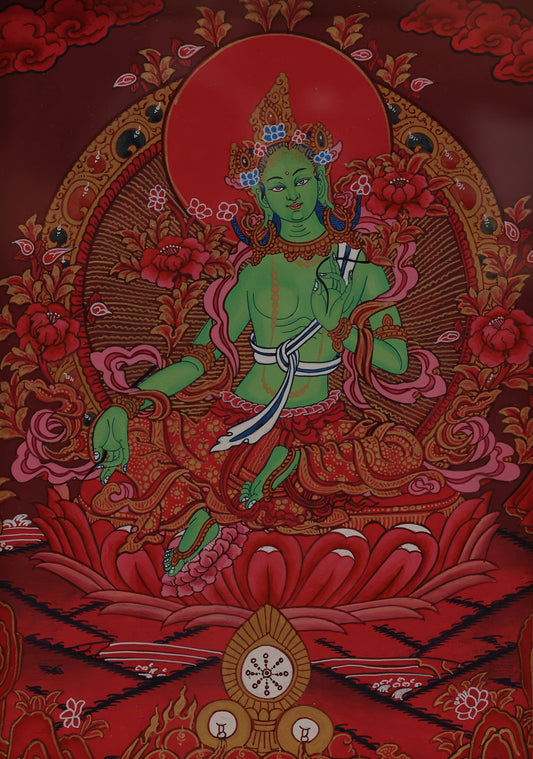
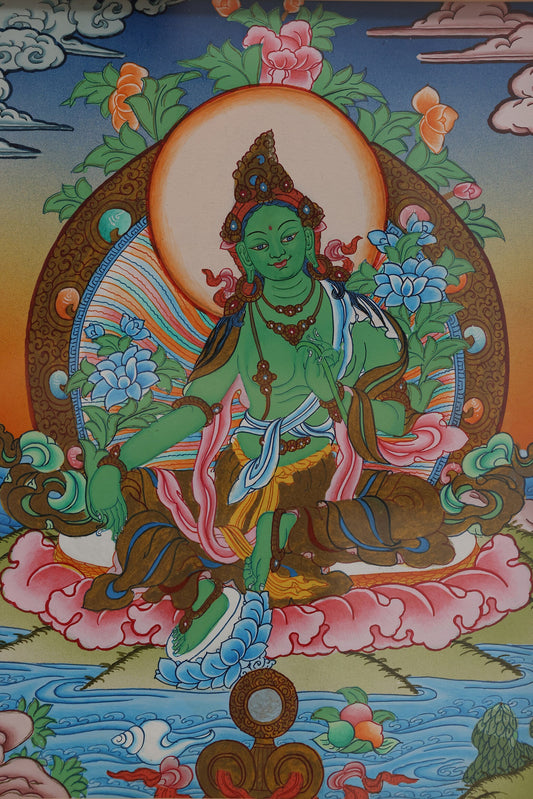
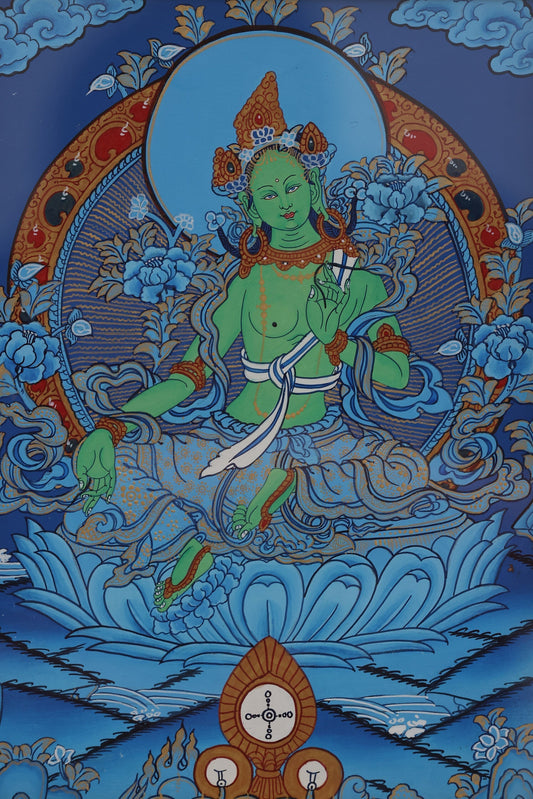
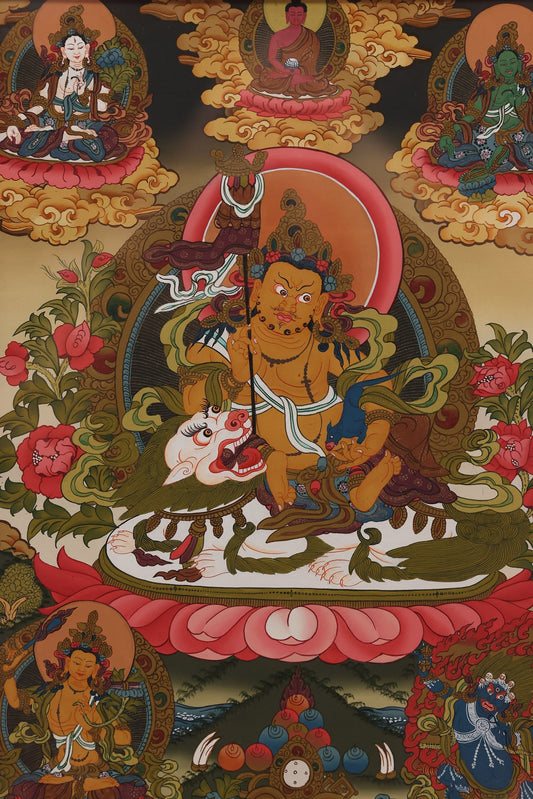
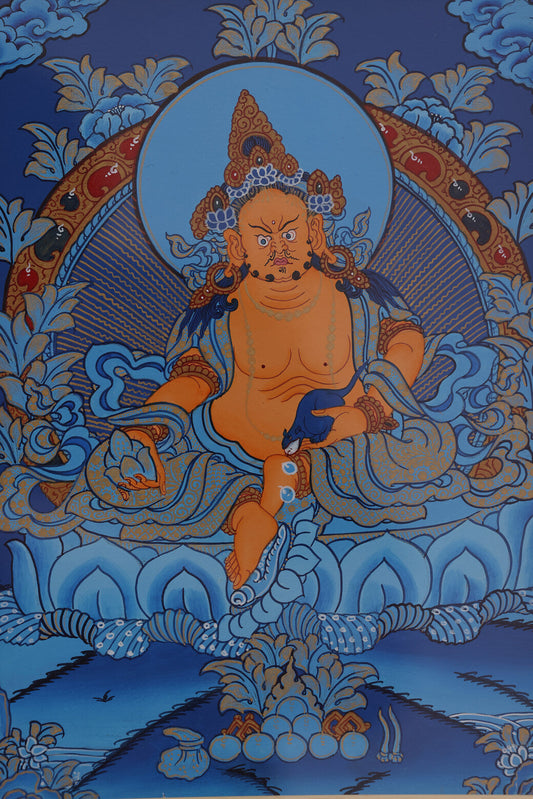
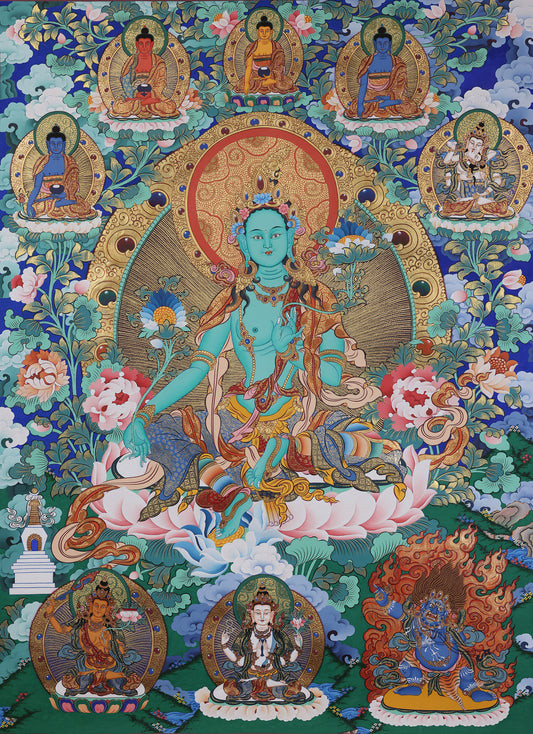
When lapis lazuli-ground indigo spreads across the canvas, a Sword of Wisdom slices through the void—the Manjushri in this blue thangka is not just the pinnacle of Tibetan Buddhist art, but a tangible "wisdom gene" that has persisted for millennia. In Tibet, Manjushri (Tibetan: འཇམ་དཔལ་དབྱངས་, transliterated as "Jampelyang") is never merely a deity: he is the embodiment of the Prajñāpāramitā Sūtra, the dharmakāya of Tsongkhapa, the object of supplication before the verbal sparring of debate courtyards, and the blade that cuts through ignorance in every practitioner’s heart.
In this blue thangka, Manjushri sits upon a moon disc atop a blue lotus, right hand raising the Sword of Wisdom, left hand holding a Prajñāpāramitā scroll to his chest—every detail is a visual commentary on tantric scriptures. The blue thangka itself, which bears this sacred image, is a form of practice.
Tibetan painters use lapis lazuli as the core pigment. This mineral, sourced from Badakhshan in Afghanistan, requires dozens of rounds of grinding and settling to yield over 20 shades, from peacock blue to Tibetan indigo. Artists follow the Iconometric Canon of Painting: applying nine layers of yak bone glue mixed with minerals to cotton canvas, polishing it to a mirror-like finish; sketching the "seven measures of the body" in gold lines to ensure every proportion of Manjushri aligns with "the balance of compassion and wisdom"; allowing each layer of pigment to air-dry for seven days during coloring. After more than 30 processes, the blue on the canvas resonates with the sky of the Himalayas—a visual translation of the tantric "Dharmadhātu Wisdom": blue is both the true nature of emptiness and the clarity of wisdom dispelling delusion.
A Ming Dynasty blue thangka of Manjushri in the Palace Museum has retained its vibrant hues for 600 years. Restoration experts discovered that the molecular structure of lapis lazuli resonates with Tibet’s geological layers—as if this thangka grew from the depths of the plateau, using color to prove that "wisdom transcends time and space."
In Sanskrit, Manjushri means "Glorious Auspiciousness"; in Tibetan Buddhism, he is the "Confluence of the Wisdoms of All Buddhas of the Three Times," and the Mañjuśrīnāmasaṃgīti even calls him "the Father of All Buddhas"—because prajñā wisdom is the foundation of Buddhahood. This positioning elevates Manjushri beyond the category of "bodhisattva" to become the "wisdom hub" of the entire exoteric-esoteric system.
Tibetan Buddhism decomposes Manjushri’s ultimate buddha-wisdom into the manifestations of the "Five Manjushris," corresponding to the "Five Wisdoms" and the antidotes to the "Five Poisons":
-
Yellow Manjushri (Fundamental Manjushri): Golden in color, holding the Sword of Wisdom and Prajñāpāramitā scroll, symbolizing "Dharmadhātu Wisdom" to dispel "ignorance"—like sunlight piercing a dark room;
-
White Manjushri: Pure white, holding sword and scroll, symbolizing "Mirror-like Wisdom" to purify "attachment"—like a clear mirror reflecting all things without taint;
-
Red Manjushri: Coral-red, four-armed holding sword, scroll, and vajra bow/arrow, symbolizing "Discriminating Wisdom" to sever "anger"—like flames burning away afflictions;
-
Black Manjushri (Wrathful Manjushri): Deep indigo, three eyes wide open, holding sword and skull cup, symbolizing "All-Accomplishing Wisdom" to crush "pride"—like thunder subduing demons;
-
Orange-Red Manjushri (Sweet-Voiced Manjushri): Golden-red, seated in a half-lotus posture, symbolizing "Equality Wisdom" to dissolve "jealousy"—like melodious sound embracing all beings.
This "one body, five faces" design is essentially the tantric philosophy of "non-duality of skillful means and wisdom": there is no single "wisdom," only "methods of taming" tailored to different temperaments. When Sakya monks practice the Five-Deity Union Sadhana in retreat, they merge the serenity of Yellow Manjushri, the ferocity of Black Manjushri, and the poetic nature of Orange-Red Manjushri into one mind—at this moment, the "Five Wisdoms" are no longer concepts, but awareness flowing in every breath.
Tibet has never confined Manjushri to an altar: Tsongkhapa, founder of the Gelug school, is revered as "Manjushri’s Earthly Manifestation," and his Great Exposition of the Stages of the Path to Enlightenment (Lamrim Chenmo) is a systematic presentation of Manjushri’s wisdom; monks at Sakya Monastery recite Manjushri’s heart mantra "Oṃ A Ra Pa Ca Na Dhīḥ" daily, infusing wisdom into every moment of walking, standing, sitting, and lying; in the debate courtyards of the three great monasteries, scholars recite this mantra before clapping to pose questions—the crisp sound is the echo of the Sword of Wisdom cutting through logical delusions.
The most touching example is recorded in the Sadhana of Red Manjushri, the Lion of Speech: a 99-year-old illiterate man in India practiced this method with devotion for one day and night, and personally beheld Manjushri, who incarnated as an eight-year-old child. The old man then attained unobstructed mastery of the Five Sciences and became a pandita. This promise of "swift wisdom attainment" has made Manjushri the shared object of supplication for Tibetan students, artists, and even merchants—before lifting a brush, thangka painters visualize Manjushri’s sword-light entering their wrists, turning lines into offerings of wisdom; when Lhasa merchants open their shops, they enshrine Manjushri statues, praying for "right livelihood through wisdom."
In Tibetan Buddhism, devotion to Manjushri is never "idolatry," but a "transformative practice of mind nature." Taking the Sadhana of Red Manjushri, the Lion of Speech as an example, its core is the "generation stage" of "visualizing oneself as Manjushri":
Practitioners must first abandon lying, abstain from alcohol and meat, and renounce anger, grounding themselves in compassion that "sees all beings as one’s only child." During visualization, the syllable "Dhīḥ" on the moon disc in one’s heart transforms into Red Manjushri—coral-red in color, holding sword and scroll; the syllable "Tsa" in the heart becomes a four-spoked wheel, surrounded by mantra garlands—at this moment, the practitioner is no longer "supplicating Manjushri," but "becoming Manjushri": the Sword of Wisdom is in hand, the Prajñāpāramitā is in the heart, and the "self" of ignorance has been dissolved by the sword-light.
The ritual specifically mentions "signs of wisdom growth": dreaming of the sun and moon rising, plucking flowers, drinking ink, writing scriptures—these everyday images have long been transformed by tantra into codes for "wisdom integrating into life." The ultimate goal of practice is the "non-duality of bliss and emptiness" described in the Mañjuśrīnāmasaṃgīti: when the visualized Manjushri and oneself become indistinguishable, wisdom is no longer an "external tool," but the "innate nature of mind."
Recent discoveries of Yuan Dynasty "New-Style Manjushri" murals in Tibet’s Shalu Monastery and Pelkor Chode Monastery have uncovered another dimension of Manjushri devotion: these surviving "Five-Figure Manjushri Images" (Manjushri, Sudhana, King of Khotan, Buddha Pāli, and the Great Holy Elder) share an origin with the Han-style New-Style Manjushri in Dunhuang’s Mogao Caves.
The "New-Style Manjushri," formed in the late Tang Dynasty, combines Manjushri with legends of Mount Wutai, integrating him with the King of Khotan and dharma-seeking monks. It spread to Tibet via the Western Xia Dynasty. Sakya Pandita and Phagpa played the role of "cultural hubs": they merged Han legends of Manjushri with Tibet’s five-wisdom system, imbuing the "Manjushri Riding a Lion" image with both Han narrative qualities and Tibetan philosophical depth—in the Manjushri murals at Pelkor Chode Monastery, the five peaks in the mountain halo are a dual metaphor for the "Five Wisdoms" and "Mount Wutai."
This fusion is the best commentary on Manjushri’s wisdom: wisdom is never the product of a single culture, but a broader emptiness born from the encounter of different civilizations.
When we gaze at Manjushri in this blue thangka, we see more than a bodhisattva—we see a complete "wisdom operating system": from lapis lazuli pigments to five-wisdom manifestations, from ritual visualization to debate-courtyard claps, Manjushri’s wisdom has long permeated every corner of Tibet—it is the indigo on thangkas, the mantras in scriptures, the sharpness in scholars’ eyes, and the unextinguished light of wisdom on the plateau.
Perhaps we need not travel to Tibet; we need only let the image of "the Sword of Wisdom cutting through ignorance" flash in our hearts for a moment—at that instant, the Manjushri in the blue thangka resonates with our own awareness.
Would you like me to compile a core symbolism and practice guide for Manjushri in Tibetan Buddhism?
#TibetanBuddhism #Manjushri #BlueThangka #TibetanBuddhistArt #PrajnaWisdom #VajrayanaPractice