翻译成英文 Six-Syllable Mantra Mandala Thangka: The Visualization of Cosmic Order and the Spirituality in Craftsmanship

I. The Mandala: A Geometric Diagram of Cosmic Philosophy
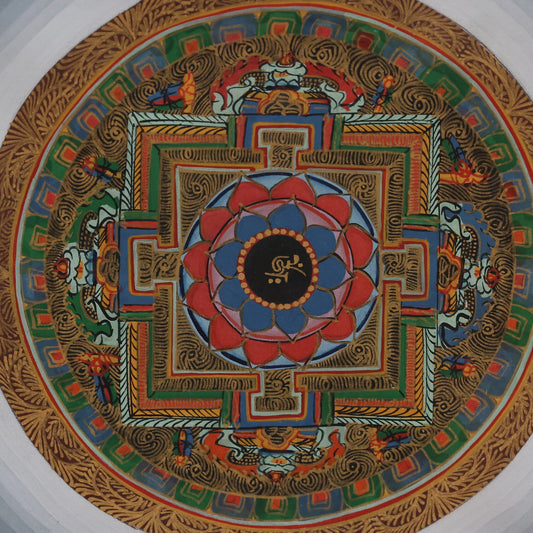
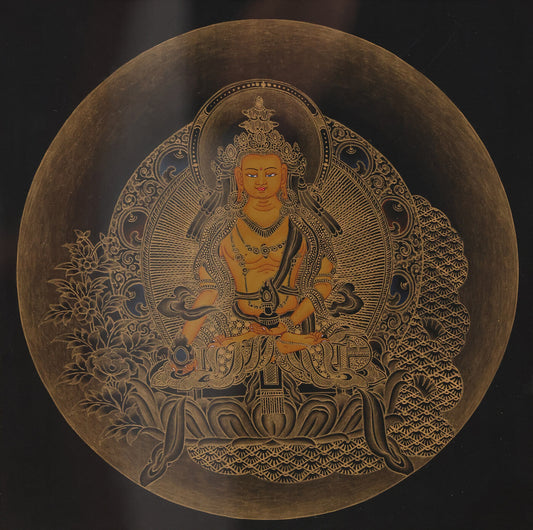
Within the profound symbolic system of Tibetan Buddhism, the mandala (Tibetan: "Kyilkhor," Sanskrit: "Maṇḍala") represents a philosophical expression that transcends language. This Six-Syllable Mantra Mandala Thangka is, in essence, the condensation of vast cosmic principles and subtle mental mechanisms onto a circular canvas less than one meter in diameter.
Layered Structure: The Triple Journey from Phenomenon to Essence
The most striking feature of the mandala is its strict concentric structure. This is not an aesthetic design but a visualized ladder of practice stages:
The First Layer: The Gradient Blue Circle – The Veil of the Phenomenal World
-
Color Choice: Mineral blue ground from lapis lazuli, graduating from deep indigo at the edges to sky blue towards the center.
-
Philosophical Correspondence: Symbolizes the "outer mandala" – the mundane world perceived by sentient beings.
-
Practice Metaphor: Blue represents the "ocean of ignorance," while the gradient implies the possibility of moving from confusion to clarity.
The Second Layer: The Golden Mantra Wheel – The Luminous Path of Transformation
-
Material Property: Written with 24K pure ground gold, creating dynamic shimmer under light.
-
Religious Meaning: Corresponds to the "inner mandala" – the spiritual realm of practice.
-
Functional Interpretation: The mantra letters spiral like a staircase, each revolution representing an elevation of the mind.
The Third Layer: The Seed Syllable Core – The Manifestation of the Source
-
Positional Significance: The absolute geometric center, the convergence point of all lines.
-
Symbolic Value: Represents the "secret mandala" – the original face of the mind's nature.
-
Key to Visualization: The practitioner ultimately seeks union with this syllable "Om."
Symmetrical Aesthetics: Visual Proof of the Wisdom of Equality
The absolute symmetry of the mandala contains profound teachings:
-
The Center Point: Symbolizes the "center of the Dharma realm," from which all phenomena emanate and to which they return.
-
Radiating Lines: 108 golden lines (or multiples thereof) represent the overcoming of 108 afflictions.
-
Perfect Proportions: Each sector has equal angles, subtly signifying "the equal Buddha-nature of all beings."
This geometric precision is not a mathematical game but a faithful tracing of the universe's essential nature—at the level of dharmata (ultimate reality), all things are inherently perfect and complete.
II. The Six-Syllable Mantra: The Sonic Universe of Avalokiteshvara's Compassion
The Three-Dimensional Presentation of the Mantra
The Six-Syllable Mantra "Oṃ Maṇi Padme Hūṃ" acquires a spatial dimension within the mandala:
Oṃ – The Cosmic Vowel
-
Resides at the center, radiating energy like the sun.
-
In Sanskrit, represents "the essence of all sound."
-
In the thangka, it is supported by a three-tiered lotus throne, symbolizing "born from purity."
Maṇi – The Wish-Fulfilling Jewel
-
The first set of mantra letters arranged clockwise.
-
Symbolizes "compassion like a wish-fulfilling jewel, capable of fulfilling all wishes."
-
Colors are typically white and yellow, representing "the union of compassion and wisdom."
Padme – The Lotus
-
The circulating mantra letters of the middle level.
-
The lotus grows from mud unstained, metaphor for "afflictions themselves are enlightenment."
-
The script is slightly smaller than the outer layer, hinting at "introspective wisdom."
Hūṃ – Perfect Accomplishment
-
The concluding syllable in the outermost circle.
-
In Tantric practice, represents "ultimate commitment and power."
-
The gold lines are thickest here, forming a solid protective boundary.
Visual Guide to the Method of Visualization
This thangka is essentially a three-dimensional instruction manual for practice:
Stage One: Gazing at the Outer Ring
-
Begin with the "Hūṃ" syllable in the outermost circle.
-
Follow the flow of mantra letters clockwise.
-
Corresponds to the preliminary practice of "accumulating merit and purifying obscurations."
Stage Two: Merging with the Inner Circle
-
Let the gaze enter the middle layer of "Padme."
-
Feel the purifying power of the rotating lotus.
-
Equivalent to the initial stage of "deity yoga" practice.
Stage Three: Union with the Core
-
Fix the gaze on the central "Oṃ" syllable.
-
Merge with the wisdom mind of Avalokiteshvara.
-
Reach the peak of visualization practice, the state of "non-duality of self and other."
III. Nepalese Craftsmanship: Material Practice in a Millennial Tradition
The Living Heritage of the Newar Painting School
This thangka originates from the hands of a Newar painter from the Kathmandu Valley, a school whose lineage can be traced back to the 13th century:
Characteristics of the Master-Disciple System:
-
Transmission from father to son or master to disciple, with clear genealogies.
-
Each painter must first study the Treatise on Iconometry for three years.
-
The graduation piece must be a mandala of Manjushri or Avalokiteshvara.
The Wisdom of Local Materials:
-
Canvas: Fine cotton from the Terai region, with fibers three times the length of ordinary cotton.
-
Glue: A secret formula of Himalayan rock honey and bone glue.
-
Grinding Stone: Specific sandstone from the banks of the Bagmati River, with ideal porosity.
The Sevenfold Purification Process
First Purification: Purifying the Cloth (3 days)
-
Soak in melted snow water → Sun-dry → Repeat three times.
-
Reflection: "Like purifying karmic obscurations to reveal innate luminous nature."
Second Purification: Solidifying with Glue (15 days)
-
Apply nine layers of a mixture of yak bone glue and chalk.
-
Polish with malachite after each layer dries.
-
Symbolism: "Strengthening the resolve for enlightenment, never regressing."
Third Purification: Establishing Boundaries (7 days)
-
Draw the base circle with charcoal, error margin less than 0.5 mm.
-
Use the inherited "wisdom compass" – sinew thread and bone pin.
-
Meaning: "Establishing the boundaries of practice, unwavering and unbiased."
Fourth Purification: Applying Color (21 days)
-
Lapis lazuli powder must be ground, settled, and separated seven times.
-
Work only during the first three hours after sunrise (most stable light).
-
Corresponds to: "Ascending the seven-fold diamond mountain step by step."
Fifth Purification: Writing in Gold (30 days)
-
Gold powder用量 for each character precisely measured to 0.01 grams.
-
The mouse-whisker brush must be washed in an agate bowl after every ten characters.
-
Discipline: "Each character is a Buddha, each stroke a prostration."
Sixth Purification: Dotting the Eyes (Day of Retreat)
-
The painter must observe fasting, recite mantras, and bathe before painting the "Om" syllable.
-
Uses a special "life pen" – a pure gold pen holder inlaid with coral.
-
Ritual: "Inviting sanctity, bestowing life upon the painting."
Seventh Purification: Recitation of Blessings (3 days)
-
The completed thangka must be consecrated by recitation from at least three monks.
-
Recite the Great Compassionate Heart Dharani of Avalokiteshvara Bodhisattva.
-
Achievement: "The ritual object is activated, its blessings flow."
IV. The Symbolic Language of Mineral Pigments
Lapis Lazuli: The Unchanging Azure of the Dharma Realm
Physical Properties and Philosophical Correspondence:
-
Color Stability: Does not fade for millennia, corresponding to "the eternal abiding of Dharma nature."
-
Golden Flecks: Naturally contains pyrite, like stars, symbolizing "wisdom inherent within afflictions."
-
Mining Difficulty: Only specific mines in Afghanistan yield the finest quality, metaphor for "the preciousness of enlightenment."
Preparation Ritual:
-
Selection: Manually remove impurities of white calcite.
-
Grinding: Performed on days with specific moon phases.
-
Sieving: Obtain seven different grades of blue particle size.
-
Mixing: Used in sequence from dark to light.
Cinnabar: The Fiery Protection of the Dharma Protectors
Multiple Meanings of the Red Border:
-
Physics: Vermilion (cinnabar) is chemically stable, resistant to oxidation.
-
Color Theory: In Tibetan culture, red is the color of "vitality and protection."
-
Ritual Studies: The border forms a "wall of flames," impervious to negative forces.
Painting Taboos:
-
Cannot paint on rainy days (humidity affects adhesion).
-
Cannot paint while angry (emotions affect the energy).
-
Cannot paint at night (needs natural light to discern hue).
Gold: The Immortal Vehicle for Mantras
Five Secrets of the Gold Line Technique:
-
Secret of Malleability: 1 gram of gold leaf can be hammered to 1 square meter, symbolizing "Buddha-nature pervading everywhere."
-
Grinding Time: Must be during the Yin hour (3-5 AM), when "the energy of heaven and earth is clear."
-
Glue Formula: Deer antler glue + Saffron juice + Rock salt, proportions passed down secretly.
-
Breathing for Writing: The painter's breath synchronizes with the rhythm of the mantra while writing.
-
Luster Control: Seven types of agate burnishers create seven layers of sheen, corresponding to the "seven factors of enlightenment."
V. Contemporary Value: An Anchor of Order in an Age of Chaos
Anti-Fragile Design for the Digital Age
In the information-explosive 21st century, this mandala offers threefold spiritual protection:
Visual Anchoring Effect:
-
Gazing at the mandala for 3 minutes increases alpha brain waves by 40%.
-
Symmetrical patterns activate the brain's "order perception" area.
-
The blue基调 reduces sympathetic nervous system excitement.
Spatial Energy Restructuring:
-
Hung on the main wall of a living room, it becomes the "energy core of the home."
-
Placed in a study, it enhances concentration and creative flow.
-
Displayed in a bedroom, it improves sleep quality and dream clarity.
Temporal Rhythm Regulation:
-
Morning Gaze: Sets the mental tone for the day.
-
Noon Contemplation: Resets the focus of attention.
-
Evening Meditation: Digests the informational load of the day.
A Cross-Cultural Grammar of the Mind
Inspirations for Western Psychology:
-
Jung saw the mandala as a symbol of the "Self archetype."
-
Mindfulness therapy borrows from the "attention anchor" technique of mandala visualization.
-
Art therapy uses drawing simplified mandalas as a tool for emotional integration.
Contributions to Modern Design:
-
The rebirth of sacred geometry in architecture (e.g., mandala-style layouts in new airports).
-
Interface design借鉴 of concentric navigation.
-
The profound use of symmetrical aesthetics in brand logos.
VI. Wisdom in Collection and Veneration
Five Dimensions for Choosing a Thangka
Purity of Lineage:
-
Does the painter come from a recognized lineage genealogy?
-
Is there a complete "creation log" recording the process?
-
Has it undergone a proper consecration ritual at a monastery?
Level of Craftsmanship:
-
The proportion and grinding precision of mineral pigments.
-
The three-dimensional quality and layered sheen of the gold lines.
-
Whether the back exhibits a "sense of breath" – high-quality thangkas show faint color on the reverse.
Perception of Energy:
-
Intuitive reaction when facing it with a calm mind.
-
Subtle changes in the ambiance of the space.
-
The effect of "joint practice between person and painting" developed through long-term companionship.
Key Preservation Points:
-
Avoid direct sunlight but needs periodic "awakening" by natural light.
-
Ideal humidity: 40%-60%, adjustable with Himalayan salt.
-
Annual light smoke offering (cypress leaves + pine needles) to cleanse the energy field.
Stages of Visualization Practice:
-
Beginner: Simple daily gaze for 5 minutes.
-
Intermediate: Visualization配合 with mantra recitation.
-
Advanced: "Self-manifestation of the mandala" meditation under guidance.
Conclusion: Encountering Wholeness in the Circle
The Six-Syllable Mantra Mandala Thangka ultimately reveals a profound truth to us: The outer order of the cosmos and the inner order of the mind are, in essence, the same order.
When the painter grinds lapis lazuli into the finest powder, when the gold lines begin to shimmer in the morning light, when the viewer's gaze meets the central "Om" syllable—in that moment, the three dimensions of time are folded:
Past: A thousand-year lineage revives at the tip of the brush.
Present: The viewer's mind finds peace within the mandala.
Future: The seed of enlightenment is planted in that gaze.
This thangka is not an endpoint but a starting point. It invites everyone who sees it to begin a journey of return—from the periphery to the center, from chaos to order, from the individual to the cosmos.
In an age where everything is becoming fragmented, perhaps we need to relearn the ancient wisdom of "gazing at the circle." For within this perfect geometric form lies the code to counter all separation—a code that is both the six syllables of "Oṃ Maṇi Padme Hūṃ" and the inherently perfect mandala that has never been lost within each of our hearts.
#SixSyllableMantraMandala #MandalaPhilosophy #NepalNewarPaintingSchool #MineralPigmentSymbolism #GoldMantraInscriptions #SevenFoldPurificationProcess #TibetanBuddhistArt #CosmicOrderDiagram #SpiritualPracticeTool #VisualMeditation #IntangibleCulturalHeritage #SacredGeometry #AvalokiteshvaraMandala #TantricVisualization #MentalOrderReconstruction #ArtTherapy #HimalayanArt #ZenSpaceDesig#MindfulnessTooln #MillennialCraftsmanshipHeritage
Tags: