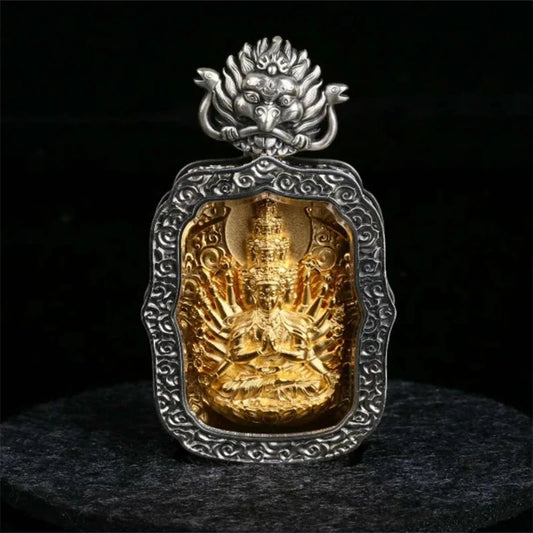
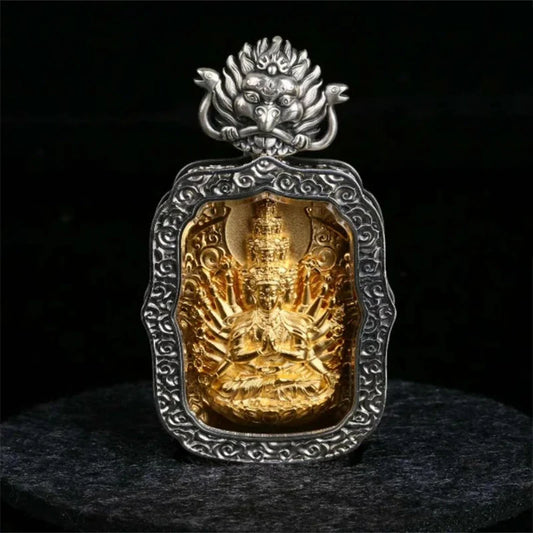
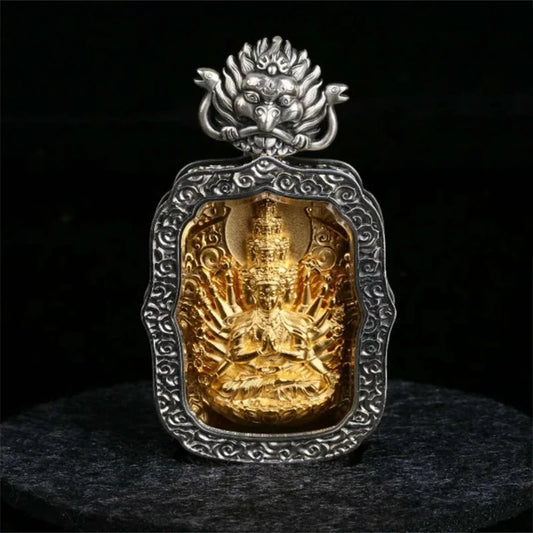
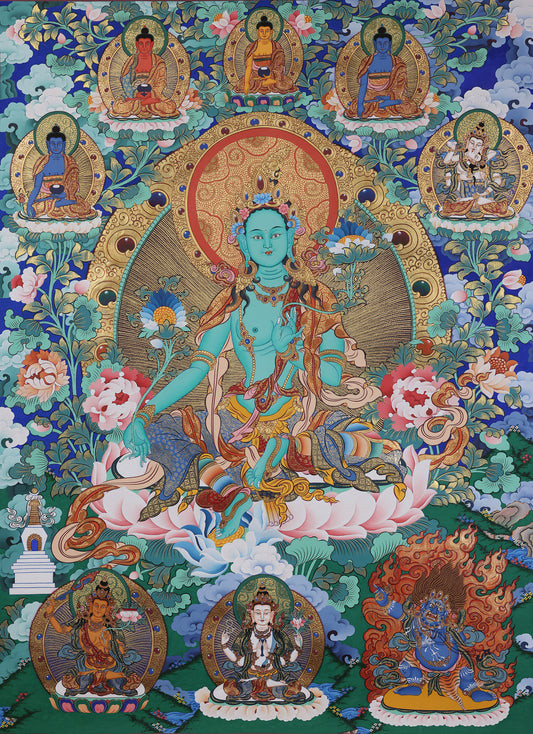
When your gaze rests on this Blue Thangka of Vairocana Buddha, the interwoven tones of cobalt blue and gilded gold first seize your attention: the deity sits serenely at the center, with four faces unfolding gently, holding the Dharma Wheel in the Dhyana Mudra at the abdomen, and a lotus throne stretching amid cloud patterns. Every line and hue hides the profound codes of Tibetan Buddhism. This Dharmakaya Buddha, rendered in the clear hue of lapis lazuli pigment, is the supreme central deity in the Tibetan Tantric system: Vairocana Buddha, also called Mahāvairocana. In the cosmology of Tibetan Buddhism, he is not merely a Buddha but the personified manifestation of the ultimate reality of the Dharmadhatu—and this Blue Thangka is precisely the visual carrier of his wisdom and compassion.
In the Vajradhatu Mandala of Tibetan Buddhism, the Five Dhyani Buddhas form the core framework of the Tantric universe, and Vairocana (called “Namgyal Nampar Nangdze” in Tibetan, meaning “pervading light”) is the central deity of these five.
Unlike Han Buddhism, where Vairocana is sometimes equated with the Dharmakaya of Shakyamuni Buddha, Vairocana in Tibetan Tantra symbolizes an independent Dharmakaya Buddha—he is the origin and destination of all Buddhas and Bodhisattvas. His meaning of “pervading light” is not comparable to worldly sunlight, but the unobstructed manifestation of Dharmadhatu Wisdom, which can illuminate all Dharmadhatu where principles and phenomena are unimpeded (Sound and Meaning of All Sutras).
As the principal deity of the Five Dhyani Buddhas, Vairocana corresponds to Dharmadhatu Wisdom—the fundamental wisdom among the Five Wisdoms. The other four wisdoms represented by the four directional Buddhas (Aksobhya in the East, Ratnasambhava in the South, Amitabha in the West, Amoghasiddhi in the North)—the Mirror-like Wisdom, Equalizing Wisdom, Discriminating Wisdom, and All-Accomplishing Wisdom—all emanate from it (Treatise on the Bodhicitta). His pure land is called the “Akanishtha Realm,” meaning “supreme transcendence” in Tibetan; it is not a physical place but a Dharmadhatu state realized after seeing the true nature of the form aggregate. When a practitioner breaks through the ignorance obscuring the Dharmadhatu, they align with Vairocana’s Dharmakaya.
Every element of this Blue Thangka of Vairocana is a visual language of Tibetan Tantric doctrine:
The dominant hue of this Thangka is the “imperial blue” ground from ground Afghan lapis lazuli. In Tibetan Thangka craftsmanship, the rarity and clarity of lapis lazuli perfectly correspond to Vairocana’s essence as the “all-pervading Dharmadhatu.”
Here, blue symbolizes “void”: it represents both the boundlessness of the Dharmadhatu and the wisdom that 包容 s all without obstruction (in Tibetan Buddhism, blue is often associated with emptiness and the power to subdue afflictions).
The deity’s
four-faced form is Vairocana’s “all-luminous” appearance in Tibetan Buddhism—each face faces a cardinal direction, corresponding to the spatial structure of the Five Dhyani Buddhas, and symbolizing the all-pervading coverage of Dharmadhatu Wisdom over the four directions and four wisdoms.
Each face is serene, compassionate, and without distinction, embodying the “equality of the Dharmadhatu”: in Vairocana’s wisdom, all sentient beings and all Dharmadhatu are inherently without difference.
The hands form the
Dhyana Mudra (left hand below, right hand above, thumbs lightly touching), holding the Dharma Wheel at the abdomen—one of Vairocana’s iconic mudras.
The Dharma Wheel here is not merely a symbol of “preaching the Dharma” but the externalization of Dharmadhatu Wisdom: its circular shape corresponds to the pervasiveness of the Dharmadhatu, the spread of its spokes corresponds to the universal illumination of wisdom, and the stability of the mudra embodies the “inherent stillness of the Dharmadhatu.”
The Five-Buddha Crown, ornaments, and armlets worn by the deity are characteristics of the “Sambhogakaya” (Reward Body)—representing Vairocana’s manifestation in the practitioner’s visualization with a perfect form.
The thousand-petal lotus throne beneath, with overlapping, unfolding petals, is a classic symbol of “purity” in Tibetan iconography: just as the lotus grows from mud yet remains unstained, Vairocana’s Dharmadhatu Wisdom enables sentient beings to realize their pure nature amid the mud of afflictions.
In the practice logic of Tibetan Tantra, Vairocana’s core significance is the awakening of Dharmadhatu Wisdom—a wisdom that transcends dualistic opposition, pointing to the essence of “the true nature of all phenomena.”
According to Commentary on the Mahāvairocana Sutra, Dharmadhatu Wisdom is the realization achieved after breaking through “ignorant afflictions”: sentient beings cling to the illusory forms of the five aggregates (form, feeling, perception, mental formations, consciousness) due to the obscuration of ignorance, while Vairocana’s Dharmadhatu Wisdom is the foundation for transforming these illusions into pure nature.
As the source of the Five Wisdoms, Dharmadhatu Wisdom gives rise to the other four:
- The Mirror-like Wisdom of Aksobhya (East), which reflects the true nature of all phenomena
- The Equalizing Wisdom of Ratnasambhava (South), which views all sentient beings as equal
- The Discriminating Wisdom of Amitabha (West), which skillfully observes the differences between phenomena
- The All-Accomplishing Wisdom of Amoghasiddhi (North), which fulfills altruistic deeds
For Tibetan practitioners, visualization practice centered on Vairocana is essentially a process of “aligning with the Dharmadhatu”: by visualizing his four-faced form and cobalt blue Dharmakaya, and reciting his mantra (e.g., “Om Vajra Tathāgata Hum”), practitioners ultimately merge with the reality that “one’s own being is the Dharmadhatu.” As Treatise on the Bodhicitta states: “This bodhicitta contains all the virtuous qualities of the Bodhisattvas; when realized, it becomes the guide for all; when returning to its origin, it is the Realm of Secret Bliss. Without rising from the seat, it can accomplish all Buddhist affairs.”
This Blue Thangka of Vairocana is both a religious icon and a spiritual carrier of Tibetan culture:
The Blue Thangka is a rare category of Thangka, its background requiring repeated grinding and layering of Afghan lapis lazuli. This gemstone, sourced from the Pamir Plateau, not only brings a clear cobalt blue hue but is also regarded by Tibetans as “the material manifestation of the Dharmadhatu void” due to its nature of “being tempered by mountains and rivers.”
The creation of each Blue Thangka is a practitioner’s practice: from priming to gilding, from outlining the form to filling in patterns, reverence and technical skill intertwine, making the Thangka a “touchable Dharmadhatu.”
In Tibetan Buddhism, a Thangka is not merely an “artwork” but a “visualization resource” for practice. When a practitioner faces this Blue Thangka of Vairocana, visualizing his four-faced form and recalling his Dharmadhatu Wisdom, they can approach the state of “aligning with the Dharmakaya” through the connection between sight and mind.
The circulation of Thangkas also allows Vairocana’s wisdom to transcend time and space: from monastery halls to believers’ shrines, this cobalt blue Dharmakaya Buddha has always been a symbol of “pervading light” in Tibet’s spiritual world.
When we gaze at this Blue Thangka of Vairocana, we see not just an icon of a Buddha, but a visual interpretation of Tibetan Buddhism’s “true nature of the Dharmadhatu”: cobalt blue is the void, four faces are pervasiveness, the Dharma Wheel is wisdom, and the lotus throne is purity.
In the lineage of Tibetan Tantra, Vairocana has never been distant—he is every ray of blue light from lapis lazuli, every glimmer of light in visualization, and the gentle manifestation of Dharmadhatu Wisdom in the world. And this Blue Thangka is precisely a bridge connecting the mundane and the Dharmadhatu, allowing us to touch the core wisdom of Tibetan Buddhism in colors and lines: all sentient beings inherently possess Dharmadhatu Wisdom, like the light of the great sun, shining unobstructed.
#TibetanBuddhism #VairocanaBuddha #FiveDhyaniBuddhas #BlueThangka #DharmadhatuWisdom
#ThangkaArt #TibetanTantra #BuddhistIconography #DharmakayaBuddha #LapisLazuliThangka #TibetanSpiritualHeritage
Ritual objects can help create a focused, respectful space for offering, recitation, meditation, and reflection.
These objects are not a substitute for sincere practice. Their value is to support attention, reverence, and continuity, helping readers return to the meaning of the teaching in daily life.