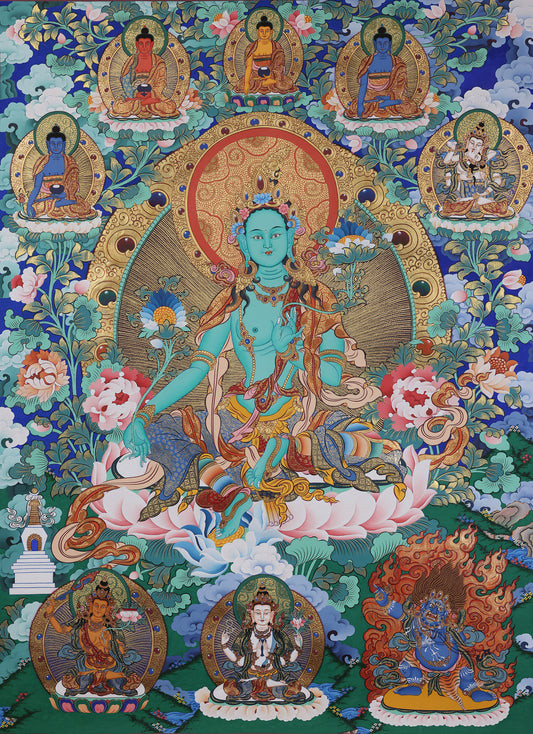
Tibetan Yellow Jambhala Thangka: Cultural Analysis of Theme, Iconography, Craftsmanship, and Spiritual Essence

Tibetan thangka painting is more than just an art form; it is a mobile sacred space, a tangible medium of faith, and a vessel of cultural wisdom. Among the revered deities in Tibetan Buddhism, Yellow Jambhala (Zanbala Serpo / Yellow Dzambhala) stands out as the protector of wealth and prosperity. This hand-painted Red Background Yellow Jambhala Thangka is not merely a decorative piece—it embodies centuries of ritual precision, symbolic meaning, and spiritual guidance, serving as a bridge between worldly abundance and spiritual cultivation.
In this article, we explore the theme, principal deity, associated symbolism, craftsmanship, and spiritual essence of the Yellow Jambhala thangka, offering insights for practitioners, collectors, and admirers of Tibetan Buddhist art.
I. Theme: Wealth as a Vehicle for Spiritual Practice
The central theme of this thangka is the Tibetan Buddhist concept of “using wealth to cultivate the Dharma”, a philosophy known as “wealth as the cause for spiritual merit”. Unlike the common notion of wealth as mere material gain, this thangka emphasizes that prosperity is a tool to alleviate suffering, accumulate merit, and enable dedicated spiritual practice without economic distraction.
In the Tibetan Buddhist context, Yellow Jambhala is not simply a “fortune symbol”, but a guardian deity whose essence guides practitioners to utilize wealth ethically. The thangka incorporates elements like the “Treasure-Yielding Mouse” (Nyulé), symbolizing the continuous outflow of wealth for the benefit of others rather than hoarding. This motif aligns perfectly with the Buddhist teaching: wealth should circulate through generosity, not through greed or attachment.
Culturally, the thangka represents a practical-spiritual balance: it fulfills the material aspirations of Tibetan communities while reinforcing the ethical principle that true wealth is inseparable from virtuous action. Thus, the Yellow Jambhala thangka functions simultaneously as a religious offering and a symbol of harmonious social values.
II. Principal Deity: Iconography and Ritual Symbolism
The main figure of this thangka is Yellow Jambhala, the foremost of the Five Jambhala deities. Its depiction adheres strictly to the “Measure and Proportion Sutra for Sacred Images”, ensuring every detail conveys precise symbolic meaning.
Physical Characteristics
Golden Yellow Skin: Represents the earth element (土), symbolizing stability, abundance, and grounded prosperity.
Large Belly, Small Body: This proportion is not a representation of gluttony, but a metaphor for compassion, reflecting the wisdom that an open heart attracts true fortune.
Five-Buddha Crown: Decorated with blue gemstones, symbolizing the blessings of the Five Dhyani Buddhas, merging wealth with spiritual wisdom.
Posture and Implements
Sitting Posture (Utpala Style): Left leg bent and right leg stepping on a white conch, symbolizing “entering the ocean of wealth”—a metaphor for accessing prosperity through wisdom and right effort.
Right Hand Holding Mani Jewel: The jewel represents the fulfillment of legitimate desires, including both material wealth and spiritual merit.
Left Hand Holding Treasure Mouse (Nyulé): A small mouse carrying jewels, symbolizing continuous generosity and the joy of giving, reinforcing the principle that wealth flows to those who practice generosity.
Cultural Lineage
The origins of Yellow Jambhala trace back to the Indian deity Kubera, later incorporated into Buddhism and fused with Tibetan mountain deity traditions. By the Yuan Dynasty, Yellow Jambhala had become a protector of communal prosperity, as evidenced in the Altrazai grotto murals. This thangka continues that legacy, portraying a deity who embodies both protective authority and benevolent generosity, exemplifying the “balance of firmness and compassion” central to Tibetan spiritual culture.
III. Attendant Deities: The Subtle Protective Network
This is a single-deity Yellow Jambhala thangka, distinct from multi-deity Five Jambhala thangkas. While no attendants are explicitly depicted, the painting inherently conveys the deity’s protective entourage:
Symbolic Attendants: The five-Buddha crown signifies Yellow Jambhala’s dominion over the White, Red, Green, and Black Jambhalas, integrating their blessings.
Background Symbolism: The red lotus seat and golden halo subtly invoke the protective energy of Vaishravana, a primary source of Yellow Jambhala’s spiritual authority.
Decorative Motifs: Red floral vine patterns on the thangka edges, derived from Eight Auspicious Symbols, represent guardian female deities of wealth (dragon maidens), echoing multi-deity compositions while maintaining simplicity and focus on the principal deity.
IV. Craftsmanship: Red Thangka Technique and Mineral Pigments
This thangka belongs to the Red Thangka category, characterized by a vermillion base layer and meticulous ritualized techniques that unite art and spiritual practice.
Base and Pigments: Sacred Materiality
Vermillion Base: High-purity cinnabar (HgS > 90%) is processed via “water-sifting” for over five days, layered to form a deep, enduring red—symbolizing vitality and auspicious fortune.
Principal Figure: Golden pigment from Kang region stone yellow (arsenical mineral), ground over multiple days to create lasting brilliance, representing Yellow Jambhala’s golden body.
Decorative Colors: Blue accents from Nimu stone azure, gold detailing using 24K gold leaf, finely cut and integrated into the pigment, signify the eternal nature of wisdom and wealth.
Techniques: Precision and Devotion
Dotting Technique: Minuscule brush strokes applied to garments, halo, and lotus create depth and layering, embodying the Tibetan principle of transmitting blessings through meticulous work. Each stroke accompanies the visualization of the Yellow Jambhala mantra: “Om Dzambhala Dzale Zaye Svaha.”
Gold Engraving: Gold leaf applied on the vermillion base enhances the visual splendor and symbolic integration of wisdom and wealth, reflecting the Hotong school tradition of cinnabar engraving.
Cultural Significance of Materials
The use of locally sourced mineral pigments emphasizes interconnectedness with nature, reflecting the Tibetan Buddhist view of the five elements (earth, water, fire, wind, space). Even pigments collected from natural sediments link human, natural, and divine realms, making the thangka a cohesive spiritual artifact.
V. Spiritual Essence: Beyond Material Wealth
The deeper value of the Yellow Jambhala thangka lies in its interpretation of wealth as spiritual practice. The deity’s generous yet authoritative demeanor reminds practitioners that wealth is meaningful only when governed by ethics and compassion.
For Tibetan devotees, the purpose of displaying or meditating upon this thangka is not to seek sudden riches, but to cultivate merit, generosity, and virtuous action. The principle of “using wealth to enter the path” transforms the thangka from a mere fortune talisman into a cultural symbol balancing worldly and transcendental life.
The Red Background Yellow Jambhala Thangka thus embodies centuries of Tibetan spiritual wisdom, artistic mastery, and ethical guidance, offering both a sacred object for practice and a cultural artifact for appreciation.
Conclusion
The Yellow Jambhala thangka is a profound intersection of art, ritual, and spiritual philosophy. Through careful iconography, rich symbolism, mineral pigments, and ritualized techniques, it conveys the Tibetan Buddhist understanding that wealth is a tool for spiritual cultivation, not mere accumulation.
By appreciating this thangka, collectors, practitioners, and admirers gain not only a visually stunning piece of art but also a spiritual guide for integrating compassion, generosity, and wisdom into everyday life.
Whether placed in a home shrine, meditation space, or business environment, the Yellow Jambhala thangka serves as a reminder that true abundance arises from virtuous action and mindful generosity, transcending the mere pursuit of material gain.
#YellowJambhalaThangka
#TibetanBuddhistArt
#HandPaintedThangka
#WealthDeity
#Dzambhala
#RedThangka
#BuddhistSacredArt
#TibetanThangka
#SpiritualArt
#BuddhistIconography
#ProtectorDeity
#TibetanCraftsmanship
#SacredMineralPigments
#BuddhistWealthPractice

Tags:
Previous
The Blue Thangka of 4-Armed Chenrezig: Unveiling Tibet’s Sacred Art of Compassion
Next
Tibetan Buddhist Four-Armed Avalokiteshvara Thangka: In-Depth Analysis of Theme, Deity, Attendants, and Craftsmanship