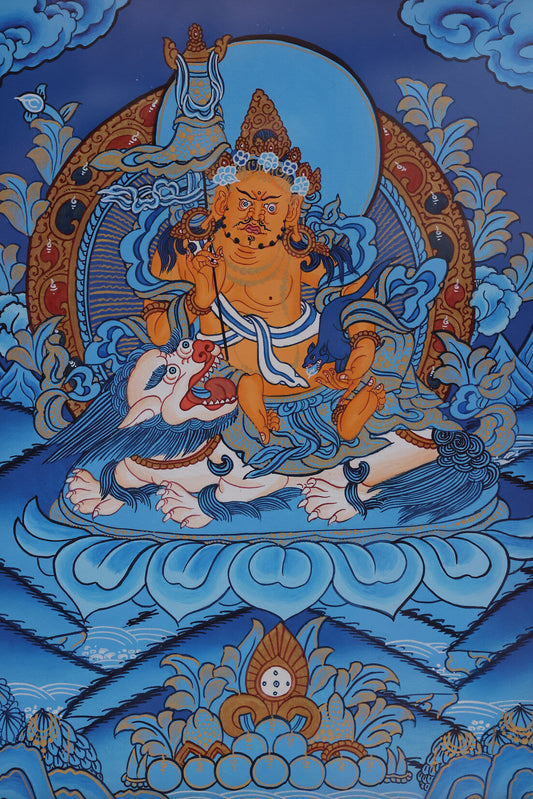
When a blue-background gilded Black Dzambhala thangka unfolds before your eyes, it’s hard not to be stunned by its jet-black wrathful face, the serpent coiled around its body, the skull cup and treasure-vomiting rat in its hands—this is not the "harmonious wealth god" of secular perception, but the "Wealth King" in Tibetan Buddhism who liberates sentient beings through a wrathful manifestation. As the most "swift in bestowing wealth" among the Five Wealth Gods, Black Dzambhala’s image holds Tibetan Buddhism’s ultimate reflections on wealth, desire, and liberation.
In Tibetan, Black Dzambhala is called "Zambala Lönpo," with roots tracing back to the ancient Indian god of wealth Kubera. However, after Padmasambhava brought Buddhism to Tibet, it was endowed with a deeper Buddhist core: He is the wrathful emanation of Akshobhya Buddha (the Buddha of the East) to free the suffering of poverty in the Saha World.
In the Tibetan Buddhist system, the Five Wealth Gods (Yellow, White, Black, Red, Green) each have distinct roles, and Black Dzambhala is revered as the "Wealth King"—Tantric scriptures record that his blessings are "like a wish-fulfilling jewel, granting requests instantly." But unlike the secular utilitarian imagination of a "wealth god," Black Dzambhala’s "wealth" is never given out of thin air:
"The jet-black color of Black Dzambhala symbolizes ‘freedom from all attachments in the ultimate truth’—it is the manifestation of the ‘nature of the mind-vajra’; the nude form represents ‘being unencumbered, breaking free from the net of worldly dust,’" notes Deji, a master of Regong thangka, in his interpretation of The Canon of Iconometric Proportions.
His wrathful form is not hatred, but the subjugation of the "obsession with poverty"—when sentient beings sink into suffering due to lack, Black Dzambhala uses his wrathful form to break their attachment to "scarcity" and transform greed into the intention of generosity with compassion.
The blue thangka Black Dzambhala before you strictly follows the "iconometric rules" of Tibetan Buddhist art, with every detail embodying spiritual symbolism:
-
Three Wide-Open Eyes: Not a glare, but "watching the suffering of sentient beings across past, present, and future";
-
Exposed Fangs: Symbolize "crushing all obstacles to prosperity";
-
Surrounding Flames: Represent the "fire of wisdom, burning away greedy attachments."
When creating, Master Deji uses lapis lazuli powder to paint Black Dzambhala’s third eye—not just artistic refinement, but a devotional expression of "representing treasure with treasure": Black Dzambhala’s "wealth" is essentially the perfection of the spirit.
-
Skull Cup in the Right Hand: Not a vessel for filth, but a "cup of compassion filled with nectar," symbolizing resolving the root causes of poverty through compassion;
-
Treasure-Vomiting Rat in the Left Hand: This weasel vomiting jewels represents "tamed greed"—Black Dzambhala does not satisfy endless desire, but helps sentient beings "escape suffering with moderate wealth";
-
Coiled Serpent: Eight dragons (serpents) winding around his body symbolize "mastery over all treasures in heaven and earth" without the slightest attachment.
In Regong thangka norms, Black Dzambhala’s head must account for 1/8 of his height, and the treasure-vomiting rat’s eyes must use lapis lazuli pigment—these seemingly strict rules are actually the wisdom of "expressing the Dharma through form": every proportion is a metaphor for the "balance between wealth and liberation."
Venerable Rinzin Namgyal emphasizes in his teachings on Black Dzambhala practice: "Black Dzambhala’s method is never a shortcut to overnight riches, but the practice of perfecting the paramita of generosity."
Scriptures record that the lineage of Black Dzambhala practice began with Vajrapani transmitting it to dakinis, later unearthed by treasure-revealing masters "from precious gems"—the prerequisite for its practice is "generating unsurpassed bodhicitta":
If practiced with greed, even if there are responses, they are temporary; if practiced with the intention of "offering to the Three Jewels and giving to sentient beings," one can attain "blessings that never fade."
Historically, a small kingdom’s king practiced Black Dzambhala due to an empty treasury. After three months of no results, he lost faith—until Black Dzambhala manifested as a child, advising him to "strengthen faith and use wealth to benefit others." Six months later, the treasury was replenished—not a "miracle of the wealth god," but the king’s "intention of generosity" attracting blessings.
Today, Tibetan people offer honey balls, black tea, and red wine when worshiping Black Dzambhala, placing the thangka in the north of their homes (Black Dzambhala corresponds to the water element, ruling the north)—but the true "offering" is practicing "transforming greed into generosity" in daily life:
- If wealth is obtained, use a portion to aid the poor and support the Dharma;
- If in poverty, abide with a mind "unattached to scarcity" while accumulating blessings through good deeds.
When modern people misinterpret Black Dzambhala as a "lucky charm for wealth," Venerable Genden Tenzin’s words cut to the essence: "What Black Dzambhala teaches is to maintain dignity in poverty and clarity in wealth."
In today’s consumerist era, Black Dzambhala’s wisdom is precisely an antidote:
-
Obsession with scarcity: Black Dzambhala’s jet-black color tells us that "poverty" is not fate, but an illusion of attachment;
-
Greed for wealth: The "controllable treasure-vomiting" of the rat reminds sentient beings that "wealth is a tool to escape suffering, not a chain that binds the mind";
-
Understanding of generosity: The "nectar" in the skull cup is the compassion that transforms "self-serving wealth" into "altruistic blessings."
Black Dzambhala in Regong thangka, with the richness of mineral pigments and the brilliance of gold lines, freezes the dialectical relationship between "wrath and compassion" and "wealth and liberation" on canvas—this is not just religious art, but the Tibetan people’s profound reflection on life:
True "financial freedom" is never owning endless money, but having a "mind unshackled by money."
When you gaze at this blue thangka Black Dzambhala again, you may no longer see an angry deity, but a teacher who awakens your "wealth wisdom" in a unique way—the treasure-vomiting rat in his hand never spits jewels, but the freedom that comes from letting go of attachment.
#BlackDzambhalaTibetanBuddhism #BlueThangkaArt #FiveWealthGods #WealthWisdom #TibetanBuddhistCulture #ThangkaArt #TibetanSpirituality #BuddhistWealthTeachings #BlackDzambhalaExplained #SpiritualWealth #TibetanCulturalHeritage #RegongThangka #BuddhistIconography