The Tibetan Thangka of Akashagarbha Bodhisattva: Where Spirituality Meets Timeless Craftsmanship
wudimeng-Dec 13 2025-
0 commentaire
In the vibrant tapestry of Tibetan Buddhist art, the Thangka stands as more than a painting—it is a sacred portal, a visual mandala that weaves together doctrine, devotion, and centuries of artisanal wisdom. Among the most revered of these works is the Thangka of Akashagarbha Bodhisattva, the "Bodhisattva of the Void Treasury"—a figure whose name encapsulates two of Buddhism’s most cherished ideals: wisdom as boundless as the sky, and blessings as endless as a hidden treasure.
For anyone drawn to Tibetan culture, spiritual symbolism, or traditional art, this hand-painted Thangka is a masterclass in how form and meaning converge. Let’s decode its layers: from its core spiritual theme to the meticulous craftsmanship that makes it a timeless artifact.
At its heart, this Thangka embodies the "wisdom-abundance symbiosis" central to Akashagarbha’s identity in Tibetan Buddhism.
In the Sutra of Akashagarbha, the bodhisattva is described as a guardian of "unlimited wisdom" (dissolving ignorance and clarifying the mind) and "infinite treasures" (fulfilling sincere wishes for prosperity, career success, and life’s blessings). For Tibetan practitioners, he is also the astrological protector of those born in the Year of the Ox or Tiger—making this Thangka both a spiritual tool and a personal talisman.
Unlike secular art, the Thangka’s theme is not decorative: it is a functional sacred space. When displayed or used in meditation, it invites the viewer to "connect with the bodhisattva’s vows"—to cultivate wisdom while embracing life’s legitimate good fortune (what Tibetans call "skillful means" in spiritual practice).
Tibetan Thangkas adhere to strict iconographic rules (outlined in the Sutra of Iconometric Proportions), and every element of Akashagarbha’s form carries spiritual weight:
-
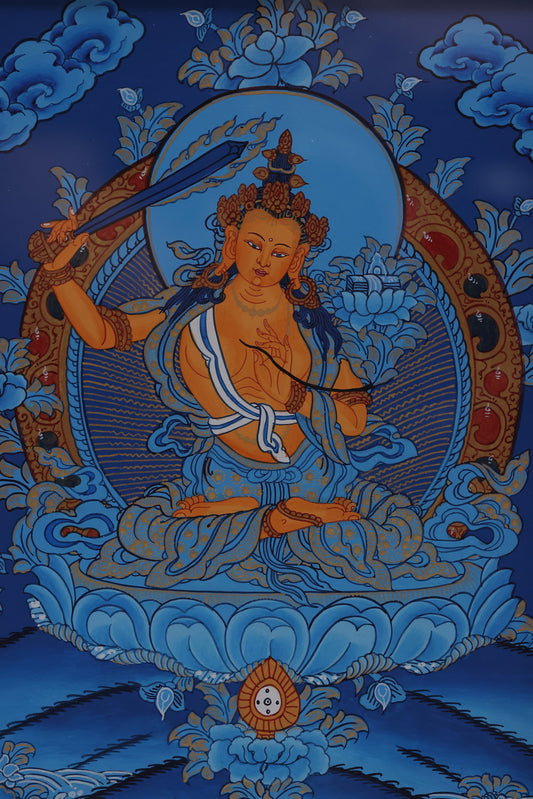
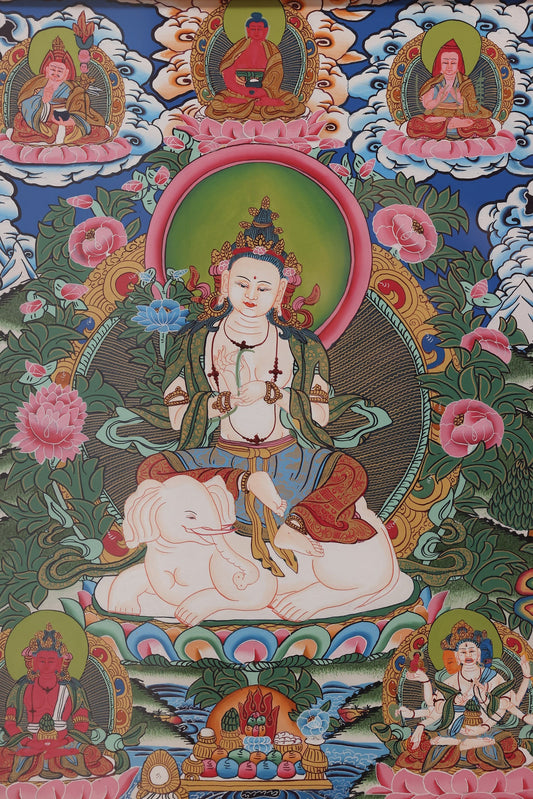
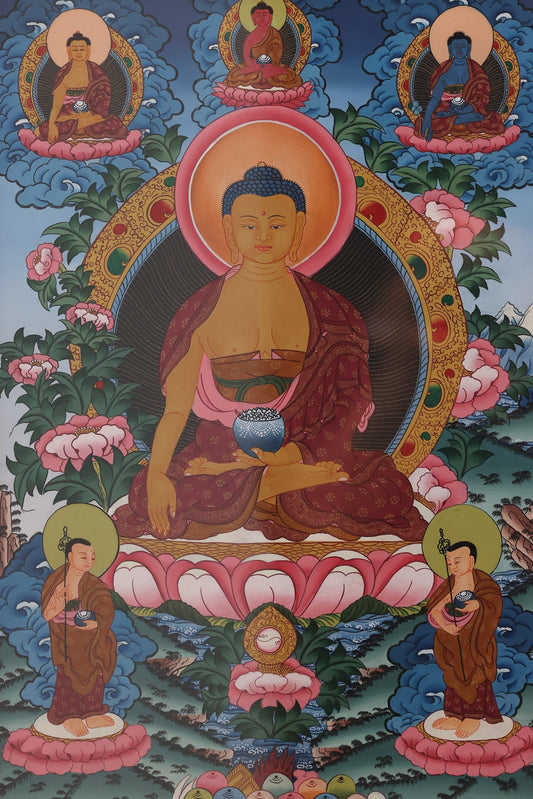
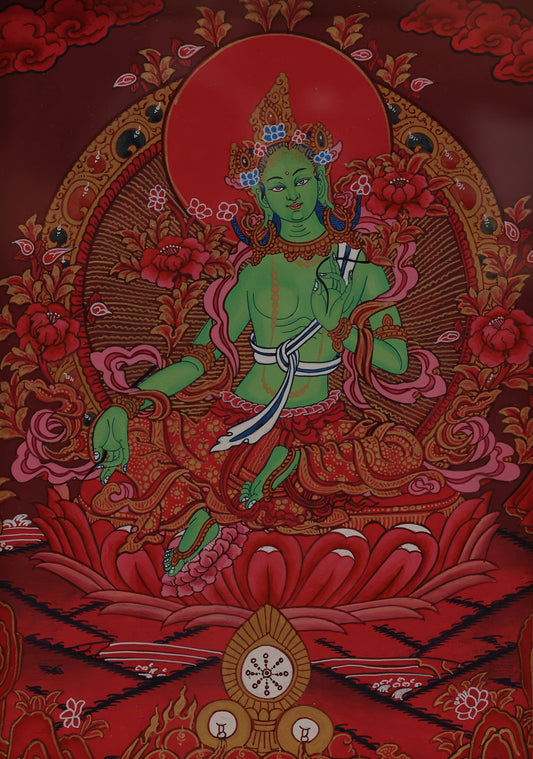
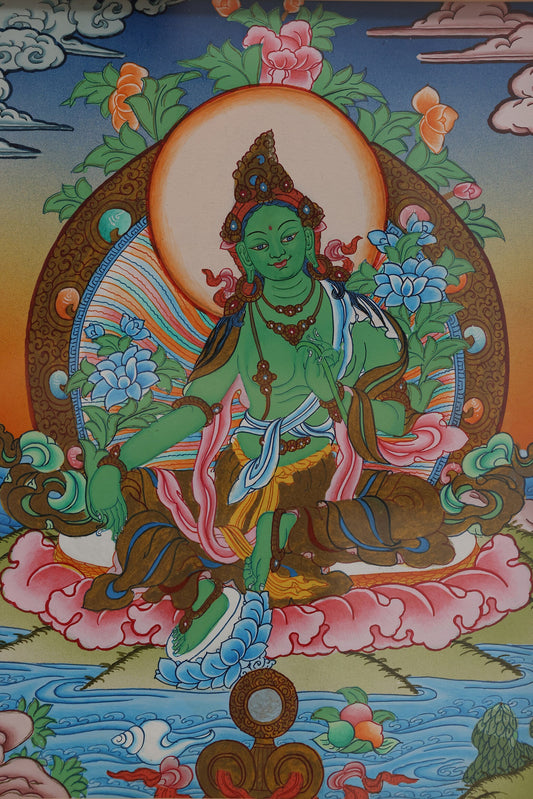
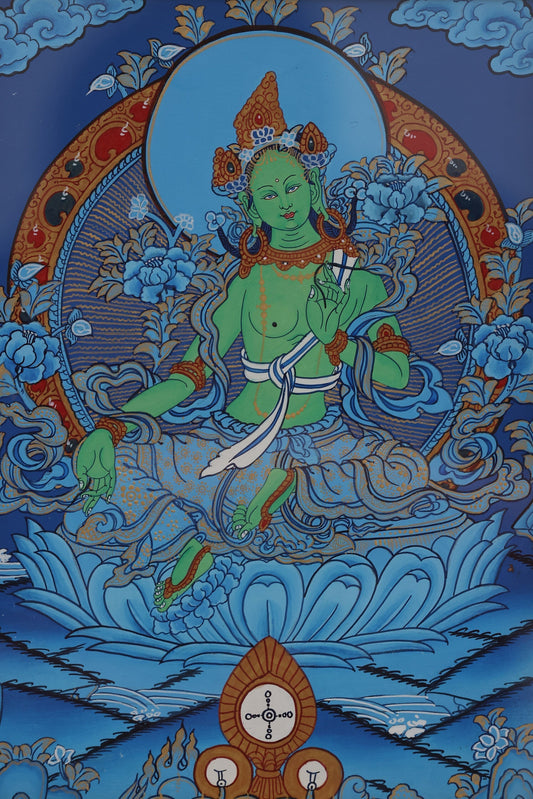
The Compassionate Visage: His soft, moon-shaped eyebrows and gentle eyes define him as a "peaceful deity" (as opposed to wrathful protectors), embodying the bodhisattva’s vow to "embrace all beings with kindness." His pale jade skin, per sacred texts, symbolizes purity untainted by worldly attachment.
-
Ornaments With Purpose: The Five-Buddha Crown (adorned with jewels representing the Five Wisdom Buddhas) signifies mastery of omniscience. The three strands of gold 璎珞 (necklaces) correspond to overcoming greed, anger, and delusion—the "three poisons" of suffering. The flowing blue-and-gold sashes wrap around his arms to symbolize "freedom from karmic bonds."
-
Mudras & Vessels: Vows Made Visible: His right hand forms the Fearless Mudra (palm outward), a promise to dispel fear; his left hand holds a Lotus Vase (filled with a wish-fulfilling jewel), the ultimate symbol of his ability to grant blessings. He sits on an 8-petal lotus throne—each petal representing one step of the Eightfold Path to liberation—surrounded by a golden rayed aura (wisdom’s light) and floral backdrops (merit and purity).
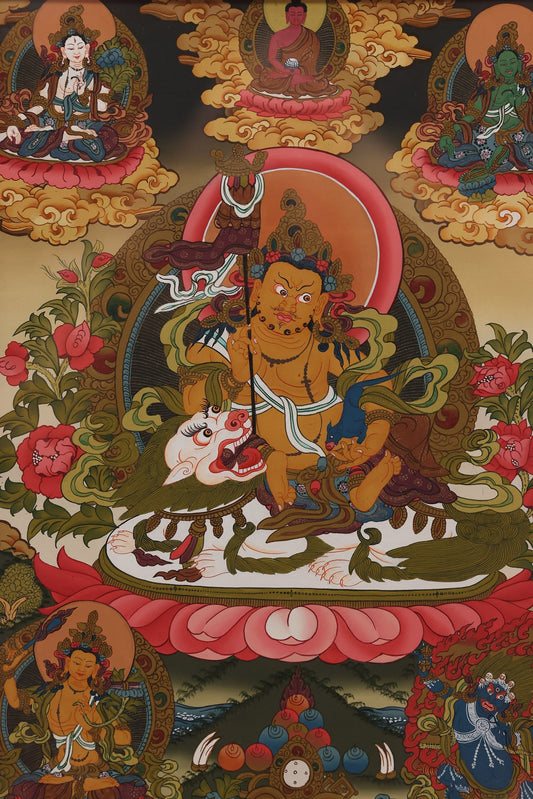
Tibetan Thangkas are often part of a mandala (a sacred circular layout), and Akashagarbha is accompanied by a retinue that amplifies his vows (even if not fully visible in this focused composition):
-
Attendant Bodhisattvas: Prabhamitra (Bodhisattva of Treasure Light) and Ratnapani (Bodhisattva of Treasure Hand) stand at his sides, holding a luminous jewel and a sacred seal, respectively—they reinforce his gifts of wisdom and abundance.
-
Guardians & Offerings: Deities like Dhrtarastra (Guardian of Prosperity, holding a lute to "harmonize worldly affairs") and Saraswati (Goddess of Wisdom, playing a stringed instrument) often appear in full sets, creating a "circle of blessings" that turns the Thangka into a self-contained spiritual ecosystem.
This Thangka is a product of the Regong school—one of Tibet’s most celebrated painting traditions, renowned for its precise lines and vivid natural pigments. What makes it a labor of devotion (not just art)?
-
The Canvas: Built to Last Centuries: The base is cotton cloth coated with yak glue and white clay, polished repeatedly until it sounds "like a drum when tapped." This durable foundation is a metaphor: "a pure vessel for sacred imagery."
-
Natural Pigments: Earth & Sky in Color: Every hue comes from the natural world:
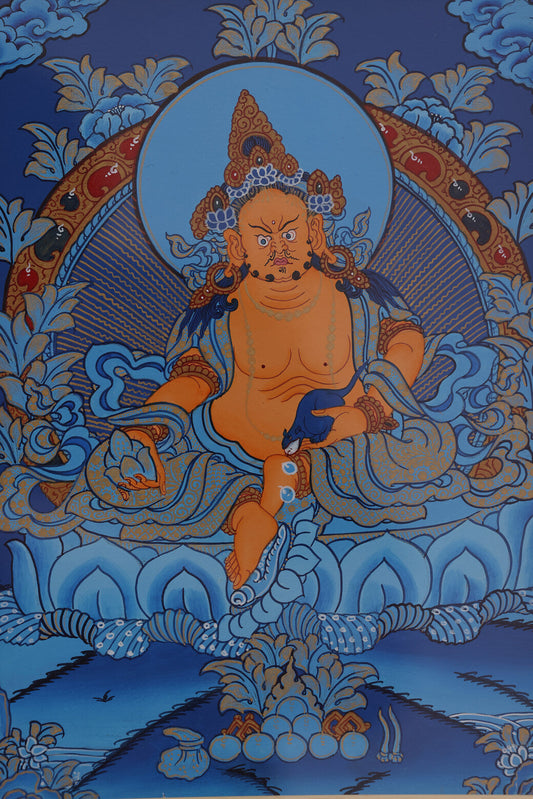
- Deep blue (the dominant shade) is ground lapis lazuli—symbolizing the vastness of the void.
- Gold accents are 24K gold leaf, hand-ground and mixed with herbal glue—representing divine light.
- Skin tones blend vermilion (cinnabar) and white clay—evoking compassionate warmth.
-
The Sacred Process:
-
Sketching: Charcoal lines follow the Iconometric Proportions exactly—no "creative license" is allowed, as the form must match the bodhisattva’s divine essence.
-
Coloring: The Regong school’s dot-dye technique layers faint pigments, with each layer drying for 3–5 days to avoid smudging—a practice that demands patience and focus (a form of meditation for the artist).
-
Eye-Opening: The final, non-negotiable step: the artist fasts, prays, and then paints the bodhisattva’s eyes. This ritual "infuses the image with spirit"—turning a painting into a sacred artifact.
In an era of mass-produced decor, this hand-painted Thangka is a reminder of art’s spiritual purpose. It is:
- A meditation tool: Used to visualize Akashagarbha’s vows and cultivate wisdom.
- A cultural heirloom: Its materials and techniques preserve 1,000 years of Tibetan craftsmanship.
- A bridge: Connecting modern viewers to the profound ideals of Tibetan Buddhism—where wisdom and abundance are not opposites, but two sides of the same spiritual coin.
For anyone seeking to understand Tibetan culture beyond stereotypes, or to own a piece of art that carries meaning beyond beauty, the Akashagarbha Thangka is a window into a world where every brushstroke is a prayer.
#TibetanThangka
#AkashagarbhaBodhisattva
#BuddhistArt
#RegongSchool
#TibetanCulturalHeritage
#SpiritualSymbolism
#HandPaintedArt
#NaturalMineralPigments