When an emerald-green figure emerges against the indigo background of a thangka, with her right foot extended beside the lotus seat as if ready to step toward suffering beings—this is Green Tara, the most warm-hearted sacred symbol in Tibetan Buddhism. As the emanation of Avalokiteśvara’s compassionate tears, she has been a spiritual guardian across millennia in Tibet and the entire Himalayan cultural sphere, known for her “immediate response to cries for help.” This article decodes the sacred core of this “Swift Heroine Mother” through thangka art, faith origins, symbolic meaning of salvation, and contemporary spiritual value.
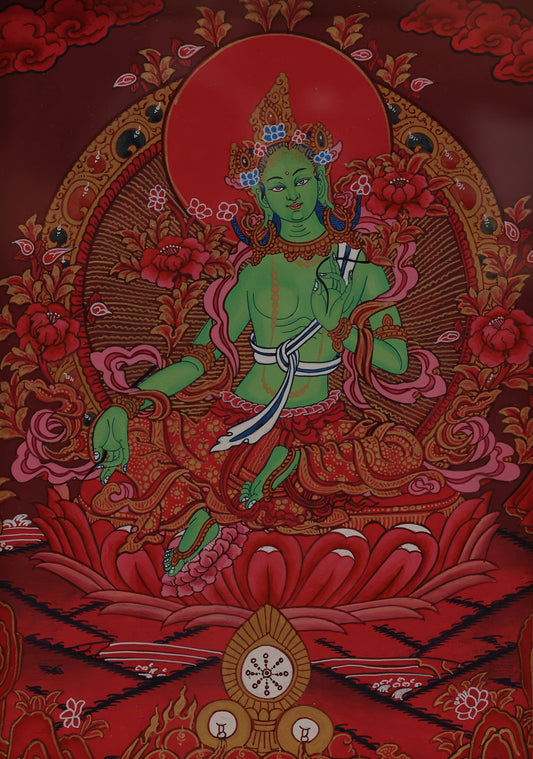
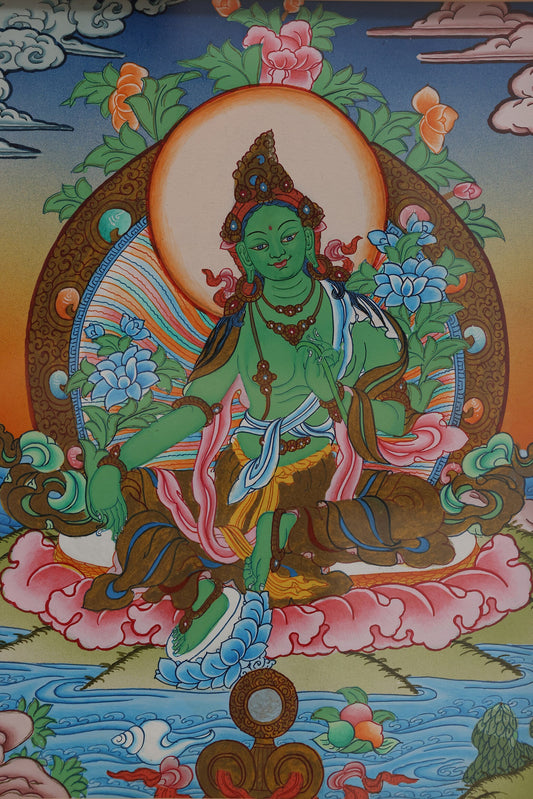
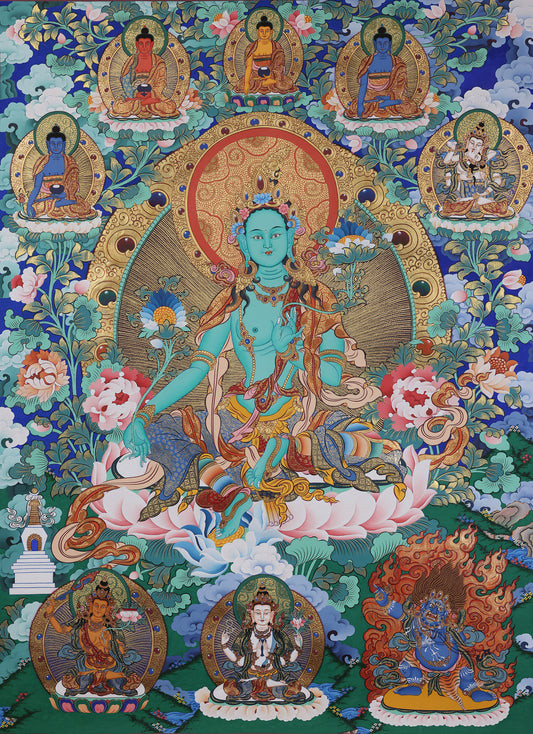
The Blue Thangka of Green Tara before you is a branch of “color thangka” in Tibetan art—crafted with lapis lazuli-ground indigo as the base, the mineral-pigmented Green Tara glows like jade, creating a striking visual contrast with the blue lotus, gold leaf decorations in the background. Every detail of this icon adheres to the sacred rituals of the Iconometric Canon:
-
Emerald-green body: Corresponding to the “activity color” of Amoghasiddhi Buddha in Vajrayana, it symbolizes the vitality of life and the transformation of afflictions into wisdom;
-
Half-lotus posture: The left foot folded in meditation represents wisdom, while the right foot extended on the lotus signifies “readiness to rise and save”—embodying the idea of “practicing compassion with wisdom”;
-
Facial Features and Adornments: With the appearance of a 16-year-old maiden, she wears a five-Buddha crown and three strings of 璎珞 (symbolizing perfect wisdom). Her eyes droop like crescent moons, and her smiling “Tara expression” conveys calm and warmth.
Her left hand holds a utpala (blue lotus), its stem reaching her ear, bearing a fruit, a blooming flower, and a bud—representing the Buddhas of the past, present, and future, signifying that Green Tara carries the saving vows of the Dharma across three eras. Her right hand forms the varada mudra (palm outward), a concrete expression of “fulfilling sentient beings’ good wishes.”
The indigo base of this thangka is made from ground lapis lazuli, symbolizing “emptiness and wisdom” in Tibetan art. Thangka creation involves over ten processes: stretching the canvas, grinding mineral pigments, drafting according to rituals, coloring and gilding, and consecration by lamas. The final work becomes a “living ritual implement”—when devotees visualize its image, they can resonate with Green Tara’s compassionate energy.
In the cosmology of Tibetan Buddhism, Green Tara is not a “mythological figure” but the concrete embodiment of Avalokiteśvara’s compassionate heart; her origin embodies Buddhism’s ultimate interpretation of “benefiting others”:
According to the Tara Root Sutra, Avalokiteśvara surveyed the six realms with his wisdom eye, saw that sentient beings’ suffering had not diminished, and his compassion surged—one tear from his right eye transformed into a lotus, from which Green Tara emerged. She clasped her hands to Avalokiteśvara and vowed: “As long as there is a cry for help in the world, I will never enter nirvana!”
This origin makes Green Tara a “compassionate actor”—unlike Avalokiteśvara’s serene observation, she is defined by “swift salvation” and known as the “Swift Heroine Mother.” Scriptures record that she “responds within 7 seconds of hearing a cry,” making her the “spiritual first responder” in Tibetan devotees’ hearts.
Green Tara’s most well-known vow is “saving the eight perils”: resolving dangers from lions, elephants, fire, snakes, water, imprisonment, thieves, and non-human beings. In Vajrayana context, these external perils correspond to sentient beings’ inner afflictions:
- Lion peril → arrogance; Elephant peril → ignorance; Fire peril → anger;
- Snake peril → jealousy; Water peril → greed; Imprisonment peril → stinginess;
- Thief peril → wrong views; Non-human peril → doubt.
Her salvation is not just about averting disasters, but helping sentient beings transform the “five poisons” into wisdom—especially converting “doubt” into perfect wisdom, which is why she is regarded as the “guardian of female practitioners.”
In the 7th century, Princess Bhrikuti of Nepal brought the first Tara statue to Tibet; in the legend of Princess Wencheng’s journey to Tibet, she is revered as an emanation of Green Tara (or White Tara), making Green Tara a symbol of Sino-Tibetan cultural integration. During the Kangxi era of the Qing Dynasty, the “Speaking Tara” statue was enshrined in Guangren Temple in Chang’an, becoming the only Green Tara temple in Han regions, where incense still burns today.
In Tibetan Buddhism, Green Tara is not just an enshrined icon, but a practice accessible through mantra and visualization, centered on “threefold correspondence” (aligning body, speech, and mind with the deity):
The mantra is “Oṃ Tāre Tuttāre Ture Svāhā”, with each syllable corresponding to a dimension of salvation:
-
Oṃ: Encompasses the wisdom of the Buddha family, opening the source of blessings;
-
Tāre: Swift salvation, seeing suffering;
-
Tuttāre: Saving from all fears, resolving the eight perils and sixteen sufferings;
-
Ture: Transcending samsara, realizing emptiness;
-
Svāhā: Invoking the mantra’s power to accomplish good, benefiting all sentient beings.
When devotees chant it, they often visualize the mantra transforming into green light, permeating themselves and all beings. This dharma, short and powerful, is one of the most popular compassionate practices in Tibet.
In Tibet, Green Tara’s faith is deeply integrated into daily life:
-
Thangkas and Tsa Tsas: Families enshrine Green Tara thangkas in their altars, or carry Green Tara tsa tsas (clay Buddha amulets);
-
Mantra Recitation: Chanting the mantra in the morning, before bed, or during work, based on bodhicitta (the mind of enlightenment), so the vow can reach all beings;
-
Altruistic Practice: Devotees believe that practicing kindness (not killing, not stealing, treating others well) aligns with Green Tara’s compassionate spirit.
In today’s fast-paced society, Green Tara’s “swift salvation” and “maternal protection” have become sources of spiritual comfort:
Green Tara appears in a female form, breaking the stereotype that “only men can become Buddhas”—as a “Buddha-Mother,” she combines sacredness with maternal tenderness, becoming a spiritual symbol of women’s self-awakening and growth: “She teaches us that compassion is not weakness, but the greatest strength.”
When people face work pressure, emotional distress, or life changes, Green Tara’s “saving the eight perils” can be understood as resolving inner “lions of arrogance,” “fires of anger,” and “waters of greed”—facing difficulties with wisdom and compassion. As a Tibetan proverb says: “When you call ‘Dolma’ (Green Tara in Tibetan), her hand is always within your reach.”
Today, cultural forms like Green Tara thangkas and mantra chanting are spreading globally through art exhibitions and new media—she is no longer just a religious symbol, but a universal “totem of kindness,” reminding us that compassion is a universal value transcending faith and region.
As Green Tara extends her right foot on the blue thangka, the lotus seems to step toward every life that needs to be seen. Her compassion is Avalokiteśvara’s tears, the wind in Tibetan prayer flags, and a touch of green in modern hearts—reminding us: As long as we hold good thoughts, the power of salvation is beside us; as long as we are willing to reach out, we can also be a “Green Tara” to others.
#GreenTara #TibetanBuddhism #TaraBuddha #ThangkaArt #BuddhistDeities#GreenTaraMeaning #BlueThangka #TaraMantra #BuddhistCompassion #TibetanSpirituality#GreenTaraOrigins #BuddhistArt #TaraPractice #HimalayanCulture #SpiritualGuardian#WhoIsGreenTara #GreenTaraBenefits #TibetanThangkaExplained #BuddhistDeitiesForProtection#GreenTaraMantraGuide #CompassionInBuddhism