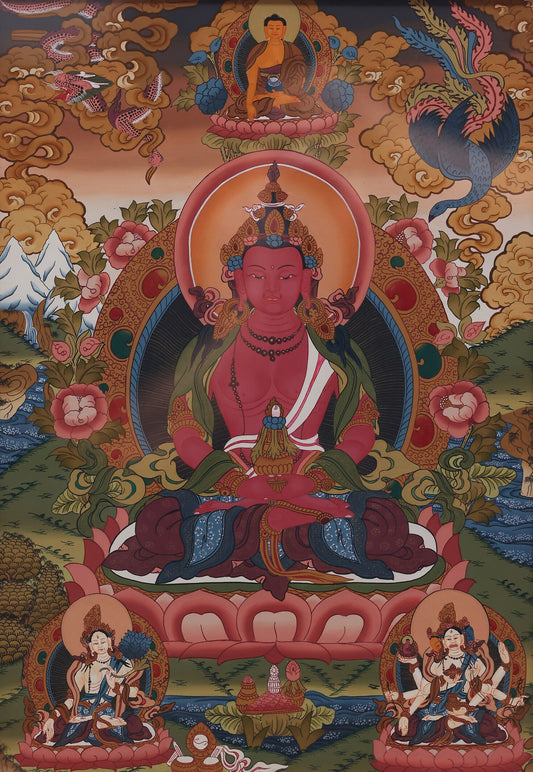
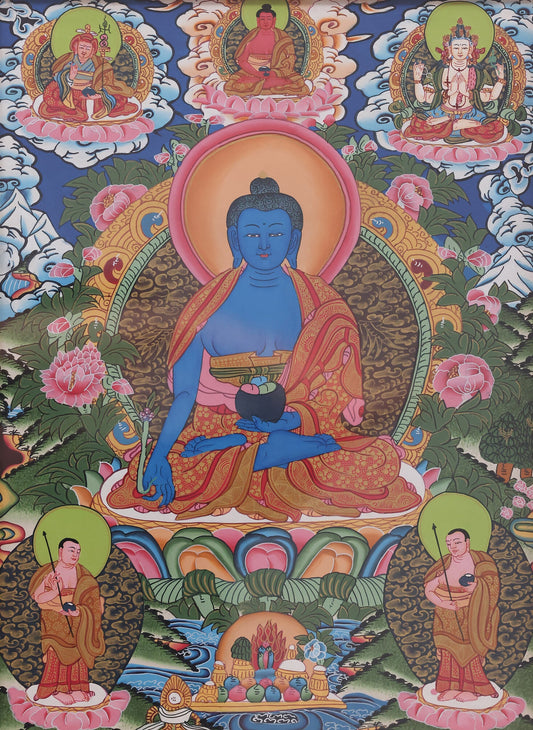
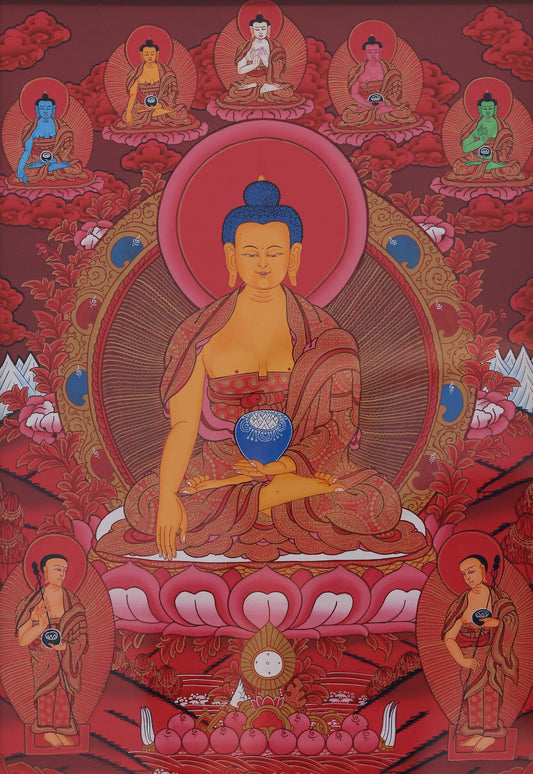
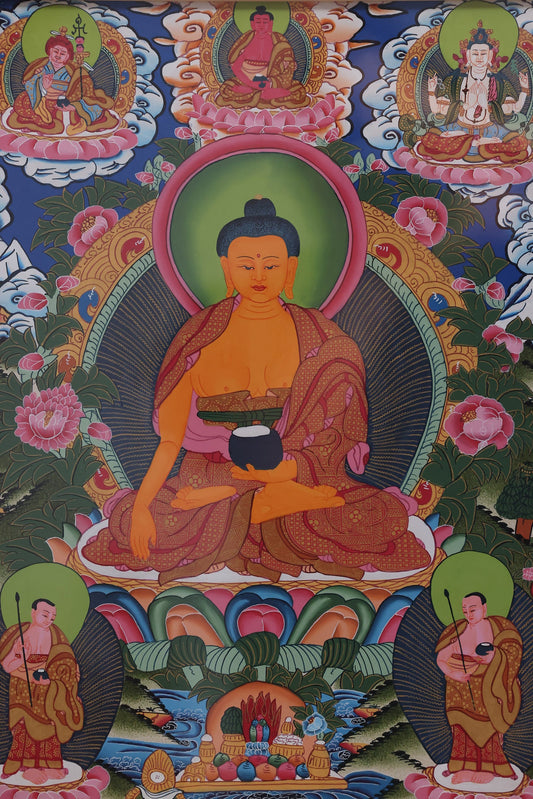
When you gaze at this vividly colored Tibetan thangka, the sage seated serenely on a lotus throne at the center is none other than Guru Rinpoche—honored as Guru Rinpoche (Precious Master) in Tibetan Buddhism. He wears a lotus hat inlaid with sun and moon emblems, holds a bowl of nectar in his left hand, and forms the abhaya mudra (gesture of fearlessness) with his right. A vajra standing beside him is adorned with three small figurines—this is no ordinary religious painting, but a visual cipher of Tibet’s thousand-year spiritual faith.
Guru Rinpoche’s birth is itself an esoteric parable. According to The Autobiography of Guru Rinpoche, he was born in the 8th century in Lake Danakosha in Oddiyana (modern-day Swat Valley, Pakistan): a blue lotus suddenly bloomed, and an eight-year-old child sat in its 花蕊 (stamen), adopted by King Indrabodhi—hence his name "Padmasambhava" (Lotus Born, or Pema Jungne in Tibetan). This "manifest birth" aligns with his identity as the vajra incarnation of "the body of Amitabha, the speech of Avalokiteshvara, and the mind of all Buddhas."
In his youth, Guru Rinpoche already displayed transcendent qualities: he ruled Oddiyana as a prince, but upon seeing the emptiness of royal power, he danced naked atop the palace holding a vajra, accidentally killing a minister’s wife. Exiled, he later took ordination from Ananda in Sahor, receiving the Dharma name "Shakya Senge" (Lion of the Shakyas). He then traveled across India, studying the Great Perfection (Dzogchen) with eight esoteric masters, becoming an accomplished practitioner at Nalanda Monastery—laying the groundwork for his future Dharma propagation in Tibet.
In the mid-8th century, Tibetan Emperor Trisong Detsen sought to revive Buddhism, but faced resistance from Bonpo forces and local spirits: palaces flooded, Red Hill was struck by lightning, and plagues raged. The Indian monk Shantarakshita advised: "You must invite the Ocean-Born Vajra (Guru Rinpoche) from Oddiyana to subdue Tibet’s demons with fierce mantras." Trisong Detsen sent envoys twice to invite him; along the way, Guru Rinpoche "subdued demons wherever he met them," converting Bon deities like the mountain god Yarchen Shapao and the Twelve Tenma Goddesses into Buddhist protectors, before finally meeting the emperor at Samye Palace.
His arrival reshaped Tibet’s religious landscape:
- Reconciling Buddhism and Bon: He integrated Bon practices like divination and ritual into Buddhism, localizing the foreign faith;
- Establishing Samye Monastery: This "symbol of Mount Meru" was Tibet’s first monastery with the Three Jewels (Buddha, Dharma, Sangha), its Sino-Hindu-Tibetan architectural style remains a testament to cultural fusion;
- Cultivating the Sangha: He ordained the "Seven Tested Ones" and guided the "Twenty-Five Acharyas," laying the foundation for Tibetan Buddhism’s monastic community.
For this, Tibetans called him the "Second Buddha"—just as Shakyamuni founded Buddhism, Guru Rinpoche rooted it in the 雪域高原 (snowy plateau).
Every element in this thangka carries deep esoteric meaning:
-
Lotus Throne and Nectar Bowl: Guru Rinpoche sits on a thousand-petal red lotus, symbolizing "enlightenment untainted by samsara"; the bowl of "immortal nectar" in his left hand, topped with a wish-fulfilling tree, represents "granting all sentient beings’ good wishes"—embodying his union of compassion and wisdom;
-
Lotus Hat and Vajra: The sun and moon on his hat correspond to "skillful means" and "wisdom emptiness," while the eagle feather on top signifies "ultimate realization"; the three-pointed vajra beside him represents the Dharmakaya, Sambhogakaya, Nirmanakaya (three bodies of Buddha), and the stacked figurines on the vajra symbolize his power to subdue heretics and spirits;
-
Form and Robes: His half-lotus posture denotes "spiritual freedom," his brown monastic robe balances the discipline of a bhikshu and the authority of a tantric master, and the cyan-blue sashes on his sleeves allude to "emptiness without defilement."
This "teaching through imagery" thangka tradition is essentially a "visual scripture" for Tibetan practitioners—contemplating Guru Rinpoche’s form is a way to recall his virtues and teachings. As Nyingma scriptures state: "To see Guru Rinpoche’s image is to see the Buddha himself."
After Guru Rinpoche left Tibet (some say he traveled to Dravida to spread Dharma), he left thousands of termas (hidden treasures)—esoteric scriptures buried in caves, statues, or sutras, to be unearthed by tertöns (treasure revealers) when "the time is right." Tertöns like Nyang Nyima Öser (12th century) and Sangye Lingpa (14th century) organized the Nyingma school’s teachings using these termas.
As the founder of the Nyingma (Old School), Guru Rinpoche’s core contribution was introducing Dzogchen—the Nyingma school’s highest teaching, which holds that "all sentient beings inherently possess Buddha-nature; enlightenment comes from recognizing one’s true nature." In the 14th century, Longchenpa systematized it into three parts: Semde (Mind Section), Longde (Space Section), and Menngagde (Instruction Section), making it one of Tibetan Buddhism’s most distinctive practices.
Today, Nyingma monasteries (e.g., Dorje Drak, Mindrolling) still center their ceremonies on honoring Guru Rinpoche: the monthly 10th day Guru Puja sees monks and laypeople chanting and offering lamps to seek his blessings; on the 10th day of the 6th Tibetan month (Guru Rinpoche’s birthday), monasteries hold grand cham (ritual dance) ceremonies, reenacting his demon-subduing and Dharma-spreading deeds.
To guide sentient beings of different capacities, Guru Rinpoche manifested eight forms (the Eight Manifestations of Guru Rinpoche), each tied to a specific Dharma-propagating purpose:
-
Padmakara (Ocean-Born Vajra): The child born from a lotus, representing "primordial awakening";
-
Padma Raja (Lotus King): The prince of Oddiyana, illustrating "the impermanence of royal power";
-
Shakya Senge (Lion of the Shakyas): The ordained bhikshu, symbolizing "disciplined practice";
-
Loden Chokse (Wise and Compassionate Guru): The wandering Dharma teacher, representing "spreading the teachings widely";
-
Padmasambhava: The form of his arrival in Tibet, as depicted in the thangka;
-
Senge Dradrok (Lion’s Roar): The form that subdued heretics, defeating opponents with debate and supernatural power;
-
Nyima Özer (Sunlight Guru): The form that tamed spirits, protecting Buddhism with fierce power;
-
Dorje Drolo (Wrathful Guru): The terma incarnation, riding a tiger and holding a vajra, symbolizing "destroying the demons of affliction."
These manifestations are not mere myths, but expressions of Tibetan believers’ faith that "Guru Rinpoche is everywhere"—whether facing obstacles in practice, hardships in life, or cultural inheritance, people believe he will appear in the appropriate form to protect them.
From 8th-century Tibet to the 21st-century world, Guru Rinpoche’s influence has transcended religion:
-
Cultural Symbol: His image appears in thangkas, sculptures, and art, becoming a core theme of Tibetan culture;
-
Spiritual Bond: In Bhutan, Nepal, and the Himalayas, Guru Rinpoche faith is a marker of cross-border cultural identity;
-
Practice Guide: His mantra "Om Ah Hum Vajra Guru Padma Siddhi Hum" remains a daily recitation for countless practitioners, believed to hold the power of "purification, blessing, and accomplishment."
As a Tibetan proverb says: "Guru Rinpoche’s teachings are like snowmelt water, nourishing every child of the 雪域 (snowland)."
When you look at this thangka again, you may understand: Guru Rinpoche is not just a historical figure, but the "spiritual gene" of Tibetan culture—he reconciled conflicts with wisdom, integrated into the local context with compassion, nourished souls with teachings, and ultimately became a faith totem spanning millennia.
#GuruRinpoche #TibetanBuddhism #ThangkaArt #NyingmaSchool #TermaTransmission #Padmasambhava #TibetanSpirituality #EsotericBuddhism #BuddhistArt #HimalayanCulture