Green Tara: The Emerald Light Wheel of Compassion and Deliverance in Tibetan Buddhism
wudimeng-Dec 15 2025-
0 commentaire
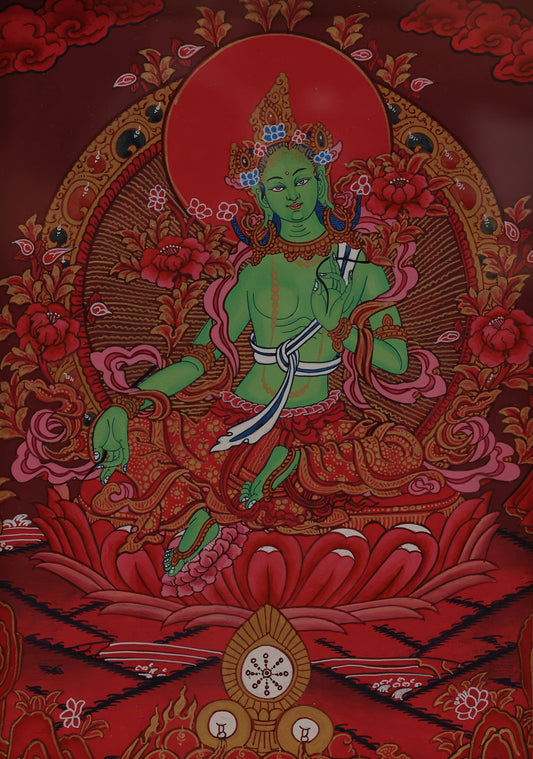
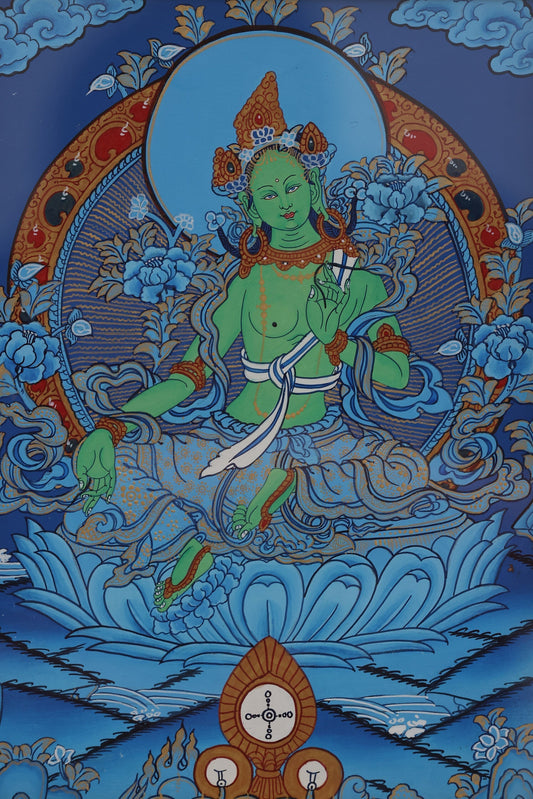
When an emerald-hued Green Tara Thangka unfolds before your eyes, you’ll see the gentle face of a sixteen-year-old maiden holding the power to shatter the Eight Dangers; in the posture of her right foot resting lightly on a lotus, lies the promise of “response within seven seconds” for deliverance. In the constellation of Tibetan Buddhist faith, Green Tara is the light wheel manifested from Avalokiteshvara’s tears of compassion—she bears the sanctity of the “Mother of All Buddhas” in her female form, and conveys vitality and hope through her emerald body, becoming one of the most venerated symbols of compassion across the Tibetan Plateau and the world.
According to the Origin of Tara (a Tibetan Buddhist scripture), Green Tara’s birth stems from Avalokiteshvara’s boundless compassion: When Avalokiteshvara surveyed the six realms with his wisdom eye and saw sentient beings still drowning in the sea of samsara, great sorrow arose in his heart. A tear from his right eye fell to the earth and transformed into a lotus, from which Green Tara emanated. She vowed to Avalokiteshvara: “I wish to deliver sentient beings in female form; if anyone calls for help, I will respond swiftly, until samsara is emptied.”
This origin grants Green Tara dual sacredness:
-
The embodied compassion of Avalokiteshvara: She is an extension of Avalokiteshvara’s “compassionate heart,” bearing the core vow of “relieving suffering and bestowing joy”;
-
An independent Buddha-Mother dignity: In the esoteric tradition, she is revered as the “Mother of All Buddhas,” symbolizing the source of wisdom and compassion, capable of generating all the merits of Buddhahood.
In historical legends, Green Tara’s image is also closely intertwined with Han-Tibetan cultural exchange—Tibetans believe that Princess Wencheng (who married Songtsen Gampo) was an emanation of Green Tara. When Songtsen Gampo passed away, Princess Wencheng transformed into a sixteen-petaled emerald lotus, with Green Tara’s mudra (hand gesture) appearing at the lotus core. This legend has made her a spiritual bridge for Han-Tibetan peace.
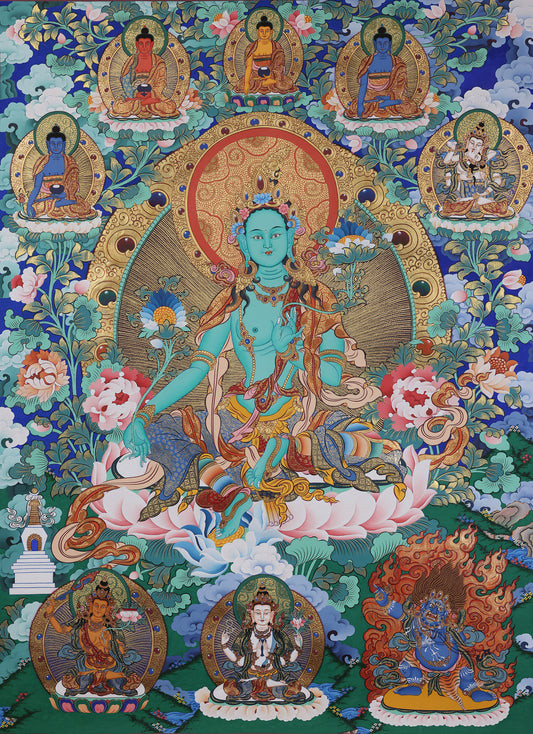
The Iconometric Canon (a Tibetan Buddhist text on sacred art proportions) endows Green Tara’s image with a rigorous symbolic system. Taking the Thangka you see as an example, every detail carries esoteric meaning:
-
Emerald-green body: Corresponding to the “activity color” of Amoghasiddhi Buddha (one of the Five Dhyani Buddhas), it symbolizes both the vitality of growing plants and the essence of spiritual practice—“transforming afflictions into wisdom,” like spring sunshine melting ice, dissolving suffering with gentle power.
-
Lalita Asana (royal ease pose): The left leg is crossed in meditation, while the right foot rests lightly on a lotus, signifying “ready to rise and deliver sentient beings at any time.” The lotus her toes touch in the Thangka is a metaphor for “adapting to circumstances to rescue the distressed.”
-
Abhaya Mudra (fearlessness gesture) with the right hand: Palm facing outward, symbolizing “fulfilling sentient beings’ good wishes”; as in the Thangka, her slightly raised hand seems to extend protection to all.
-
Tri-ratna Mudra (three jewels gesture) with the left hand: Holding a blue utpala lotus at the chest, the index, middle, and little fingers represent the Three Jewels (Buddha, Dharma, Sangha), while the thumb and ring finger touch to symbolize the “union of compassion and wisdom.” The “bud, blooming flower, and fruit” on the lotus stem correspond to the vows of all Buddhas in the past, present, and future.
-
Five-Buddha Crown: The crown atop her head is inlaid with the Five Dhyani Buddhas, symbolizing “protecting sentient beings with the wisdom of all Buddhas”;
-
Three Neck Lines: Represent “perfected wisdom.” The garlands around her neck in the Thangka are not just ornaments, but symbols of “fulfilled merits of blessing and wisdom.”
The clouds, flowers, and landscapes in the Thangka’s background are not mere embellishments—the blue-green color palette echoes Green Tara’s body hue, and the imagery of lotuses and fruits subtly aligns with the core spirit of “nurturing sentient beings with compassion.”
In Tibetan Buddhism, Green Tara is called the “Tara Who Rescues from the Eight Dangers,” capable of dispelling eight calamities: lion, elephant, water, fire, imprisonment, thief, snake, and non-human (spirit) dangers. This trait of “swift deliverance” has made her the most relied-upon protective deity among Tibetan believers.
Green Tara’s mantra—Om Tāre Tuttāre Ture Svāhā—is the core of her practice. Tibetan tradition holds that reciting this mantra 108 times can remove obstacles and increase blessing and wisdom. The esoteric meaning of the mantra corresponds to different deliverance functions:
-
Tāre: Dispels illness and demonic obstacles;
-
Tuttāre: Breaks fear and predicaments;
-
Ture: Fulfills good wishes and wisdom.
In Tibet, Green Tara’s faith permeates every corner of life:
-
Monastic Rituals: All schools (Gelug, Nyingma, etc.) practice Green Tara’s teachings; when Atisha (a key Indian Buddhist master) entered Tibet, he took Green Tara as his personal deity and widely propagated her practice.
-
Folk Worship: Almost every Tibetan household enshrines a Green Tara Thangka, and girls are often named Drolma (Tibetan for “Tara”) to pray for her protection.
-
Sacred Site Legends: In the cave of Pharping (Nepal), there is a “self-arisen Green Tara statue,” said to have manifested naturally due to a practitioner’s mantra recitation. It remains a source of blessing for believers to this day.
In the fast-paced modern world, Green Tara’s faith has not faded—it has become a cross-cultural spiritual symbol:
-
Symbol of Feminine Power: Her attainment of Buddhahood in female form breaks the traditional belief that “only men can become Buddhas,” making her a “prototype of female awakening” in feminist Buddhist studies.
-
Spiritual “First Responder”: Tibetans call her Thuksey Drolma (the Swift One), with the legend that “she responds within 7 seconds of a call.” This vow of “immediate deliverance” perfectly aligns with modern people’s need for spiritual comfort.
-
Cross-Cultural Symbol of Compassion: In the West, Green Tara’s Thangkas and mantra are seen as symbols of “healing,” and her emerald image has become a metaphor for nature and kindness.
When we gaze at a Green Tara Thangka, we see more than a sacred icon—we see the spiritual core of Tibetan Buddhism: “compassion as action.” She bears the vows of all Buddhas in the form of a maiden, conveys the hope of vitality through her emerald body, and responds to every faint cry for help in the world with her “ready-to-rise” posture.
In the chants of the Tibetan Plateau, and in Thangka frames in urban corners, Green Tara’s light wheel never fades. She reminds us: Compassion is not a distant divine will, but a gentle, active force like spring rain—so long as we hold good intentions, everyone can be a “deliverer” for themselves and others.
#GreenTara #TibetanBuddhism #ThangkaArt #AvalokiteshvaraEmanation #CompassionateDeliverance