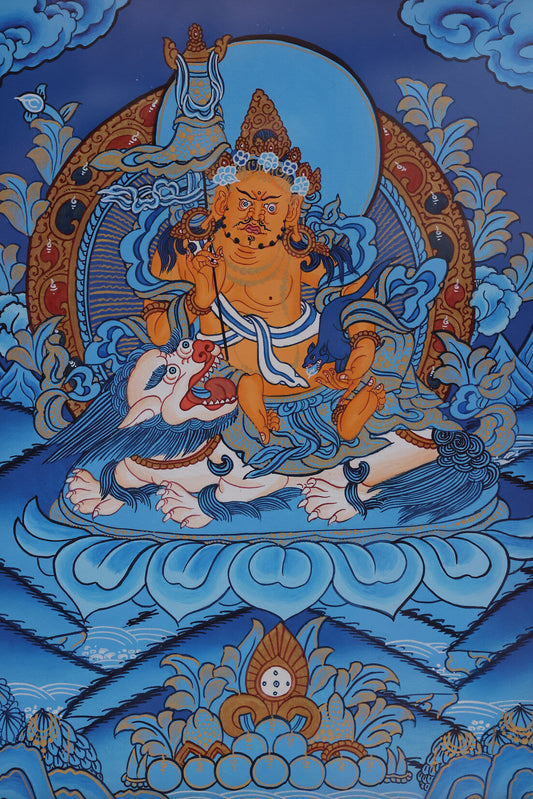
In the pantheon of Dharma protectors in Tibetan Buddhism, one wealth god manifested in a "fierce form" stands out: his ink-black body is coiled by a spiritual serpent, three eyes glare wide, fangs bare; his right hand holds a skull cup brimming with nectar, his left clutches a treasure-spitting mongoose that endlessly spews jewels—this is Black Dzambhala (Tibetan: Zang Lha Nag Po), known as the "Wealth King." When we gaze at a Regong Red Thangka of Black Dzambhala, we see not just a wealth-guarding Dharma protector, but the profound philosophy of Tibetan Buddhism that "expresses compassion through ferocity," and the exquisite craftsmanship of Red Thangka art that materializes faith.
Black Dzambhala’s origin traces a faith lineage spanning civilizations.
His prototype can be traced to Kubera, the wealth god of ancient Hinduism—this guardian of the north in Brahmanism, depicted as the "Ugly Deva" and "King of Yakshas," oversaw the treasure vaults of Uttarakuru. But when this belief was introduced to Tibet by Guru Padmasambhava, Kubera’s image took on new Buddhist connotations: he was no longer a mere god of wealth, but an "transcendental wealth god" manifested by Akshobhya Buddha (the Buddha of the East) to liberate the poor and suffering.
Tibetan Buddhist scripture The Complete Ritual of Wealth Gods: Showering Desired Rain records Black Dzambhala’s manifestation: an ancient Indian king, driven to suicide by empty coffers, saw a black child emerge from the river, who taught him a practice and instructed him to persist for six months. The king, fruitless after two months, nearly gave up—until the child reappeared to urge him on; when the six months ended, the king entered a crystal retreat chamber and found it overflowing with jewels—that child was the incarnation of Black Dzambhala.
Compared to other wealth gods, Black Dzambhala’s "blessing targets" are uniquely specific. Guru Padmasambhava’s Terma Teachings clearly states: This practice is most accessible to the poor, lower classes, and solitary practitioners. Tibetan master Rinchen Namgyal once taught: "Black Dzambhala is the most esoteric and swiftly blessing among the 21 great wealth gods, and has no ‘hidden obstacles’—other wealth gods may have non-human interferences when bestowing wealth, but Black Dzambhala, as an incarnation of Akshobhya Buddha, can remove obstacles and grant wealth without side effects."
The Black Dzambhala image in Regong Red Thangka is the pinnacle of Tibetan Buddhist art’s "expressing Dharma through form." Taking the Red Thangka at the start of this article as an example, every detail holds deep symbolism:
Black Dzambhala’s all-black body is not a symbol of "evil," but a representation of "innate purity without defilement"—just as ink covers all impurities, black signifies subduing greed and purifying karmic obstacles. His three wide-glaring eyes and bared fangs are classic features of a "fierce form": the left eye sees the past, the right eye the present, and the third eye between the brows sees the future, thus 震慑 ing all obstacles to wealth; his naked body implies "unburdened by attachments," breaking fixation on material things.
-
Right hand holding a skull cup: The cup does not contain blood, but "compassionate nectar," symbolizing transforming greed with bodhicitta, elevating worldly wealth into supramundane spiritual resources.
-
Left hand clutching a treasure mongoose: This mythical beast, nakchhya, endlessly spits out wish-fulfilling jewels, representing Black Dzambhala’s ability to grant sentient beings’ wealth aspirations; yet it is firmly held by the wealth god, hinting that "wealth must be governed by wisdom" rather than indulging greed.
This Red Thangka uses natural cinnabar as the base and 24K gold leaf for outlines; the flaming patterns in the background surround the main deity—flames are not for destruction, but "wisdom fire" that burns away the afflictions of poverty; the lotus moon seat symbolizes rising unsoiled from mud, maintaining a pure mind even amid worldly wealth.
Regong Thangka intangible cultural heritage inheritor Deji Master emphasizes: "A genuine Black Dzambhala Thangka must follow the Iconometric Sutra: the head accounts for 1/8 of the body height, and the treasure mongoose’s eyes must use lapis lazuli pigment—this is reverence for tradition."
In Tibetan Buddhism, practicing Black Dzambhala is not a "shortcut to unearned gain," but a method of "cultivating blessings through generosity."
In Black Dzambhala Practice Teachings, Rinchen Namgyal states: "Practicing wealth god Dharma with a stingy mind itself goes against its intent. Black Dzambhala is the manifestation of the Buddha’s perfection of generosity; practitioners must vow to ‘use wealth for Dharma propagation and benefiting sentient beings,’ not to satisfy personal greed."
Traditional Black Dzambhala practice includes:
-
Offerings: Honey balls, black tea, and red wine are presented, symbolizing offering sweet, pure things;
-
Visualization: Visualize Black Dzambhala manifesting from the syllable Hung, the treasure mongoose showering jewels like rain upon all sentient beings;
-
Mantra Recitation: Chant the heart mantra "Om Shrim Mahakala Shyamale Svaha" while visualizing wealth not as "private property," but as "shared by all sentient beings."
There is a Tibetan katha: a practitioner who practiced Black Dzambhala for years remained poor, and when he questioned the god, Black Dzambhala replied: "You were stingy in past lives and did not practice generosity—I cannot grant you wealth." This reveals a core truth: Wealth gods do not "create wealth," but "reveal the blessings you already possess"—the essence of practicing Black Dzambhala is accumulating the blessings of generosity through offerings, mantra recitation, and intention, allowing wealth to naturally manifest.
In a modern society anxious about material things, Black Dzambhala devotion offers a new perspective on wealth:
-
The root of poverty is not "lack of money," but "inner scarcity": Black Dzambhala’s black form reminds people to "subdue the inner poverty of greed"—when you stop fixating on "possessing," you gain more;
-
The meaning of wealth is not "enjoyment," but "responsibility": Just as Black Dzambhala showers jewels on all sentient beings, modern wealth should also be used to help others—this is "sustainable wealth";
-
The most precious wealth is "blessings": Tibetan Buddhism holds that the "Seven Noble Wealths" (faith, precepts, shame, remorse, learning, generosity, wisdom) are true wealth; Black Dzambhala’s blessings essentially help people attain these "inexhaustible riches."
When we look again at this Red Thangka of Black Dzambhala, his black face is no longer "frightening," but radiates a compassion that "cannot bear sentient beings’ suffering": using a fierce form to subdue the afflictions of poverty, a treasure mongoose to fulfill sentient beings’ aspirations, and a skull cup to remind us that "wealth must be rooted in compassion."
Black Dzambhala is not a "wealth deity"—he is a teacher who shows us: True abundance is freedom from inner scarcity; true wealth is the ability to benefit others.
#BlackDzambhalaTibetanBuddhism #RedThangkaArt #TibetanWealthPractice #RegongThangka #WealthWisdom #TibetanBuddhismArt #WealthSpirituality #BlackDzambhalaMeaning #ThangkaSymbolism #BuddhistWealthTeachings