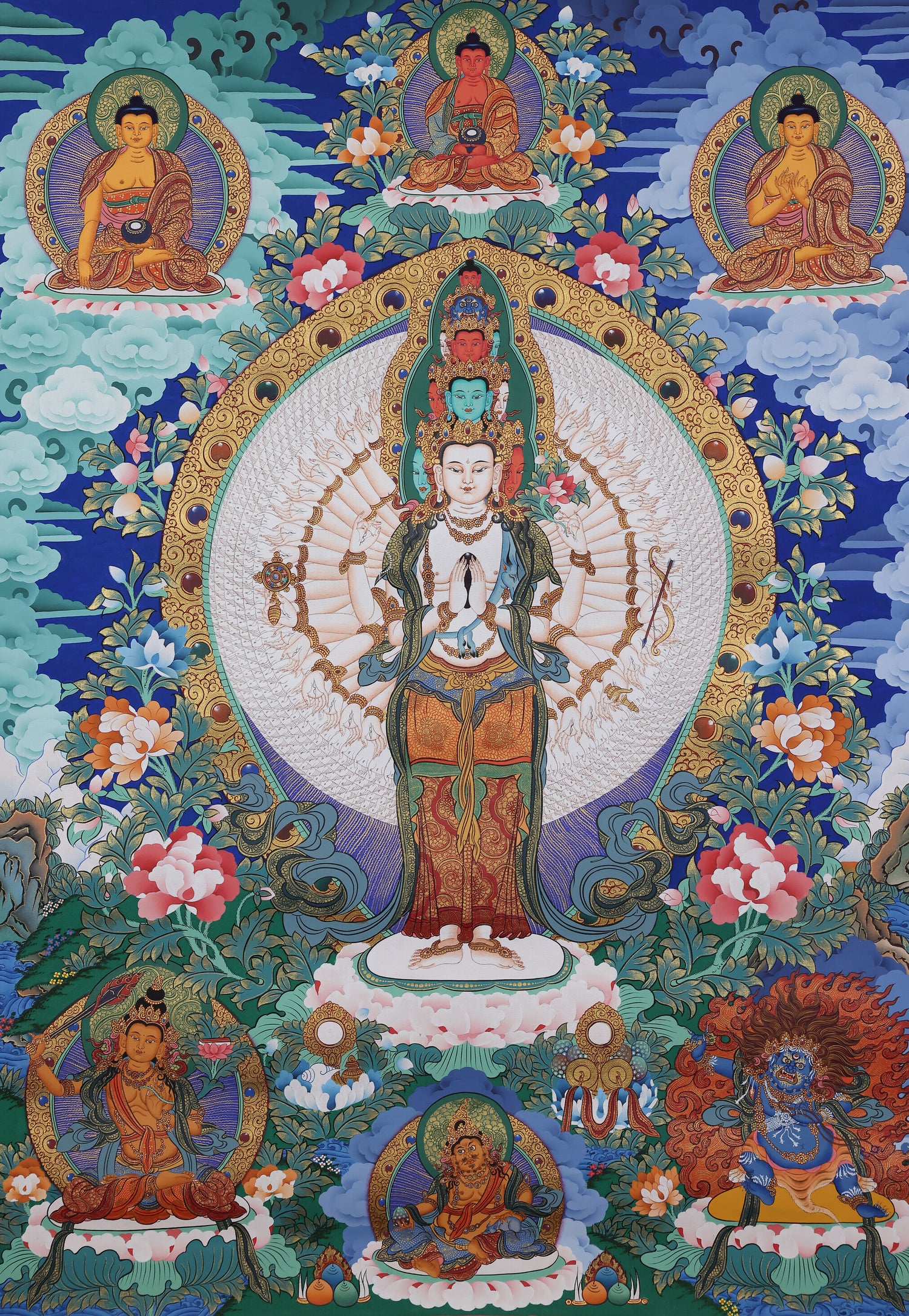
When a vivid, intricately detailed hand-painted Nepalese Thangka unfolds before your eyes, it is more than just an art collection; it is a "mobile Buddhist shrine" in Tibetan Buddhism—carrying millennia of religious wisdom, regional culture, and artisanal skill. Today, we focus on a 50x70cm "color Thangka of Yellow Jambhala," unpacking the dual essence of Tibetan Buddhist wealth philosophy and Nepalese Thangka art from theme, main deity, attendants, to craftsmanship.
I. Theme: The Materialized Vow of "Merit and Virtue Resources" in Tibetan Buddhism
In the context of Tibetan Buddhism, "wealth" is not mere secular material accumulation but the tangible carrier of "merit and virtue resources"—this is the core theme of this Yellow Jambhala Thangka.
Yellow Jambhala (Tibetan: "Zangla Serpo") is the central deity among the "Five Wealth Gods." Originating as a bodhisattva who vowed to liberate the poor, he later manifested as a form of the "Vaiśravaṇa" (one of the Four Heavenly Kings) with the function of bestowing treasures. The theme of this Thangka is essentially the embodiment of Tibetan Buddhism’s concept that "wealth is a favorable condition for practice": it safeguards the stability of sentient beings’ material lives (alleviating poverty, smoothing careers) while supporting their spiritual cultivation (using wealth as a resource for almsgiving and supporting the Three Jewels).
As a Nepalese work, it also integrates the local secular longing for "the coexistence of wealth and auspiciousness"—its vibrant colors and rich composition balance religious vows with life’s aspirations, making it a spiritual bridge between the sacred and the secular.
II. Main Deity: Yellow Jambhala – Every Detail Is a "Sacred Code" of Tibetan Rituals
Yellow Jambhala’s form and ritual tools are not decorative; they are the materialization of Tibetan Buddhism’s "ritual language," with each detail bearing specific religious meaning:
1. Form: Symbols of Merit and Virtue
-
Bright Yellow Body: Corresponds to the "earth element" in Tibetan Buddhism’s "Five Elements," symbolizing the stable accumulation of wealth and the capacity to bear merit—just as the earth supports all things, Yellow Jambhala’s yellow form represents "wealth that does not dissipate easily and nourishes the resources for practice."
-
Five-Buddha Crown + Skull 璎珞 (Garland): The crown inlaid with jewels symbolizes "the wisdom blessings of the Five Dhyani Buddhas"; the combination of a skull garland and a jewel necklace is a signature ornament of Tibetan wealth gods: the skull represents "transcending attachment to life and death," while the jewels represent "perfect merit"—together, they embody the wisdom of "using secular wealth to break greed and move toward spiritual liberation."
-
Large Belly, Small Frame: This is not a "gluttonous appearance" but a "compassionate mandala that embraces all impoverished sentient beings"—it aligns with the practice logic that "a broad heart attracts good fortune," signifying that Yellow Jambhala can accommodate all of sentient beings’ needs and vows.
2. Ritual Tools: The Logic of Protection
-
Left Hand Holding the Treasure-Vomiting Rat: The gray-black rat with a jewel in its mouth materializes the idea that "almsgiving is the source of wealth"—the rat vomits treasures outward rather than hoarding them, representing the core of Tibetan wealth philosophy: "Wealth is born from merit accumulated through almsgiving, not static possession."
-
Right Hand Holding the Cintāmaṇi (Wish-Fulfilling Jewel): The Cintāmaṇi is the "aggregate of merit and virtue resources," signifying that Yellow Jambhala can fulfill all good wishes of sentient beings—from material stability to wisdom growth, covering both life and practice.
-
Right Foot Treading on a White Conch: The conch symbolizes "retrieving treasures from the sea," signifying that Yellow Jambhala can gather hidden worldly wealth (such as career opportunities, karmic connections) and also implies the practice meaning of "using wisdom to understand the laws of wealth."
3. Posture and Aura: Constructing a Protective Field
-
Half-Lotus Posture (Ruyi Posture): The left leg is bent, and the right foot hangs down to tread on the conch, representing "free giving without rigid form"—Yellow Jambhala’s protection is not limited to religious rituals but is close to daily life.
-
Head Aura and Body Aura: The head aura (pink outer ring + white inner circle) represents compassion and purity; the body aura (black background + golden scrollwork) represents subduing obstacles and lasting merit—together, they construct a "sacred protective field" that covers the worshipper’s body and mind.
III. Attendant Deities: Building a Complete Wealth-Protection Matrix
The two deities of the same color as the main deity, located on the left and right below the Thangka, are Yellow Jambhala’s "two attendant deities," following the logic of the Tibetan Tantric "Mandala protection system":
-
Left Attendant: Its form and ritual tools are nearly identical to the main deity, representing "Yellow Jambhala’s self-manifestation"—signifying that the deity’s power can cover different times, spaces, and circumstances, so sentient beings can receive protection no matter their life situation.
-
Right Attendant: Wearing a white cloth with slightly different ritual tools, it is a "companion deity of the treasure-protection division"—responsible for "wealth enrichment in specific areas" (such as career, family, karmic connections), ensuring that vows cover all dimensions of material life.
Their configuration is not decorative but "the perfection of the wealth-protection field": the main deity represents "aggregate merit," while the attendants represent "segmented life," together forming a protection matrix from the whole to the details.
IV. Nepalese Color Thangka Craft: Artistic Commitment to Natural Mineral Pigments and Regional Aesthetics
This Thangka is a typical example of Nepalese "hand-painted color Thangka," infusing unique regional skills while adhering to Tibetan rituals:
1. Materials: The Sacredness and Durability of Natural Substances
-
Mineral and Earth Pigments: Pigments are derived from natural Himalayan minerals (such as lapis lazuli, malachite, cinnabar) ground manually to 5-20μm particles, mixed with 5-year-aged cowhide glue—their lightfastness lasts over 100 years, meeting the Thangka’s spiritual need for "eternity" while ensuring long-lasting vibrant colors; earth pigments are taken from local Nepalese clay, filling the background with a rustic texture.
-
Canvas Treatment: White cotton cloth is soaked in cowhide glue three times, stretched, and air-dried. Though simpler than the "multi-layer glue mounting" of Tibetan Thangkas, it still ensures flatness and stability, embodying Nepal’s "balance between practicality and craft."
2. Techniques: Artistic Expression Under Ritual Norms
-
Iconometric Proportions: Strictly following the "37:25 golden ratio" in the Iconometric Sutra—the main deity’s height, shoulder width, and ritual tool dimensions all comply with ritual standards, ensuring that "sacredness is not diluted by art."
-
Lines and Gradation: "Iron-wire line drawing" outlines the form (the details of the crown and garland showcase hand-painting skills), and "3-5 layer gradation" creates three-dimensionality—the smooth transition of the main deity’s bright yellow balances solemnity and vividness.
-
Golden Line Decoration: 24K gold paint outlines the crown and aura patterns, with a concentration controlled at 15-20% (smooth and non-peeling), highlighting the wealth god’s "prosperous authority" while aligning with Nepal’s tradition of "using gold to manifest sacredness."
3. Regional Style: Fusion of Religion and Local Aesthetics
-
Color Aesthetics: Unlike the "heavy and calm" Tibetan Thangkas, Nepalese color Thangkas feature "vibrant and bright" tones—the contrast between the main deity’s bright yellow and the background’s cyan-green and pink fits the wealth god’s "prosperous and bright" image, while also matching local preferences for "auspicious colors."
-
Pattern Fusion: Cloud patterns incorporate Hindu "scrollwork," and flowers draw on Nepalese "Lumbini lotus" and "Kathmandu peony"—retaining the Tibetan core while reflecting regional cultural characteristics.
-
Size and Function: 50x70cm is the mainstream size for Nepalese home worship, suitable for daily meditation in a shrine and small ritual ceremonies, achieving a balance between "religious function and secular practicality."
This Nepalese color Yellow Jambhala Thangka is a symbiosis of religious spirit, traditional craft, and regional culture: it conveys the wisdom that "wealth is a favorable condition for practice" through Yellow Jambhala’s form, carries millennia of skill through hand-painted mineral pigments, and connects the sacred and secular through its vibrant style. For worshippers, it is a carrier of vows for merit; for art enthusiasts, it is a living sample of Himalayan culture.
#Nepalese Yellow Jambhala Thangka #Color Thangka Craft #Tibetan Buddhist Thangka #Mineral Pigment Thangka #Thangka Art Analysis #Tibetan Wealth Philosophy #HandPaintedThangka #TraditionalThangkaArt #HimalayanArt #NaturalMineralPigmentArt #HomeAltarThangka #TibetanWealthGod #SacredArtifacts #CulturalHeritageArt #TibetanNepaleseArtFusion #SpiritualArt