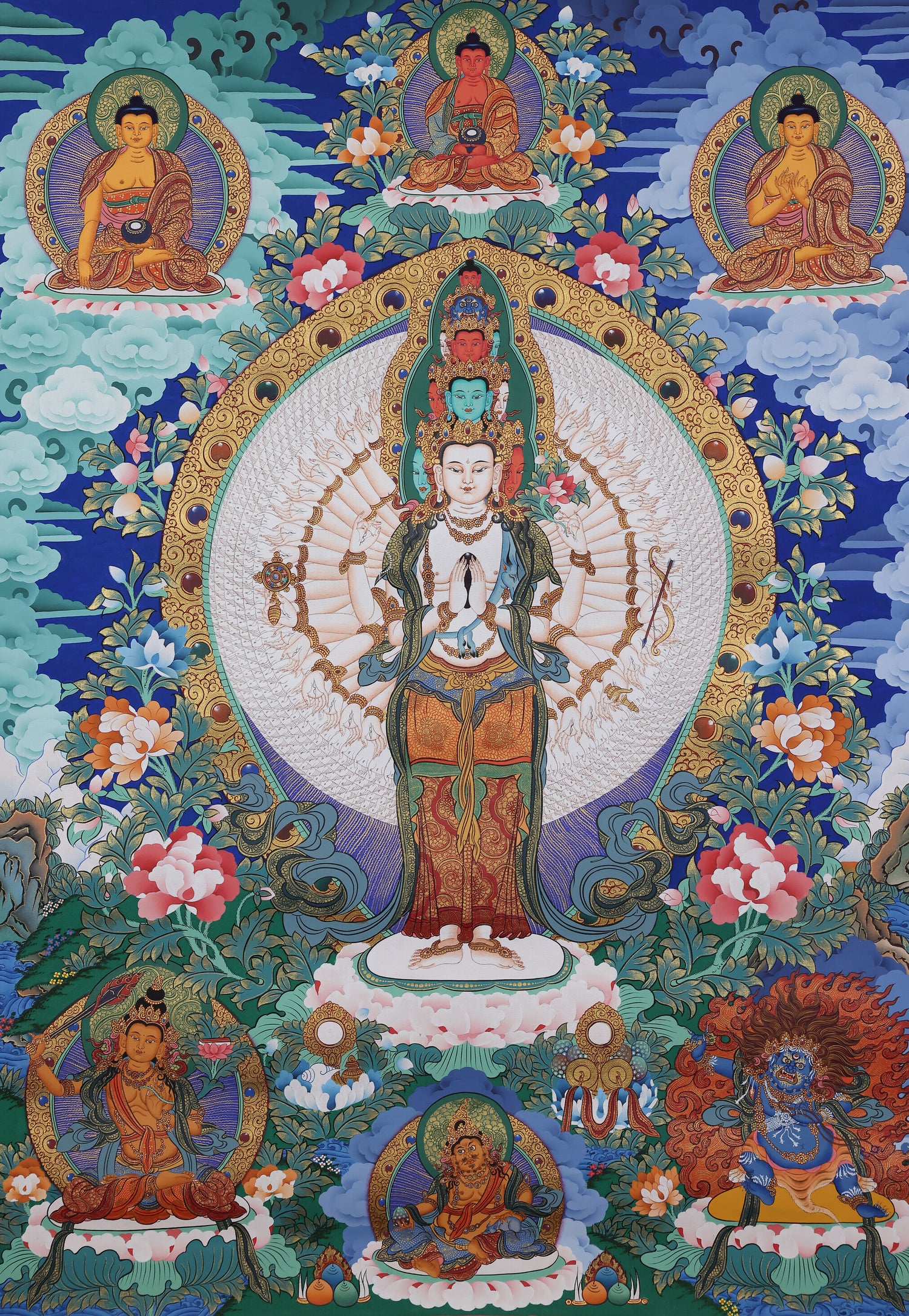
When a 20×30cm Nepalese Red Thangka of Green Tara is spread across your palm, what you touch is not just delicate mineral pigments and gilded lines, but the centuries-old fusion of Tibetan Buddhist compassionate faith and Nepalese Newari art. As a classic carrier of "portable protection + home worship" in Tibetan culture, every detail of this Red Thangka of Green Tara holds the deep logic of faith, craftsmanship, and aesthetics.
I. Red Thangka Green Tara: A Miniature Carrier of Tibetan Compassionate Faith
In the Tibetan Thangka system, "Red Thangka" is a iconic branch of colored Thangkas—using cinnabar-based mineral pigments as the base, it symbolizes "fiery compassion that awakens amid afflictions." Green Tara, meanwhile, is the most widely venerated female 本尊 (principal deity) in Tibetan Buddhism, known to believers as the "Deliverance Mother," an emanation of Avalokiteshvara’s compassionate heart.
The theme of this Thangka is not merely a "portrait of Green Tara," but a spiritual resonance of "Red Thangka’s blessing power + Green Tara’s deliverance nature": the reddish-brown base of the Red Thangka corresponds to the meaning of "awakening amid worldly afflictions," while Green Tara’s green form symbolizes "vitality and healing." Together, they embody believers’ wishes to "escape the Eight Calamities (lion, fire, etc.) and attain peace." The 20×30cm miniature size further integrates this compassionate faith into daily life—it can be placed in a portable shrine or adapted to small home altars, representing the "dailyization of faith" typical of small Nepalese Thangkas.
II. Principal Deity Green Tara: Deliverance Meanings in Form and Symbols
As the core of the Thangka, Green Tara’s iconography strictly adheres to the Iconometry Sutra, with every detail embodying "compassionate deliverance":
-
Form and Posture: The green body corresponds to the merits of "pacifying disasters and increasing blessings," echoing the legend that "Green Tara emerged from Avalokiteshvara’s compassionate tears"—the coolness and vitality of tears align with her trait of "delivering upon hearing a cry." She assumes the Ardhasana (Lalita Asana, half-lotus playful posture): the right leg is crossed on the lotus seat, while the left leg hangs down. Unlike the solemn full-lotus posture, this stance reflects the approachability of "adapting to sentient beings and delivering them as needed."
-
Mudras and Ritual Implements: The right hand forms the Varada Mudra (gesture of giving): palm facing outward, symbolizing "granting sentient beings fearlessness and ease." The left hand holds a Uttara flower stem—Uttara flowers represent "pure enlightenment," while the ribbon on the stem corresponds to "the fusion of emptiness and compassion."
-
Ornaments and Lotus Seat: Adorned with a Five-Buddha Crown and garlands, these are decorative features of a Sambhogakaya (reward body), representing perfect merit. She sits on a red lotus seat: the red lotus is not a mundane flower, but an "enlightenment lotus in the sea of afflictions," symbolizing Green Tara’s ability to protect sentient beings from defilement amid worldly troubles. The plump, layered petals are the Nepalese "prosperity lotus" style, signifying abundant blessings.
III. Implicit Attendants: Protective Symbols in Decorative Elements
This is a "solitary deity Thangka" with no concrete attendant deities, but protective power is carried through decorative elements:
-
Aura and Body Light: Behind the principal deity is a red circular body light (nimbus + aura), with an outer gilded scrollwork halo: the radiating gold lines within the body light symbolize "the deity’s light illuminating all sentient beings"; the scrollwork, a classic Newari art element, also alludes to the "precious garland" among the Seven Treasures, representing "enduring merit."
-
Offerings and Dharma Protectors: The surrounding red Gesang flower variants symbolize "worldly offerings of good intentions"; the red auspicious clouds at the top are implicit symbols of "dragon and celestial protectors"—in Tibetan culture, auspicious clouds are companion elements of Dharma protectors, signifying "the sacred space is guarded."
-
Bottom Symbols: The eight-spoked Dharma wheel represents Green Tara inheriting the Buddha’s compassionate teachings; the symbol below is a variant of the seed syllable of Green Tara’s mantra, signifying "the constant blessing of the deity’s mantra."
IV. Nepalese Hand-Painted Craftsmanship: Centuries-Old Heritage of Mineral Pigments and Newari Style
The "hand-painted" nature of this Thangka is no gimmick—it is a centuries-old technique inherited by Nepalese Newari artists:
-
Base Preparation: Cotton cloth is used as the base, coated with 3-5 layers of glue-alum water (cowhide glue + alum) to set it and prevent pigment penetration. Then, cinnabar (mineral mercury sulfide) mixed with glue is applied repeatedly to form the reddish-brown base—the core feature of Red Thangkas, ensuring long-lasting colorfastness.
-
Drafting and Coloring: A charcoal pencil outlines the design in accordance with the Iconometry Sutra, following the "three-segment body" ratio (head: torso: legs = 1:2:1). Green Tara’s green hue uses "malachite" (ground peacock stone), red uses cinnabar, and gold uses ground gold leaf powder. The "flat application + gradient dyeing" technique is employed, with subtle transitions from the brow to the jawline on the face—marking the "delicate three-dimensionality" of Nepalese Thangkas.
-
Gilding and Style: All decorative lines (halo, lotus petals, garlands) are gilded with a fine wolf-hair brush; the 20×30cm miniature size tests the artist’s control over brush pressure. The overall style blends Newari and Tibetan elements: Newari’s rich colors and intricate decorations ensure aesthetic appeal, while Tibetan iconographic norms uphold religious sanctity.
V. 20×30cm Miniature Thangka: Balancing Daily Faith and Aesthetics
This size is the "golden ratio" for small Nepalese Thangkas: it avoids the space constraints of large Thangkas, while fully presenting the principal deity’s iconography and auspicious symbols within a limited frame. The stability of mineral pigments allows long-term portable protection, and the exquisite Newari decorations make it a dual-value item as both a "faith carrier" and an "aesthetic ornament."
From the fiery compassion of the cinnabar base to the life-giving deliverance of the malachite form, this Nepalese Red Thangka of Green Tara is a miniature crystallization of Tibetan faith and traditional craftsmanship—it is more than a painting; it is tangible compassion in believers’ daily lives, and a living sample of Nepalese artistic heritage.
#NepalRedThangkaGreenTara #HandPaintedMineralPigmentThangka #TibetanBuddhistThangkaAnalysis #NewariStyleThangka #MiniatureThangkaCulture #GreenTaraRedThangka #HandmadeNepaleseThangka #NaturalMineralPigmentArt #TibetanBuddhistArtwork #ThangkaCulturalHeritage #PortableTibetanThangka #TraditionalNepaleseArt