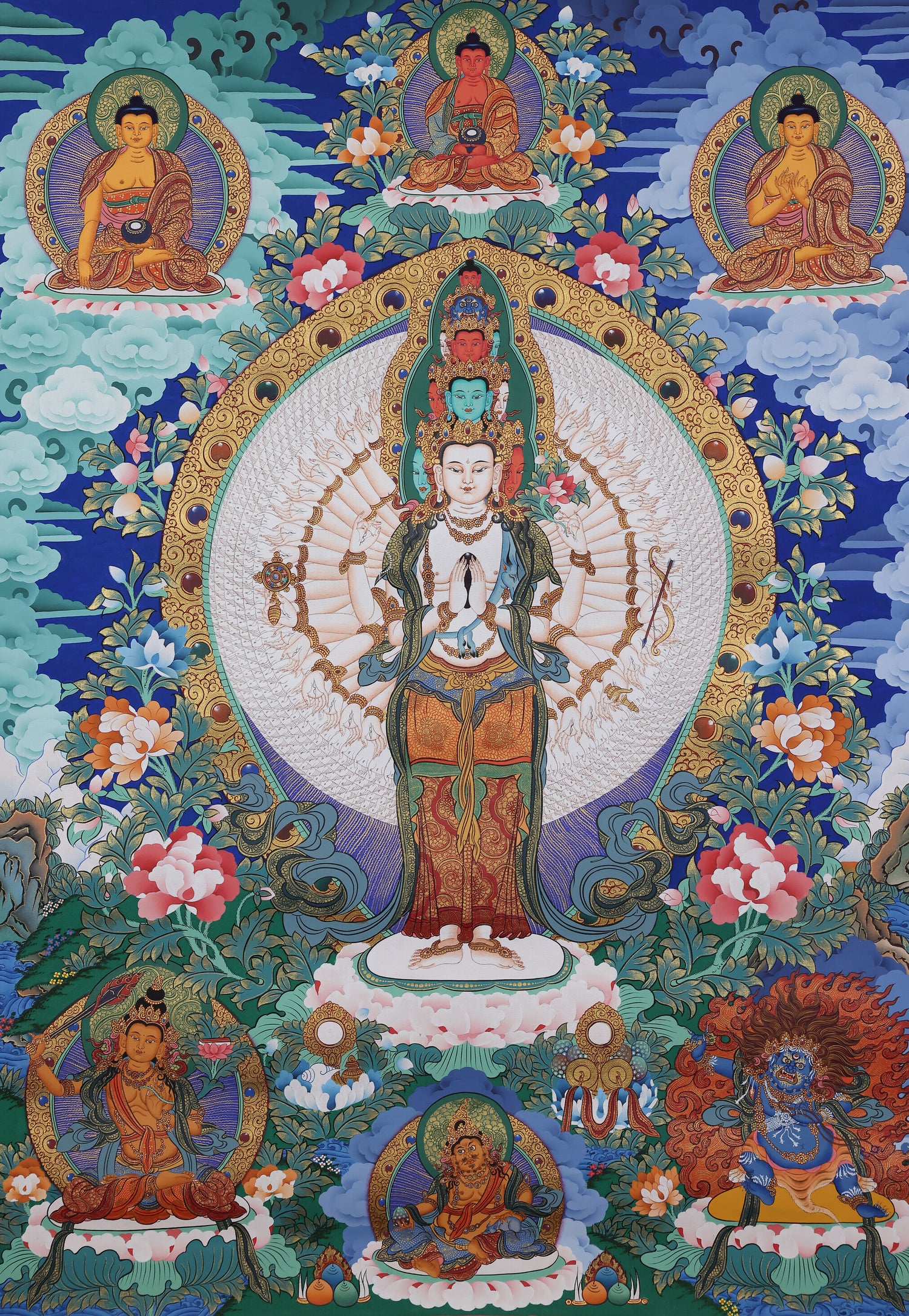
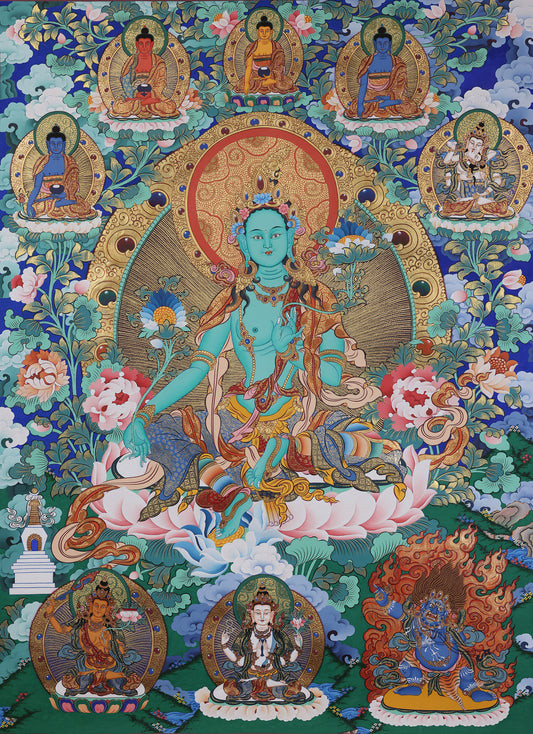
In the spiritual carriers of Tibetan Buddhism, thangkas are called "mobile Buddhist shrines"; among them, Nepalese color thangkas, with their vivid hues and rigorous ritual iconography, stand out as a highly distinctive school of Tibetan thangka art. Today, we focus on a 50x70cm hand-painted Nepalese Color Thangka of Vairocana Buddha: using natural mineral and earth pigments as its medium, it is both a visual expression of the "pervasive dharmadhatu" doctrine in Tibetan Esoteric Buddhism and a condensation of millennia-old Nepalese thangka craftsmanship.
I. Core Theme: The Esoteric Meaning of "Non-Duality of Sentient Beings and Buddhas" in Vairocana of the Garbhadhatu Mandala
Tibetan Esoteric Buddhism embodies universal truth as the "mandala," and the core theme of this thangka is the dharmakaya manifestation of Vairocana Buddha—the central deity of the Garbhadhatu Mandala.
Vairocana Buddha (known as "Vairocana" in Tibetan, meaning "pervasive radiant light") corresponds to the "Dharmadhatu Wisdom" in Esoteric Buddhism: this is the ultimate essence of all phenomena—the unborn, undying, and all-pervading dharmadhatu (realm of dharma). The core meaning of the Garbhadhatu Mandala is "the inherent bodhicitta (enlightenment mind) of all sentient beings"; as the central deity, Vairocana Buddha is the "manifestation of the essence of bodhicitta."
Thus, this thangka is not a "worldly incarnation of the Buddha," but a visual unification of "dharmadhatu truth" and "the inherent Buddhahood of sentient beings": through visualizing this iconography, practitioners can attain the state of "non-duality of sentient beings and Buddhas"—one of the core meditation logics of Tibetan Esoteric Buddhism.
II. Iconography of the Main Deity: A Symbol System of Dharmadhatu in Ritual Rules
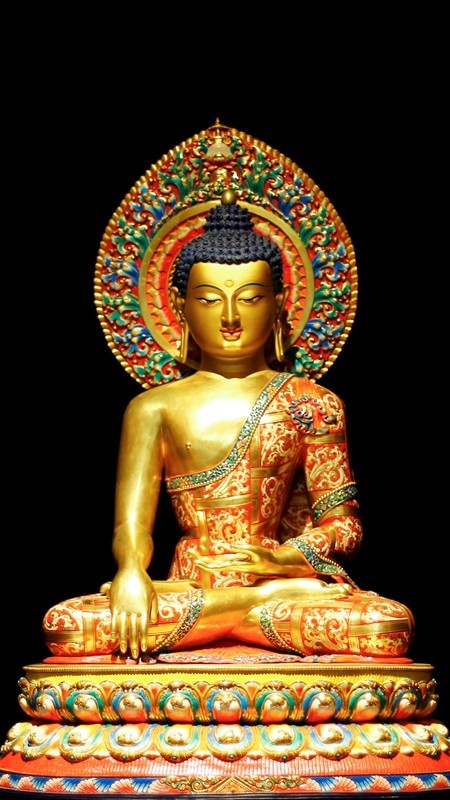
Vairocana’s iconography strictly adheres to the ritual iconographic rules of the Iconometric Sutra of Buddha Images, with every detail serving as a symbol of "expressing Dharma through forms":
1. Body Proportions: The Language of Order in Esoteric Buddhism
The main deity follows the "120-finger body measurement" standard: measured in units of its own fingers, the total body length is 120 fingers, the ushnisha (cranial protuberance) is 4 fingers high, the facial wheel is 12.5 fingers in vertical length, and the earlobes are 5 fingers long. These precise measurements are not aesthetic requirements:
- The prominent ushnisha symbolizes "perfect wisdom";
- The 规整 facial wheel represents "dharmadhatu order";
- The long earlobes signify "boundless merit and virtue."
2. Posture and Lotus Throne: A Metaphor from Samsara to Enlightenment
The main deity rests in the full-lotus position on a thousand-petal lotus throne: the soles of the feet face upward, a symbol of "subduing afflictions and abiding in samadhi (meditative concentration)"; the throne is a "thousand-petal treasure lotus," with petals gradient from orange-red to pale white—in the Garbhadhatu Mandala, the thousand-petal lotus represents "the inherent bodhicitta of sentient beings," and the Buddha seated upon it implies "the dharmakaya manifests from the good roots of sentient beings."
3. Dharmacakra Mudra: Visualizing Non-Duality of Sentient Beings and Buddhas
The main deity forms the Dharmacakra Mudra (Vairocana Mudra): the right palm rests upward on the left palm, with the thumbs touching. This mudra is the iconic symbol of Vairocana in the Garbhadhatu Mandala:
- The five fingers of the right hand represent the "five great elements (earth, water, fire, wind, space) of the Buddha realm";
- The five fingers of the left hand represent the "five great elements of the sentient being realm";
- The overlapping palms symbolize "non-duality of sentient beings and Buddhas," while the touching thumbs signify "the unobstructed unity of the space element."
4. Halo and Robes: Unity of Light and Compassion
The nimbus (head halo) is a circular yellow aura, symbolizing "wisdom light pervading the dharmadhatu"; the mandorla (body halo) is a large mandala-style aura, edged with "Eight Auspicious Symbols" (dharma wheel, conch, etc.): the dharma wheel represents "the continuous turning of the dharma wheel," and the conch symbolizes "the auspiciousness of the Buddha’s teachings."
The main deity wears a robe with the right shoulder exposed: the uncovered right shoulder signifies "unreserved compassion for sentient beings," and the ochre-red base with golden patterns reflects the purity of a renunciate while metaphorically uniting "compassion (ochre-red) and wisdom (gold)."
III. Attendant and Symbolic Elements: The Tibetan Logic of "Expressing Dharma Through Forms"
This is a "single-deity thangka" that does not directly depict attendant deities; instead, it carries "attendant meanings" through symbolic elements—a typical technique in Tibetan thangkas:
-
Flowers and Vegetation: The pink "auspicious peonies" on either side of the main deity represent "the maturation of sentient beings’ good roots," while buds and branches symbolize "good roots awaiting nourishment"; the lush "Wish-Fulfilling Tree" in the background is the "Tree of Merit," implying "the Dharma, like a tree, nurtures sentient beings to bear the fruit of enlightenment."
-
Auspicious Clouds and Sea Water: The yellow "auspicious clouds" at the top symbolize "auspiciousness covering the dharmadhatu"; the sea water beneath the lotus throne represents "the sea of afflictions," and the lotus seated above it is a metaphor for "the Buddha delivering sentient beings from the sea of suffering."
-
Seven Treasures of the Universal Monarch: The treasure banner, vase, and other "Seven Treasures of the Universal Monarch" at the bottom of the thangka are symbols of "worldly and transcendental perfection": the golden wheel treasure represents "dharmadhatu authority," and the wish-fulfilling gem symbolizes "fulfilling sentient beings’ aspirations," echoing Vairocana’s "dharmadhatu perfection."
IV. Nepalese Color Thangka Craft: Millennia-Old Mineral Pigment and Handicraft
The craft of this thangka is a classic example of Nepalese color thangkas—combining religious rigor with artistic agility:
1. 12 Traditional Processes: Devotion from Canvas to Face-Painting
-
Canvas Preparation: Cotton cloth is soaked in cowhide glue 3 times, stretched taut, coated with a gypsum-tibetan glue base, and repeatedly polished to ensure uniform pigment adhesion;
-
Mineral Grinding: Minerals such as cinnabar (mercury sulfide) and azurite (blue copper ore) are ground to 5-20μm particles, with lapis lazuli ground to less than 10μm for a royal blue hue, boasting lightfastness of over 100 years;
-
Pigment Mixing: Mineral powder is blended with 5-year-aged cowhide glue in a 3:1 ratio—aged glue improves ductility by 50% to prevent pigment embrittlement;
-
Face-Painting Ritual: The face is painted last, with eyebrow curvature and subtle smile strictly adhering to rituals—this step is regarded as the core link to "infuse spiritual vitality into the thangka."
2. Stylistic Markers of Nepalese Color Thangkas
Unlike the solemn gravity of Tibetan thangkas, Nepalese color thangkas have distinct traits:
-
Color Palette: Dominated by warm tones like ochre-red and gold, with high saturation and strong contrast, balancing vibrancy and warmth;
-
Lines: Delicate and fluid, with dynamic folds in the robe—maintaining rigorous iconometric proportions while exuding "agile softness";
-
Gold Work: Using 24K gold leaf ground into powder, with gold ink concentration of 15-20% and gold lines precisely 0.15mm ± 0.02mm thick—the radiant texture reinforces the "symbol of light."
3. Cultural Value of Natural Pigments
This thangka uses mineral and earth pigments: cinnabar offers rich, bacteriostatic hues; azurite conveys calm solemnity; earth yellow adds warmth—natural pigments are not only color-stable but also align with Tibetan Buddhism’s belief that "pure materials correspond to a pure mind."
V. Dual Cultural Identity: Meditation Tool and Living Art Heritage
This 50x70cm thangka carries dual value:
- As a meditation ritual tool: It serves as a visualization aid for Tibetan Esoteric practitioners, helping them attain the state of "non-duality of sentient beings and Buddhas";
- As a living artistic heritage: It preserves millennia-old Nepalese thangka craftsmanship, embodying intangible cultural heritage in tangible form.
When you gaze at this thangka, you see not just a hand-painted work, but the dharmadhatu logic of Tibetan Esoteric Buddhism and the devotional craftsmanship of Nepalese artisans—it is the perfect fusion of spiritual doctrine and artistic aesthetics.
#NepaleseColorThangka #VairocanaBuddhaThangka #TibetanBuddhistThangka #MineralPigmentThangkaCraft #ThangkaIconographyAnalysis #NepaleseHandpaintedThangka #TibetanEsotericArt #NepaleseTraditionalCraft #BuddhistSpiritualArt #PureHandpaintedNepaleseThangka #DharmakayaVairocana #NaturalPigmentArtwork #BuddhistRitualThangka #GarbhadhatuMandalaArt