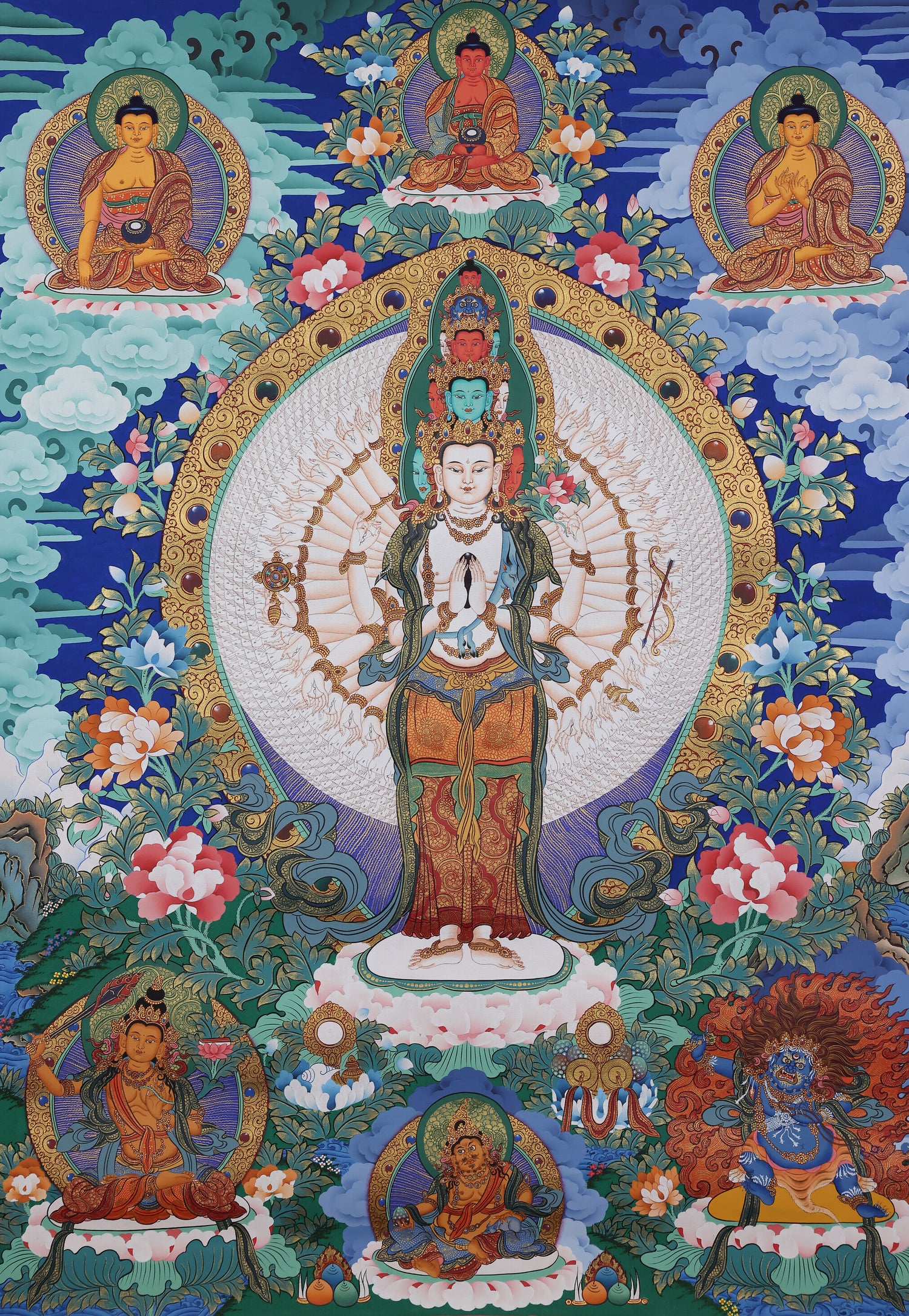
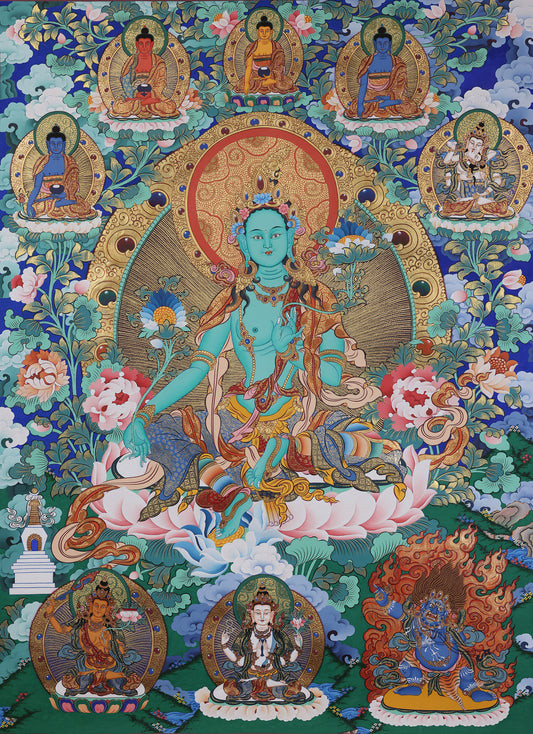
In the cultural lineage of Tibetan Buddhism, thangkas are more than just paintings—they are "mobile temples" connecting the secular and the sacred. Red Thangkas from Nepal, in particular, are a branch that carries both the weight of faith and the warmth of art. Today, we delve into a 45×60cm hand-painted Red Thangka of Amitabha Buddha: cinnabar as its base, minerals as its colors, Newari craftsmanship as its framework, and Tibetan faith as its soul—every stroke holds the code of a millennium-old culture.
1. Core Theme: Western Pure Land Reception in Cinnabar Undertones
In Tibetan Buddhism, "Red Thangka" (referred to as 玛唐 in Tibetan) is not merely a color category, but a unity of faith and form. This thangka uses cinnabar as its base, a choice rooted in the deep interweaving of Tibetan color philosophy and Pure Land belief:
Cinnabar is ground from cinnabar ore (mercuric sulfide) in the Himalayas. In Tibetan Vajrayana Buddhism, red corresponds to "Compassionate Attraction Practice" (a ritual focused on benevolent guidance) and symbolizes the vow power of Amitabha Buddha as the "Buddha of Infinite Light." As recorded in the Sutra of Contemplation on Amitayus Buddha, Amitabha 接引 (guides) sentient beings to the Western Pure Land with "light that illuminates all worlds"; the intense red of cinnabar is the visual embodiment of this vow power.
For Newari painters in Nepal, creating a Red Thangka is itself a practice: they moisten brushes with their mouths when blending cinnabar, and ingesting trace amounts of the toxin is seen as a confirmation of "aligning with the Buddha’s vows." This 45×60cm medium-sized thangka was never just a work of art—it is a "spiritual ritual object" for personal visualization: believers gaze at the Red-Bodied Amitabha Buddha, visualize the solemnity of the Pure Land, accumulate "merit for rebirth," and achieve the core Pure Land aspiration of "meeting the Buddha when the lotus blooms."
2. Decoding the Main Deity: Features and Vow Power of the Red-Bodied Amitabha Buddha
The central deity in the painting is "Amitayus Buddha" (the sambhogakaya form of Amitabha Buddha) in Tibetan Buddhism. Its image adheres to the rules of the Iconometric Sutras while incorporating the rustic traits of Newari art:
-
Form and Posture: The entire body is cinnabar red, corresponding to the luminous nature of the "Buddha of Infinite Light"; it sits in full lotus position on a thousand-petaled lotus throne— the plump, layered petals are a classic example of the Newari School’s "rounded 造型 (form)," and "lotus rebirth" is the core symbol of the Western Pure Land, signifying sentient beings’ liberation from samsara and pure rebirth.
-
Auspicious Features: The cranial protuberance (ushnisha) atop the head symbolizes the Buddha’s perfect wisdom; the white hair tuft (urna) between the brows represents light illuminating all directions; the downward-gazing eyes hold a "compassionate meditative expression." This "square-faced, solemn-featured" form not only follows the "32 Auspicious Marks and 80 Secondary Characteristics" of Tibetan Buddhist icons but also differs from the "slender, serene" style of Tibetan local thangkas, embodying the rustic solemnity of Newari art.
-
Mudra and Implements: The hands form the Dhyana Mudra (meditation gesture), holding a bowl of nectar at the abdomen—this is Amitabha Buddha’s iconic posture: the Dhyana Mudra symbolizes the eternal stillness of the Pure Land, while the nectar in the bowl signifies "purifying afflictions and guiding rebirth," a core symbol of Pure Land belief.
-
Robes and Patterns: It wears a monastic robe exposing the right shoulder, with intricate scrollwork and lotus patterns outlined in gold powder. Newari painters use the "gold-engraving technique," carving patterns into gold leaf to enhance three-dimensionality; the gold also metaphorizes the Buddha’s "merit and dignity," echoing Tibetan Buddhism’s belief that gold is the "color of celestial treasures."
3. Retinue Deities: The Sacred Assembly of the Western Pure Land
The main deity is not isolated; the elements below and around it jointly construct the "sacred scene" of the Western Pure Land:
-
Attendant Bodhisattvas: The standing figures (yellow-bodied on the left, blue-bodied on the right) are Amitabha Buddha’s retinue. While the traditional "Three Saints of the West" in Tibetan Buddhism include White-Clad Guanyin and Red-Clad Mahasthamaprapta, this thangka adopts Newari-style "color adaptation": the yellow body corresponds to "Increasing Activity" (growth of blessings and wisdom), and the blue body corresponds to "Pacifying Activity" (calming afflictions). Both hold blue lotuses— in Tibetan Buddhism, blue lotuses symbolize "purity untainted by afflictions," perfectly aligning with the "unstained solemnity" of the Pure Land.
-
Background and Offerings: The deity’s halo is "double-radiating" (inner red circular light, outer golden body light); the surrounding scrollwork and lotus buds are "decorative symbols" of Newari art, metaphorizing the "rows of treasure trees" in the Pure Land. The incense burner and lotus lamp below correspond to the "jeweled ponds and merit waters" described in the Amitabha Sutra; the white birds (likely peacocks) on either side of the base blend Nepalese local beliefs with Buddhist symbols, representing "auspiciousness and purity."
4. Craftsmanship: Millennium-Old Heritage in Mineral Pigments
The "mineral + earth pigments" used in this thangka are the core of its "enduring vibrancy"—every color is a dialogue between nature and ingenuity:
-
Pigment Selection and Production:
-
Cinnabar Base: Cinnabar ore from the Himalayas is processed via "white wine washing → stone grinding → water-floating stratification"—the finest cinnabar powder (from the top layer) requires over 48 hours of repeated grinding, and the Red Thangka base needs 15+ layers of color stacking to achieve a rich, uniform red.
-
Auxiliary Colors: Blue is derived from azurite (stone blue), divided by density into "first blue (dark), second blue (medium), third blue (light)"; yellow comes from realgar (stone yellow), purified through multiple processes to ensure color stability.
-
Gold Craftsmanship: The "gold leaf beating + honey blending" technique is used—gold leaf is beaten to a paper-thin consistency and blended with honey (a traditional Nepalese binder) to preserve luster and prevent oxidation.
-
Painting Process:
It follows the millennium-old sequence: "line drawing → color filling → gold outlining → face opening":
- First, wolf-hair brushes outline the form per the Iconometric Sutras (with an error margin of less than 1mm).
- Next, the "gradual layering method" applies 20+ layers of color.
- Finally, gold powder outlines patterns, and "face opening" (the final stroke on the Buddha’s face, regarded as a ritual to "infuse spirituality") is completed.
The entire process takes 1–2 months, embodying the Newari painters’ devotion to "infusing life into the painting."
5. Stylistic Origins: The Fusion of Newari and Tibetan Art
This thangka belongs to Nepal’s classic "Newari School of Painting," whose style is a symbiosis of "classical tradition and Tibetan ritual rules":
-
Core Traits of the Newari Style:
- Form: The figure’s head-to-body ratio is ~1:5, with soft, rounded limb lines—differing from the "slender and upright" style of Tibetan thangkas, it exudes rustic warmth.
- Decoration: Intricate, detailed patterns use "three-dimensional rendering" (with subtle perspective), distinguishing it from the "flat decoration" of Tibetan thangkas.
- Color Palette: Warm tones dominate, with strong contrast between red and gold—aligning with Tibetan "sacred color spectra" while continuing Nepal’s local aesthetic of "vibrant opulence."
-
Fusion of Newari and Tibetan Art:
After the Newari School spread to Tibet with Princess Bhrikuti in the 11th century, it merged deeply with Tibetan art—this thangka adheres to the ritual rigor of the Tibetan
Iconometric Sutras while retaining the Newari art’s "rich decoration and rustic form," making it a living modern specimen of "Newari-Tibetan cultural fusion."
Conclusion: More Than Art—A Living Carrier of Faith
This 45×60cm Nepalese Red Thangka of Amitabha Buddha is more than a hand-painted work: it is a "visualization ritual object" for Tibetan Pure Land belief, a "living heritage" of Newari art, and a "specimen" of Newari-Tibetan cultural fusion. When we gaze at its cinnabar base and gold-lined lotus petals, we see not just colors and lines, but the warmth of Tibetan faith, the depth of Newari craftsmanship, and the cross-millennial resonance of culture.
#NepalRedThangkaAmitabha #NewariSchoolThangkaAnalysis #TibetanBuddhistThangkaCulture #MineralPigmentHandpaintedThangka #RedThangkaCraftAndFaith #HandmadeNepaleseThangka #PureLandBuddhismArt #TraditionalNewariPainting #CinnabarBaseThangka #SpiritualTibetanArtifacts #MillenniumOldThangkaCraft #ArtOfTibetanBuddhistThangkas #MineralPigmentArt