Yellow Jambhala in Tibetan Buddhism: More Than Wealth Attraction – The Wisdom of Blessings in Symbolism, Worship, and Practice

Walking along the circumambulation path of Barkhor Street in Lhasa, you’ll often spot a golden-hued icon hanging from pilgrims’ robes or placed on temple altars: a figure with a rounded belly, holding a small treasure-spitting creature in his left hand and a glowing gem in his right. This is Yellow Jambhala—the most widely recognized "wealth protector" in Tibetan Buddhism.
Most people first encounter Yellow Jambhala through the label of "attracting wealth," but in the orthodox context of Tibetan Buddhism, he is far more than a "god of wealth": he is a great protector of the poor, a bridge between worldly provisions and transcendental merit, and a carrier of life wisdom centered on "using wealth as a path to enlightenment."
I. The Identity of Yellow Jambhala: A Millennium of Fusion from Indian Deity to Tibetan Protector
Yellow Jambhala is called "Zangla Serpo" in Tibetan and "Jambhala" in Sanskrit. His faith roots trace back to the dual fusion of ancient Indian and Tibetan cultures.
1. Prototype: The Buddhistization of an Indian Wealth God
His prototype is Kubera, the wealth god of ancient Hinduism—a yaksha deity who guarded celestial treasures. Later, he was incorporated into the Buddhist protector system and given a new role: "guarding the spiritual provisions of practitioners." Buddhist scriptures record that when Shakyamuni Buddha preached the Great Prajñāpāramitā Sūtra at Vulture Peak, demons stirred up landslides and earthquakes. Yellow Jambhala manifested as a protector, standing forward to shield the listening monks. Grateful for his merit, the Buddha instructed him: "Protect all poor sentient beings, so that practitioners do not suffer from a lack of provisions"—thus he became a great Buddhist protector.
2. Tibetan Localization: Head of the Five Jambhala Deities
After spreading to Tibet, Yellow Jambhala merged with local mountain god beliefs and integrated into the Five Dhyani Buddha system: he is an emanation of Ratnasambhava (the Southern Dhyani Buddha), and together with White Jambhala (emanation of Avalokiteśvara), Red Jambhala (emanation of Amitābha), Green Jambhala (emanation of Amoghasiddhi), and Black Jambhala (emanation of Akṣobhya), he forms the "Five Jambhala Deities," ranking first among them.
From the murals of the Alxa Grottoes in the Yuan Dynasty to contemporary Thangkas, Yellow Jambhala’s image gradually localized: early icons carried the majesty of Indian yakshas, while later versions incorporated Tibetan aesthetics—adorned with jewels and garlands, accompanied by Tibetan flowers—becoming a widely worshipped protector across all major Tibetan Buddhist schools (Gelug, Sakya, Nyingma).
II. The Symbolic Code of the Colored Thangka Iconography: Every Detail is a Metaphor for Blessings
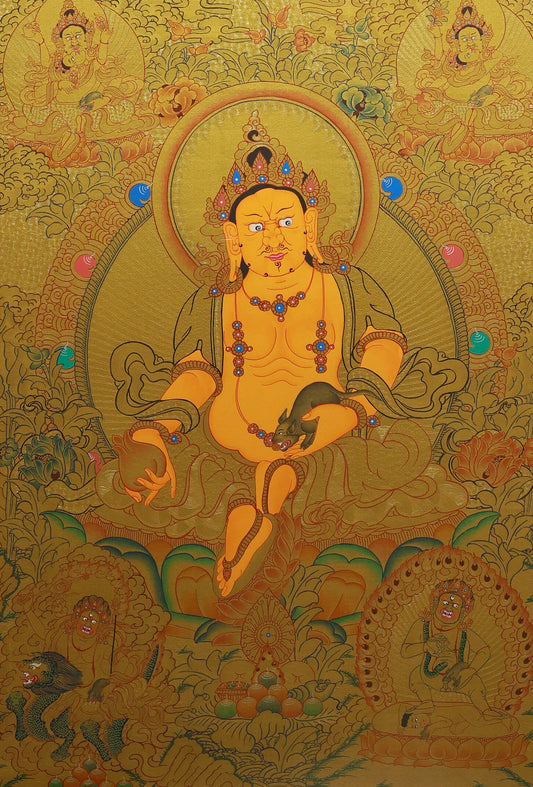
The colored Thangka you provided is a classic paradigm of Yellow Jambhala’s iconography in Tibetan Buddhism—every color, ritual implement, and posture hides wisdom metaphors from the Tantras:
1. Body Color and Appearance: A Vessel of Inclusive Blessings
- Golden body color: Corresponding to the "earth" element in the five elements, it symbolizes wealth as broad and stable as the earth—not fleeting windfall, but spiritual provisions of merit that nourish both life and practice.
- Large belly, small frame: This is not a sign of "gluttony," but a symbol of compassionate 包容 for the poor, aligning with the Tibetan proverb: "A broad heart attracts blessings."
- Five-Buddha Crown: The crown adorned with five Buddha images symbolizes the wisdom blessings of the Five Dhyani Buddhas, meaning wealth must be guided by wisdom, not blind greed.
2. Ritual Implements: More Than "Wealth-Attracting" Symbols
- Treasure-spitting rat in the left hand: This small creature is not a rat, but an Indian mongoose—a predator of snakes (ancient Indian guardians of wealth), symbolizing "subduing the karma of stinginess." It spits out treasures not as "unlimited gifts," but as a metaphor for "generosity as the source of wealth": sharing outward is the true flow of abundance.
- Wish-fulfilling gem in the right hand: Also called the "Cintāmaṇi," it symbolizes "fulfilling the reasonable virtuous wishes of sentient beings"—not indulging greed, but supporting life’s needs and spiritual provisions.
- Right foot on a conch: The 右旋 conch was originally a ritual implement of ancient Indian war gods; in Buddhism, it symbolizes "proclaiming the Dharma." Here, it implies Yellow Jambhala "can retrieve treasures from the ocean floor," meaning he can break through the "deep sea of karmic poverty."
3. Thangka Composition: A System of Complete Blessings
The two attendant figures below the main icon are Yellow Jambhala’s subordinates, "minor wealth protectors"—together with the main deity, they form a "wealth protector system," symbolizing "the perfection of five blessings (good fortune, status, longevity, joy, wealth)" rather than mere material abundance.
III. The Core Meaning of Yellow Jambhala: Wealth as "Provision," Not "Goal"
In Tibetan Buddhism, "wealth" is defined as "provisions"—divided into "worldly provisions" (food, clothing, shelter, transportation) and "spiritual provisions" (merit, wisdom). Yellow Jambhala’s blessings are never "granting wealth out of thin air," but helping sentient beings:
- Eliminate the karma of poverty: Purify the karmic seeds of poverty (such as stinginess and theft).
- Grow merit: Accumulate good causes through generosity and precept-keeping, so that wealth comes "with favorable conditions."
- Settle the mind on the path: Prevent practitioners from abandoning Bodhicitta due to life hardships, allowing them to support the Dharma and benefit sentient beings in a state of abundance.
The Yellow Jambhala Mantra Sūtra clearly states: "If a practitioner generates the supreme Bodhicitta and uses wealth to give to sentient beings, their merit will be immeasurable; if they hoard wealth for themselves, even reciting the mantra will bring no blessings." This is the core of Yellow Jambhala’s faith: wealth is a "tool," not an "end"; using wealth virtuously is the best worship of him.
IV. Orthodox Worship and Practice: More Than "Offering Goods," It’s "Cultivating the Mind"
Most people limit their worship of Yellow Jambhala to "placing fruits and burning incense," but orthodox Tibetan Buddhist rituals involve the simultaneous practice of "body, speech, and mind":
1. Daily Offerings: Simple but Pure
No elaborate offerings are needed—purity is key:
- Basic offerings: Offer 3 cups of clean water (representing the purity of body, speech, and mind), 青稞 /rice grains (symbolizing harvest), and fresh flowers (symbolizing good causes) daily.
- Altar placement: Place in a clean area of the shrine, avoiding placement with meat, fish, or clutter.
- Ritual: Wash hands and rinse the mouth before offering, recite the Yellow Jambhala mantra ("Om Jambhala Jalendraye Svaha"), and visualize the offerings transforming into a rain of treasures, given to all poor sentient beings.
2. Mantra Recitation: From "Seeking Wealth" to "Cultivating Merit"
The Sanskrit transliteration of Yellow Jambhala’s mantra is "Oṃ Jambhala Jalendrāye Svāhā," pronounced in Chinese as "Om Zanbala Zhalian Daye Suoha." Each phrase carries meaning:
- "Om": Invokes the blessings of the Dharma realm.
- "Jambhala": The name of Yellow Jambhala, meaning "holder of treasures."
- "Jalendraye": "Lord of Abundance."
- "Svaha": Fulfill all virtuous wishes.
Recitation tips: Recite 108 times or more daily. While reciting, visualize "golden light emanating from your heart, transforming into treasures given to sentient beings"—not "seeking wealth for yourself," but "wishing all sentient beings to escape poverty." This is the embodiment of Bodhicitta.
3. Practice Boundaries: Respect Lineage, Avoid Blind Practice
- Yellow Jambhala belongs to Tantric protectors; advanced rituals (such as fire offerings and mudras) require a guru’s lineage transmission—do not self-study.
- School-specific practice differences: The Gelug school emphasizes "Madhyamaka right view" to avoid greed for wealth; the Nyingma school combines terma teachings, viewing wealth as a "magical play"; the Sakya school incorporates it into the "Path and Fruit Teaching" as a preliminary practice for accumulating provisions.
V. Contemporary Significance: Yellow Jambhala’s Wisdom is a Life View of "Using Wealth as a Path to Enlightenment"
Today, Yellow Jambhala’s icons appear on young people’s bracelets and phone cases, but they are often reduced to "wealth-attracting symbols"—this precisely overlooks his core wisdom:
- Right view of wealth: Wealth is not a "measure of success," but the "ability to care for oneself and help others."
- Awareness of desire: The treasure-spitting rat’s symbol of "spitting without hoarding" reminds us: "Hoarding brings anxiety; sharing brings abundance."
- Balance in life: Yellow Jambhala’s "large belly" teaches us to tolerate life’s hardships, face circumstances with a broad heart, and accumulate merit with kind intentions.
The next time you see a Yellow Jambhala icon, set aside a little of the "utilitarian desire for wealth" and add a little of the kind intention: "May all sentient beings be abundant." This is his true blessing: not giving you a mountain of gold, but teaching you to use wealth as a boat, sailing toward the shore of merit that benefits both yourself and others.
#YellowJambhalaInTibetanBuddhism #MeaningOfYellowJambhala #YellowJambhalaWorshipMethods #YellowJambhalaMantra #FiveJambhalaDeitiesInTibetanBuddhism #TibetanThangkaArt #BodhicittaInBuddhism #TibetanBuddhistWealthProtector #BuddhistWealthWisdom #YellowJambhalaSymbolism #OrthodoxBuddhistWorshipRituals #TibetanBuddhistPractice #JambhalaInTibetanCulture
Tags:
Previous
Green Tara in Tibetan Buddhism: Compassion and Vitality in Red Thangka Iconography
Next
The Embodiment of Wisdom in Black-Gold Thangka: Manjushri in Tibetan Buddhism