Yellow Jambhala in Tibetan Buddhism: From Thangka Symbols to the Wisdom of “Using Wealth as a Path to Enlightenment”
wudimeng-Dec 23 2025-
0 comments
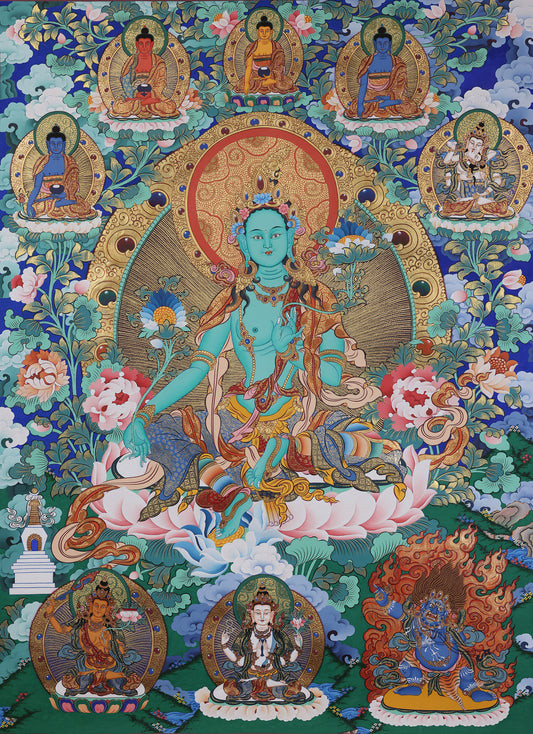
When you gaze at this Yellow Jambhala color Thangka, his golden form stands out vividly amid swirling clouds and lotus blooms: his belly is rounded yet his expression is dignified, his right hand holds a glowing wish-fulfilling jewel, a treasure-spitting rat (nakchhya) with jewels in its mouth curls around his left elbow, and his right foot rests on a snow-white conch—this is no ordinary “wealth-attracting painting,” but a cultural code of “harmony between worldly and transcendental realms” in Tibetan Buddhism. As the head of the Five Wealth Gods, Yellow Jambhala (Tibetan: Zangla Serpo) carries the thousand-year-old wealth wisdom of Tibet: Wealth is not just gold and silver, but the sum of merit, longevity, and wisdom.
In the pantheon of Tibetan Buddhism, Yellow Jambhala was not born a “wealth god”—he evolved from a Bodhisattva dedicated to saving sentient beings into a great Dharma Protector who safeguards the Dharma and the impoverished.
Buddhist scriptures record that when Shakyamuni Buddha preached the Great Prajñāpāramitā Sūtra at Vulture Peak in central India, demons from all directions disturbed the assembly, causing mountains to crumble and monks to be in mortal danger. At this moment, a golden-hued Bodhisattva stepped forward, using his divine power to protect the Dharma assembly and keep the listeners safe. Grateful for his merit, the Buddha prophesied that he would become a Buddhist Dharma Protector, specializing in “relieving the poverty of sentient beings”—this is the origin of Yellow Jambhala.
His identity is also deeply intertwined with ancient Indian culture: his prototype can be traced to Kubera, the wealth god of Brahmanism, and he is also an incarnation of Vaishravana (one of the Four Heavenly Kings), who already held the function of “governing wealth.” Tibetan Esotericism extracted this wealth-related attribute independently, forming the iconography of Yellow Jambhala.
By the Yuan Dynasty, the worship of Yellow Jambhala became further localized: in the murals of the Alxa Grottoes in Inner Mongolia, Yellow Jambhala appears as the main deity, with his attendant gods replaced by patrons of the Genghis Khan clan—by then, he was no longer just a religious protector, but a folk guardian of “ethnic prosperity and career success,” symbolizing “dual protection of merit and power.”
Every element in this Yellow Jambhala Thangka follows Tibetan Buddhist rituals and carries precise symbolic meaning:
-
Golden Form: Yellow Jambhala’s skin corresponds to the “Earth” element in the Five Elements, symbolizing merit as vast and stable as the earth—wealth is not fleeting luck, but lasting abundance that supports all things like the earth.
-
Five Buddha Crown: The jewel-encrusted crown on his head represents the wisdom blessings of the “Five Dhyani Buddhas”—wealth accumulation must be guided by wisdom, not blind greed.
-
Large Belly, Small Body: The rounded belly is not a “sign of gluttony,” but a “compassionate heart that embraces impoverished sentient beings”—it aligns with the life wisdom that “a broad heart attracts good fortune”; those who can tolerate others can gather wealth.
-
Right Hand Holding Cintāmaṇi: The wish-fulfilling jewel (Brahma) in his hand symbolizes “fulfilling the good wishes of sentient beings”—the wealth Yellow Jambhala bestows is reasonable needs rooted in good intentions, not greedy desires.
-
Left Hand with Treasure-Spitting Rat: The nakchhya curled in his arms (with jewels in its mouth) does not primarily symbolize “attracting wealth,” but “generosity”—wealth should be given outward rather than hoarded inward; this is the source of endless wealth.
-
Right Foot on Conch: The white conch under his foot symbolizes “retrieving treasures from the sea”—it implies using wisdom to understand the laws of wealth: one can acquire worldly resources without being entangled by material things.
-
Lotus Throne: Sitting on a lotus throne echoes the spiritual concept of “rising untainted from mud”—wealth is a “worldly Dharma,” but it needs to be purified by the wisdom of “transcendental Dharma” to avoid being polluted by attachment.
-
Background Clouds and Flowers: Swirling auspicious clouds represent good fortune, while blooming lotuses and peonies symbolize “merit and perfection”—the ultimate meaning of wealth is to guide life toward peace and abundance.
In Tibetan Buddhism, Yellow Jambhala is never a “tool to satisfy greed”; the core of his worship is “using wealth as a path to enlightenment”—wealth is a “favorable condition” for practice, not a goal.
The prerequisite for practicing Yellow Jambhala’s Dharma is to “generate the Bodhicitta”: practitioners must vow to “use wealth to benefit sentient beings, not to satisfy personal desires.” A Tibetan proverb says: “Yellow Jambhala’s treasure-spitting rat only spits jewels to the generous, not to the greedy”—if a practitioner harbors greed and stinginess, they will not receive protection; instead, they will fall into affliction due to “attachment.”
The “wealth” bestowed by Yellow Jambhala also goes far beyond material things: scriptures record that his merits include “increasing merit, longevity, wisdom, and all material and spiritual benefits”—he protects practitioners from financial worries so they can focus on the path, and ordinary people from the suffering of poverty so they can practice good deeds.
In Tibet, the worship of Yellow Jambhala combines “worldly wishes and religious practice”:
-
Daily Worship: Most believers hang Yellow Jambhala Thangkas in their homes, paired with offerings like butter lamps, 青稞 wine (Tibetan barley wine), and fruits—offerings are not “bribes,” but “expressions of reverence with pure objects.”
-
Mantra Recitation: The most common Yellow Jambhala mantra is “Om Zambhala Zalendaya Svaha” (Tibetan meaning: “Homage to the Holder of Treasures; may all sentient beings attain abundance”). Recitation requires focusing on the intention of “benefiting sentient beings,” not just seeking wealth.
-
Festival Rituals: During Tibetan New Year, many families wipe their Yellow Jambhala Thangkas and chant mantras for blessings—wishes at this time are mostly “family health and abundant life,” not “getting rich overnight.”
It is important to note: Wealth deity practices in Tibetan Buddhism are never “shortcuts to getting something for nothing,” but a resonance of “good intentions + action”—reciting mantras without doing good deeds goes against Yellow Jambhala’s original vow to “relieve poverty.”
For modern people, the worship of Yellow Jambhala is exactly an antidote to wealth anxiety:
-
Wealth Is a Tool, Not a Goal: Yellow Jambhala’s treasure-spitting rat “spits jewels outward,” reminding us that wealth is a tool to help ourselves and others, not capital for showing off or hoarding.
-
Merit Is Accumulated Through “Good Intentions + Generosity”: To achieve lasting abundance, one must root in good intentions and grow through generosity—from small acts of helping others to engaging in public welfare, all are ways to “accumulate merit.”
-
Avoid the “Trap of Attachment”: Yellow Jambhala’s belly represents “tolerance” rather than “greed”; excessive pursuit of wealth only brings pain. Only the mindset of “enough is sufficient” can make wealth a catalyst for happiness.
Yellow Jambhala in this Thangka is never a “symbol of wealth attraction,” but a microcosm of “harmony between worldly and transcendental realms” in Tibetan Buddhism—he tells us: Wealth and practice are not opposites; material and spiritual life can be balanced.
The true “protection of the wealth god” is not giving you endless gold and silver, but giving you the ability to “use wealth to benefit yourself and others,” the wisdom to “not be bound by wealth,” and the merit to “live abundantly while enriching your inner self.”
#YellowJambhalaInTibetanBuddhism #YellowJambhalaThangkaSymbols #HeadOfTheFiveWealthGods #WealthAsAPathToEnlightenment #ZanglaSerpo #YellowJambhalaMantra #TibetanBuddhistThangkaArt #BuddhistWealthWisdom #TibetanSpiritualPractice #JambhalaDeityWorship