Among Tara's various origin legends, the tale of her "emanation from Guanyin's tears" is the most widely spread and beloved. Rooted in the core Buddhist doctrine of "great compassion and benevolence," this legend closely links Tara's birth to Guanyin Bodhisattva's compassion for all sentient beings.
According to the Tibetan Buddhist classic The Origin of Tara, in ancient times, Guanyin Bodhisattva observed all sentient beings in the six realms with his compassionate eyes. Seeing them trapped in the sufferings of birth, old age, illness, death, love and separation, he was overwhelmed by profound sorrow. He wept bitterly for sentient beings' afflictions throughout the night, and as his tears fell to the dust, they transformed into lotus flowers. When the lotuses bloomed, Tara emerged from them. Initially, the tears from Guanyin's right eye became White Tara, and those from his left eye became Green Tara. Later, she emanated into 21 Taras, 108 Taras, and other manifestations, each fulfilling a unique role in rescuing sentient beings from different hardships.
Though seemingly mythical, this legend carries profound Buddhist meanings. Firstly, Tara's birth stems from "compassion," which directly defines her core mission—to relieve suffering. As the symbol of "great compassion and benevolence," Guanyin's tears are the incarnation of compassionate hearts, and Tara's emergence is the extension and materialization of this compassion. If Guanyin's compassion represents a broad, universal care for all sentient beings, Tara's salvation is more "targeted" and "approachable": she penetrates various scenes of suffering to provide specific protection and guidance for sentient beings.
Secondly, the narrative of "emanation from tears" reflects the Buddhist philosophy of "emptiness" and "dependent origination." Tears are inherently a secular emotional carrier, but under the blessing of Guanyin's compassionate thoughts, they can transform into the form of a bodhisattva who saves sentient beings. This confirms the Buddhist view that "all phenomena arise from the mind"—the so-called "dependent origination and emptiness" means that the forms of all things in the world are not fixed but arise from the combination of causes and conditions. Tara's birth is the meritorious fruit of the core cause of "compassionate hearts," opening a path for sentient beings to escape suffering.
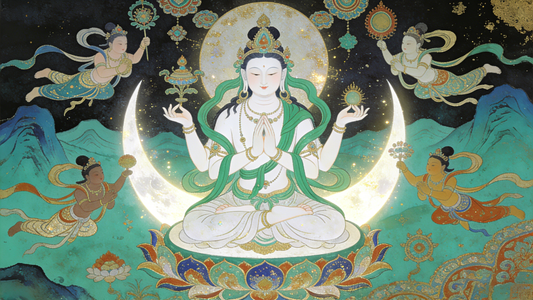
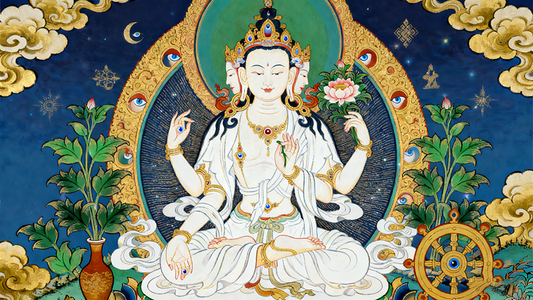
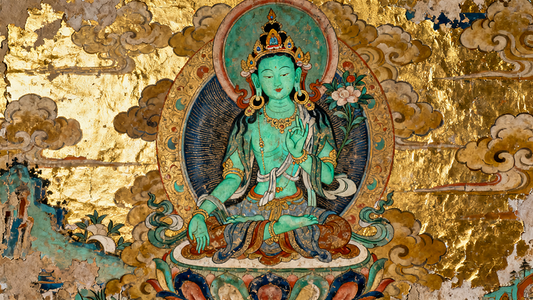
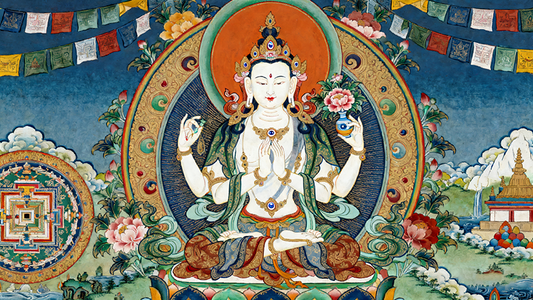
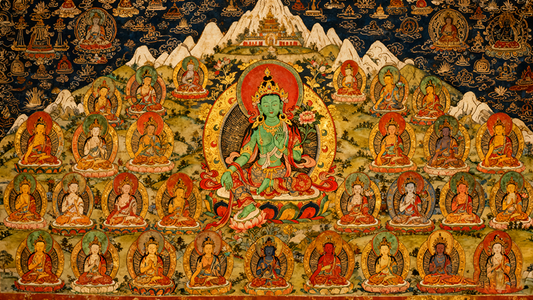
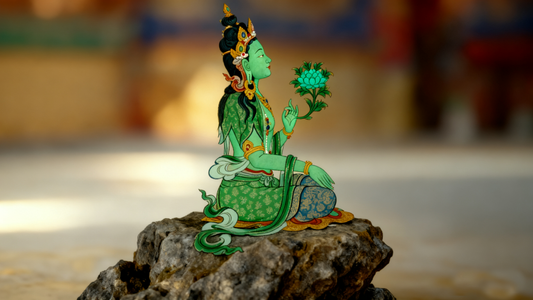
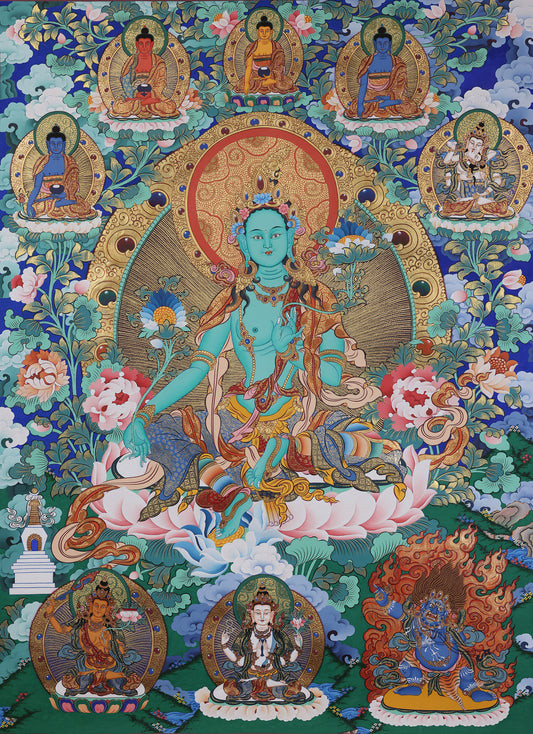
In Tibetan Buddhist art, this legend is fully depicted. White Tara has a gentle face, adorned with necklaces and ornaments, with a small image of Guanyin Bodhisattva on her head—symbolizing her connection to Guanyin. Green Tara, meanwhile, has an agile posture and holds a lotus flower, representing vitality and hope. These images are not only artistic creations but also visual interpretations of the legend of "compassionate emanation, allowing believers to feel the power of compassion when paying homage.

In addition to the "emanation from Guanyin's tears," another important origin legend closely links Tara to "Prajna Devi," holding that Tara is the personification of Prajna wisdom. This legend supplements Tara's core identity from the perspective of "wisdom," endowing her image with not only the warmth of "compassion" but also the depth of "wisdom."
Prajna Devi is the personification of "Prajna wisdom" in Buddhism. The so-called "Prajna" refers to transcendent wisdom beyond the mundane world, the core path to nirvana. Buddhism holds that compassion and wisdom are complementary: compassion without wisdom may lead to blindness, while wisdom without compassion can hardly reflect Buddhism's commitment to relieving worldly suffering. As a "combination of compassion and wisdom," Tara's connection to Prajna Devi embodies this philosophy.
According to relevant commentaries on the Prajnaparamita Sutra in Eight Thousand Lines, Prajna Devi incarnated as Tara to be closer to sentient beings and save them more effectively. Most sentient beings fear the abstractness and profundity of "wisdom," but Tara, appearing as a gentle and approachable goddess, is more likely to arouse their affection, making them willing to accept the guidance of Prajna wisdom. In this legend, Tara's identity as a "bodhisattva" is essentially a "popularized expression" of Prajna wisdom, and all her salvation actions are guided by the insight of Prajna wisdom.
This origin narrative reveals the profound philosophical connotation of Tara worship: saving sentient beings is not merely "providing protection," but more importantly, guiding them to awaken their own wisdom and achieve self-enlightenment. Tara rescues sentient beings not only from physical suffering but also from spiritual confusion. With Prajna wisdom as a sharp sword, she cuts off sentient beings' afflictions and attachments; with compassion as nectar, she nourishes their good roots and wisdom buds.
In Buddhist practice, paying homage to Tara and reciting her mantra are regarded as important ways to awaken Prajna wisdom. Believers believe that by "connecting" with Tara, they can receive the blessing of Prajna wisdom, enabling them to distinguish right from wrong, let go of attachments in daily life, and gradually move towards spiritual enlightenment. This philosophy of integrating "faith" with "wisdom practice" elevates Tara worship beyond mere "prayer" to a profound spiritual practice.
If the legends of "emanation from Guanyin's tears" and "incarnation of Prajna Devi" endow Tara with divine glory, the tale of the "Sinhalese princess attaining enlightenment through vows" gives her image a more human touch. This legend tells the story of a secular princess who transformed into a bodhisattva through unwavering vows and practice, demonstrating the possibility of "mortal awakening" for all sentient beings.
The legend takes place in the ancient Indian kingdom of Sinhala (modern-day Sri Lanka). The king had a beautiful and kind-hearted daughter. From an early age, the princess was filled with compassion and felt sorrow when she saw sentient beings suffering. By chance, she heard the teachings of Buddhism, which deeply touched her, and she resolved to follow the Dharma and save all sentient beings. She made a great vow to the Buddha: "I vow to take the female form and save all sentient beings trapped in suffering in future lives. I will not attain Bodhi until all sentient beings are liberated."
The Buddha was moved by the princess's compassion and determination, and blessed her to become Tara. In this legend, Tara was not born a "god" but transformed from a secular princess through "vows" and "practice." Her path to enlightenment was filled with human struggles and perseverance—she was once a mortal, who also experienced worldly sufferings. Yet it was her compassion for sentient beings and dedication to liberation that allowed her to transcend mundane limitations and ultimately attain the status of a bodhisattva.
The core meaning of this legend lies in emphasizing the importance of "making vows" and "practicing the Dharma." Buddhism holds that all sentient beings possess "Buddha-nature," and everyone can achieve spiritual enlightenment through their own practice. The story of the Sinhalese princess vividly interprets this philosophy. Her identity as a "princess" represents mundane wealth and comfort, yet she voluntarily abandoned secular pleasures to embark on the arduous path of saving sentient beings. This spirit of "sacrificing the self for the greater good" is the core of the Bodhisattva Path—"benefiting oneself and others, awakening oneself and awakening others."
For ordinary believers, this legend is particularly inspiring. It tells us that no matter our circumstances or social status, as long as we harbor compassion, make firm vows, and practice diligently, we can gradually purify our minds, awaken our wisdom, and move towards enlightenment. Tara's transformation from a "princess" to a "bodhisattva" is not an overnight miracle but the result of daily perseverance and dedication. This narrative of "mortal awakening" makes Tara worship more closely connected to secular life, becoming a spiritual driving force for countless people to move forward.
From the compassionate emanation from Guanyin's tears, to the wise incarnation of Prajna Devi, to the mortal awakening of the Sinhalese princess, Tara's diverse origin legends, though different in context, all point to the same core—"compassionate salvation" and "spiritual enlightenment." These legends are not isolated but collectively construct Tara's rich image from different perspectives, embodying the core philosophical concepts of Buddhism.
Firstly, compassion is the core essence of Tara worship. Whether it is Guanyin's sorrowful tears or the Sinhalese princess's sympathy for suffering, they all originate from the core emotion of "compassion." Buddhism holds that compassion is the root of all good deeds and the starting point of the Bodhisattva Path. All of Tara's salvation actions stem from compassion—she rescues those drowning, dispels plagues, protects travelers, and blesses seekers of knowledge. No matter what hardships sentient beings face, as long as they sincerely call upon Tara's name, they can receive her protection. This "all-encompassing, all-rescuing" compassion is the core reason why Tara worship has transcended time and touched the hearts of people.
Secondly, wisdom is the fundamental support for Tara's salvation. Tara's rescue is not merely "supernatural blessing" but guided by Prajna wisdom. She understands that sentient beings' suffering arises from "attachments" and "ignorance"; therefore, her salvation addresses not only the "symptoms" but also the "root causes"—through her blessing, she helps sentient beings awaken amid suffering, unlock their own wisdom, and fundamentally free themselves from afflictions. This philosophy of "balancing compassion and wisdom" reflects the Buddhist practice principle of "cultivating both compassion and wisdom," guiding believers to care for others while pursuing self-awakening.
Finally,
"the unity of mortals and saints" is an important revelation of Tara worship. The legend of the Sinhalese princess breaks the boundary between "gods" and "humans," telling us that "holiness" is not unattainable but stems from compassion and perseverance within the heart. Tara's transformation from a "mortal princess" to a "holy bodhisattva" confirms the Buddhist truth that "all sentient beings can become Buddhas." This revelation endows Tara worship with practical significance—it encourages us to practice compassion, uphold kind thoughts, and cultivate diligently in secular life, constantly elevating our lives while warming and helping others with our own strength.

In today's fast-paced, high-pressure society, people are often plagued by negative emotions such as anxiety, confusion, and loneliness, and their souls yearn for comfort and guidance. The concepts of compassion, wisdom, and awakening embodied in Tara worship offer a spiritual antidote for us.
Tara's "compassion" reminds us not to forget to care for others and ourselves amid the busyness of life. In a highly competitive society, people often focus too much on their own gains and losses, neglecting the needs of those around them. Practicing Tara's compassionate spirit does not require us to perform extraordinary good deeds, but to start with small daily acts—a warm greeting, a selfless help, a tolerant attitude. These small acts can plant the seeds of compassion in our hearts, making our lives warmer and more harmonious.
Tara's "wisdom" guides us to maintain a clear mind and let go of excessive attachments in a complex world. In today's society, material abundance has not brought spiritual prosperity; instead, it has trapped many people in the trap of "comparison" and "anxiety." Practicing Tara's wisdom means learning to "seek within" and understand that inner peace and abundance are true happiness. By letting go of excessive attachment to fame, fortune, gains and losses, success and failure, we can free ourselves from the bondage of afflictions and find inner peace and freedom.
Tara's philosophy of "awakening" further inspires us to constantly improve ourselves and pursue a higher state of life. In secular life, we may face various setbacks and difficulties, but Tara's transformation from a "princess" to a "bodhisattva" tells us that these setbacks and difficulties are opportunities for growth. Through continuous reflection, practice, and improvement, we can not only purify our minds but also influence those around us, letting the light of compassion and wisdom illuminate more souls.
For readers drawn to Tara practice, sacred art can become a gentle visual support for daily recitation, meditation, and compassion practice.
These objects are not a substitute for sincere practice. Their value is to support attention, reverence, and continuity, helping readers return to the meaning of the teaching in daily life.
From the compassionate emanation from Guanyin's tears to the mortal awakening of the Sinhalese princess, Tara's origin legends have spanned thousands of years, conveying the power of compassion and wisdom across different cultures and eras. Her image is both a holy bodhisattva and an approachable spiritual mentor; her worship is both a vivid interpretation of Buddhist philosophy and a spiritual guide for secular life.
In today's restless and confused era, re-exploring Tara's origin stories and Buddhist meanings is not about blind faith, but about drawing strength from compassion, wisdom, and awakening. When we treat others with compassion, view the world with wisdom, and improve ourselves with an awakening heart, we can find a spiritual home in the complexities of life and become the "Tara" of our own lives.
May the light of Tara's compassion illuminate every confused soul; may we all, under the guidance of compassion and wisdom, free ourselves from afflictions and achieve spiritual awakening and sublimation.