When it comes to Buddhist views on women, traditional perceptions are often limited to the numerous restrictions imposed on women in the Eight Precepts or the doctrinal statement that a Wheel-turning King must be male. Undeniably, the compilation and dissemination of Buddhist scriptures have always been constrained by the patriarchal social context, and many expressions carry the limitations of their times. But the core value of feminist Buddhism lies in breaking free from the binary black-and-white cognition, exploring the spiritual subjectivity of women from the subtleties of classical texts, and reconstructing the obscured female power in Buddhism.
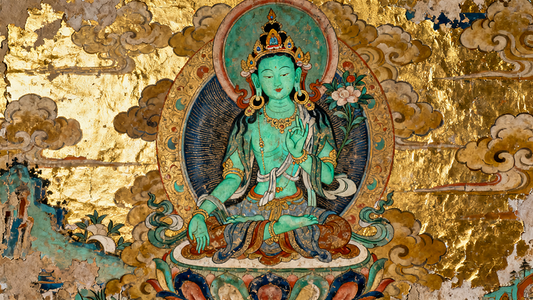
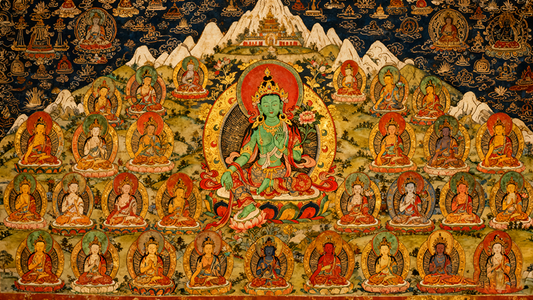
Throughout the long history of Buddhist development, women have not always been in a passive and subordinate position. From Mahaprajapati Gautami, the "first bhikkhuni" in early Buddhism, who fought for the right to become a nun, to the records of the enlightenment of female practitioners such as "dakini" and "yogini" in Tibetan Buddhism, the spiritual potential and value of women have never been completely erased. As one of the few enlightened deities in the Buddhist system who manifests in a female form, Tara has pushed this female spiritual power to its peak. Unlike other Buddhist saints, Tara's female identity is not an expedient measure of "skillful manifestation", but a direct reflection of her essential nature—she embodies compassion and wisdom in a female form, and responds to the sufferings of all beings from a female perspective. This in itself is a subversion of the traditional perception that "masculinity equals divinity".
Feminist Buddhism holds that Tara's existence fills the core gap in Buddhist views on women: she proves that women can attain Buddhahood without "transforming into a male body", breaking the traditional shackles of the "female body obstacle". In many records in the
Tara Sutra, Tara's sacredness has never been diminished because of her female identity; on the contrary, due to her unique female empathy and compassionate traits, she has become the saint closest to the sufferings of all beings. This path of enlightenment centered on female subjectivity provides important textual evidence for modern feminist Buddhist research, and allows us to re-understand the diversity and inclusiveness of Buddhist views on women.

As a paragon of feminine awakening, Tara's spiritual core is embodied in "autonomous wisdom", "proactive power" and "conscious compassion". These three traits not only constitute her sacredness as an enlightened deity but also deeply resonate with the "independence, autonomy and empowerment" pursued by modern female awakening.
In the traditional patriarchal context, "wisdom" is often regarded as an exclusive trait of men, while women are labeled as "emotional" and "ignorant". One of Tara's core traits is the Prajna wisdom of "penetrating the true nature of all dharmas". According to the records of Tibetan Buddhist classics, Tara is an incarnation of Amitabha Buddha and a manifestation of Avalokiteshvara Bodhisattva's compassion. She has long attained "omniscience", can perceive the truth of the universe and life, and transcends the cognitive limitations brought by gender.
Tara's wisdom is not the "masculine" logical reasoning, but a "compassionate wisdom" with female characteristics. Her wisdom is reflected in the precise insight into the sufferings of all beings—whether it is displacement in wars or trivial troubles in daily life, Tara can capture the root causes of all beings' pain with delicate perception and relieve them in the most appropriate way. This "wisdom based on compassion" breaks the single cognition that "wisdom equals rationality", proving that women's emotional traits are not obstacles to wisdom, but can become a unique path to truth. For modern women, this enlightenment is particularly important: women do not need to deliberately imitate male thinking patterns to prove their wisdom; their own delicacy, empathy and intuition are irreplaceable sources of wisdom.
In many religious and cultural traditions, women are often the objects of "salvation" who need to rely on the power of male saints to attain liberation. Tara's emergence has completely subverted this passive female image—she is a proactive "redeemer" who protects all beings with her own power and becomes the source of power rather than a dependent.
The Praise to the Twenty-One Taras details Tara's twelve great vows, each of which is her commitment to take the initiative to bear the sufferings of all beings: "May I quickly board the ship of Prajna, may I soon cross the sea of suffering, may I quickly attain the path of precepts, concentration and wisdom, may I soon ascend the mountain of nirvana". From saving beings who fall into hell to protecting merchants traveling on the road; from helping women give birth smoothly to guiding practitioners towards enlightenment, Tara's power runs through the entire process of all beings' liberation. This power does not come from external endowment, but from her own enlightenment—she breaks through the constraints of gender and mundane world through self-cultivation and becomes the "redeemer" of herself and all beings.
Tara's power trait is exactly in line with modern women's pursuit of "autonomous power". Modern women are no longer satisfied with the passive status of "being protected" and "being defined", but eager to control the direction of their lives through their own efforts. Tara's spirit tells us: women's power does not need to be sought from outside, but comes from inner awakening and cultivation—this cultivation is not the religious practice of seclusion, but the deepening of self-cognition, the adherence to self-worth, and the active responsibility for others and society.
Compassion is the core doctrine of Buddhism, but in the traditional patriarchal context, women's compassion is often interpreted as an accessory of "obedience" and "sacrifice". Tara's compassion, however, is a "conscious compassion" based on self-awakening and the ultimate embodiment of female subjectivity.
Tara's compassion is not blind giving, but stems from a deep empathy for the sufferings of all beings and a clear understanding of her own mission. She chooses to manifest in a female form precisely because women can better understand the sufferings of all beings—especially the oppression and hardships endured by women in patriarchal society. In the Tara Sutra, Tara often teaches female practitioners, guiding them to break through gender barriers and gain confidence and strength in practice. This kind of "compassion for women by women" fully respects and highlights the subjectivity of women.
Tara's conscious compassion provides an important enlightenment for modern women to understand the relationship between "compassion and self". Modern women often fall into a dilemma between "giving" and "self", thinking that compassion means sacrificing oneself to satisfy others. Tara's compassion tells us: true compassion must be based on self-awakening; only by first achieving self-liberation and perfection can we truly help others. This compassion is not a negation of self, but an affirmation of self-worth—because we clearly recognize our own value, we are willing to share this value with others; because we fully accept ourselves, we can truly accept others.
In the current social context, female awakening faces many challenges: the constraints of gender stereotypes, the glass ceiling in career development, the dilemma of balancing family and career, and the confusion and anxiety in self-cognition. As a paragon of female awakening, Tara's spiritual core provides valuable spiritual resources for modern women to break through these predicaments.
There are still many stereotypes about women in modern society: "women should be gentle and family-oriented", "women are not suitable for high-intensity work", "women's value lies in marriage and childbirth". These stereotypes are essentially the same as the traditional Buddhist concept of "female body obstacle", both of which suppress female subjectivity.
Tara's spirit tells us that gender has never been a criterion for defining self-worth. Tara attained Buddhahood in a female form, proving that "being female" is not incompatible with "being sacred", "being wise" and "being powerful". For modern women, to achieve true awakening, they must first break the constraints of these stereotypes and establish an autonomous self-cognition. We can be gentle and resilient; we can pursue family happiness and career achievements; we can choose to have children and choose to live alone. The right to define self-worth is always in our own hands, not in the expectations of others and social norms.
The path of modern female awakening is often accompanied by external competition and internal anxiety. In the process of pursuing material success and social recognition, it is easy to fall into the confusion of "seeking outward". Tara's path of enlightenment tells us that true power and wisdom come from inner cultivation.
Here, "cultivation" does not specifically refer to religious rituals, but a continuous self-awareness and self-improvement. For example, deepening self-cognition through reading and thinking, calming inner anxiety through meditation and reflection, realizing self-worth through persisting in a beloved career, and gaining spiritual satisfaction through helping others. This inner cultivation can help women build a stable spiritual core, and always maintain a clear self-cognition in the face of external pressures and temptations, so as not to drift with the tide or lose their way. Just as Tara broke through the constraints of the mundane world through her own cultivation, modern women can also break through the predicaments of life and achieve self-awakening and growth through inner cultivation.
In the patriarchal social structure, women are often portrayed as "competitors", consuming and suppressing each other. Tara's compassionate spirit provides spiritual guidance for modern women to build a mutual-aid female community. Tara cares for and helps women as a female, and this spirit of "female mutual aid" is the core power needed for modern female awakening.
The awakening of modern women has never been a lonely struggle, but requires mutual support and empowerment. We can take the initiative to listen to the stories of women around us and understand their predicaments; we can actively share our own experiences and insights to help others; we can strive for more equal rights for women in professional and life fields. This mutual-aid relationship based on compassion can break the estrangement and competition between women and build a strong female community. When women no longer consume each other but support and achieve each other, they can gather strong power to promote gender equality and create a better social environment for the awakening of more women.

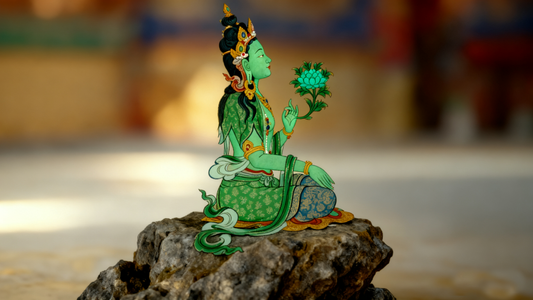
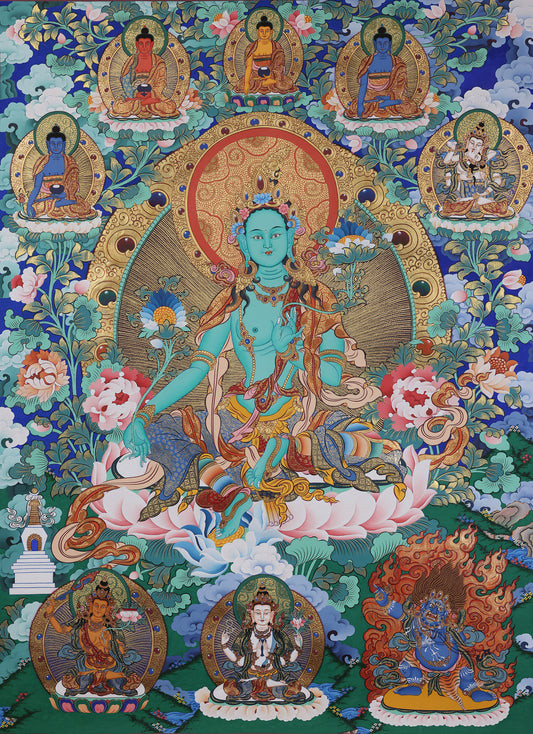
For readers drawn to Tara practice, sacred art can become a gentle visual support for daily recitation, meditation, and compassion practice.
These objects are not a substitute for sincere practice. Their value is to support attention, reverence, and continuity, helping readers return to the meaning of the teaching in daily life.
As a paragon of female enlightenment in the Buddhist system, Tara's significance has long transcended religion itself. From the perspective of feminist Buddhism, Tara not only reconstructs the diverse dimensions of Buddhist views on women but also provides valuable spiritual resources for the awakening of modern women. The autonomous wisdom, proactive power and conscious compassion she represents exactly respond to modern women's pursuit of self-cognition, self-worth and self-realization.
In the integration of tradition and modernity, we do not need to regard religious traditions as outdated dross, nor blindly worship traditions while ignoring their limitations of the times. Instead, as advocated by feminist Buddhism, we should adopt a critical and inheriting attitude to explore the core of traditional spirits that meets the needs of modern female awakening. Tara's spirit tells us: female awakening requires both breaking external gender constraints and achieving internal self-awakening; it requires both pursuing individual self-realization and promoting group mutual aid and empowerment.
When modern women resonate with Tara's spirit, they will understand that female power has never been obscured, but only needs to be awakened actively; the path of female awakening has never been to copy the male path, but to walk out a path that belongs to women themselves, which combines wisdom and compassion. On this path, every woman can become her own "Tara", illuminating her own life and warming the world of others.