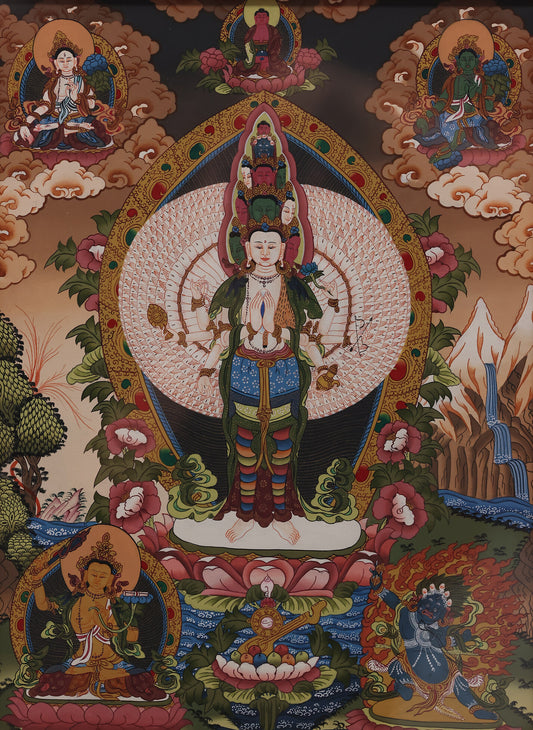
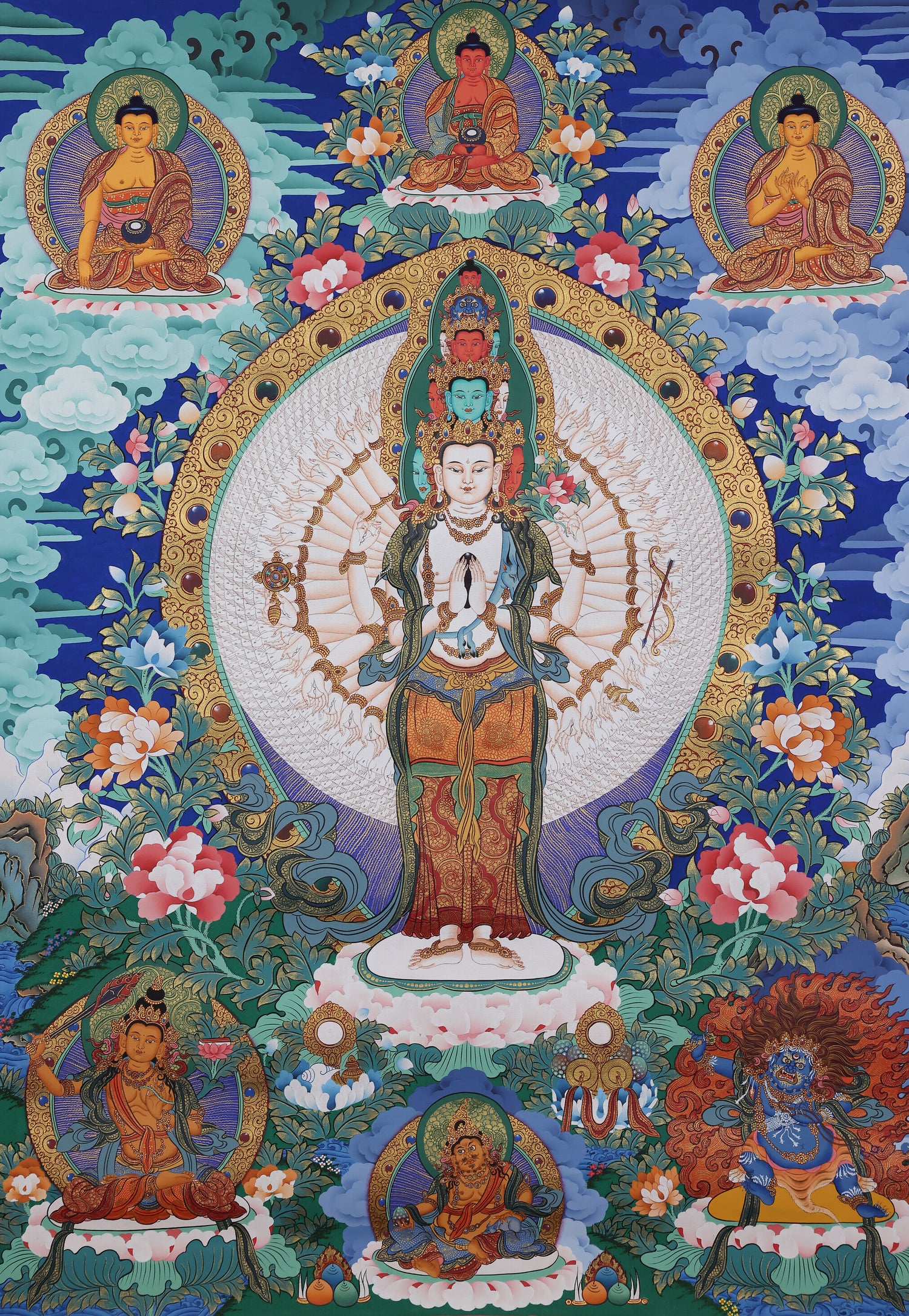
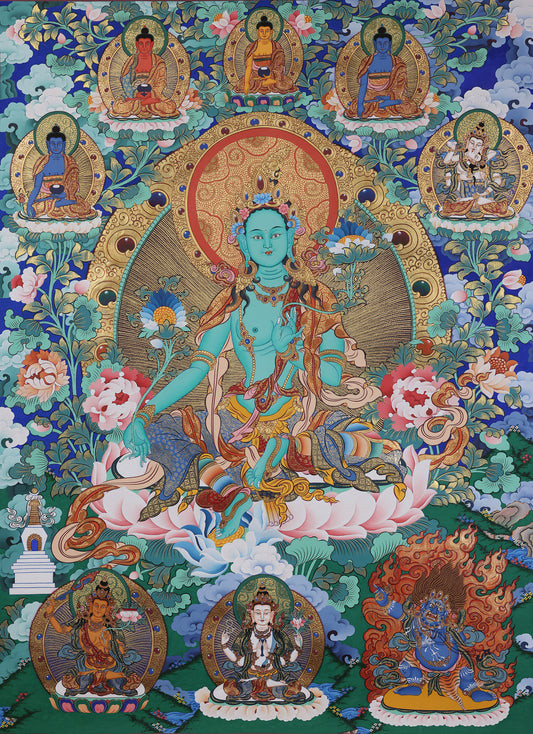
In the Tibetan Buddhist art system, Thangka is more than just a painting; it is a “mobile shrine” that embodies religious philosophy, cosmology, and spiritual practice. Each Thangka is a combination of faith and art, where design, deity configuration, and craftsmanship reflect profound religious and cultural values. This Thousand-Hand Thousand-Eye Eleven-Faced Avalokiteshvara Thangka strictly follows the ritual specifications of the Sutra on Buddhist Iconometry and employs intricate visual symbols to construct a complete salvific system, making it an outstanding example of hand-painted Tibetan Thangka art.
1. Core Theme: The Philosophy of Universal Compassionate Salvation
The central theme of this Thangka is “Avalokiteshvara’s Universal Compassionate Salvation”. This concept is rooted in the Great Dharani of the Thousand-Hand Thousand-Eye Avalokiteshvara Bodhisattva, reflecting the Tibetan Buddhist principle of “integration of compassion and wisdom”:
-
Thousand hands symbolize countless methods of aiding sentient beings, representing Avalokiteshvara’s ability to protect and guide all beings in myriad ways.
-
Thousand eyes symbolize perception of all suffering, signifying that Avalokiteshvara observes the world and identifies the most appropriate way to help each being.
-
Eleven faces represent multidimensional salvation, conveying the all-encompassing and layered nature of compassion.
In Tibetan culture, the Thousand-Hand Avalokiteshvara is regarded as the “most immediate deity for worldly salvation,” especially in the Gelug and Nyingma traditions. Through the majestic appearance of the central deity and the arrangement of attendant deities, the Thangka visualizes the principle of “compassion pervading the three realms and liberating beings across the six realms,” allowing practitioners to connect with Avalokiteshvara’s compassionate mind during meditation.
2. Principal Deity: Ritual and Symbolism of Eleven-Faced Thousand-Hand Thousand-Eye Avalokiteshvara
The central deity of the Thangka is the Eleven-Faced Thousand-Hand Thousand-Eye Avalokiteshvara, strictly adhering to the golden proportions described in the Buddhist Sutra on Iconometry, with each detail carrying specific religious significance:
-
Eleven-face hierarchy: The head has five tiers of eleven faces, with the topmost face being Amitabha Buddha, symbolizing Avalokiteshvara’s origin from the Buddha and manifestation of boundless compassion. The lower four tiers represent: Compassion (Jewelry Division), Wrathful (Vajra Division), Joyful (Lotus Division), and Fierce (Karma Division), reflecting the “Five Buddha Families” teaching and showing Avalokiteshvara’s capacity to appear differently according to the disposition of beings.
-
Thousand hands and eyes: The hands radiate in a circular pattern, each palm containing an eye. Some hands hold ritual implements such as prayer beads, water vases, Dharma wheels, and lotuses:
-
Prayer beads symbolize “unceasing compassion in every thought”
-
Water vases signify “cleansing beings of afflictions”
-
Dharma wheels represent “turning the wheel of teaching to liberate beings”
-
Lotuses represent “purity free from worldly defilements”
This “hands for action, eyes for perception” design transforms the abstract power of Avalokiteshvara’s great compassion into visible, tangible elements.
-
Posture and attire: The deity wears traditional Bodhisattva garments, with shoulder scarves, a colorful waist skirt, standing on a lotus pedestal. The lotus symbolizes “purity arising unstained from the mud,” and the standing posture represents Avalokiteshvara’s constant state of compassionate aid. The hands folded at the chest embody the integration of compassion and wisdom, consistent with Tibetan iconography where Avalokiteshvara represents compassion and Manjushri represents wisdom.
3. Attendant Deities: Three Realms Protectors and Lineage Visualization
The Thangka’s “Three Realms and Five Directions” composition displays the relationship between the principal deity and attendant deities, reflecting the Tibetan Buddhist structure of “principal deity – protector – lineage”:
-
Upper realm: At the top are Amitabha Buddha and lineage masters (e.g., Padmasambhava, Je Tsongkhapa), signifying the deity’s doctrinal lineage and the tradition of “teacher and teaching as one.” The surrounding clouds blend Han-style patterns with Tibetan scroll motifs, reflecting historical cultural exchanges.
-
Lower realm: At the bottom are protector deities and female manifestations, including Green Tara, White Tara (representing “swift salvation”), and wrathful protectors such as Mahakala and Hayagriva. The contrast between the compassionate Tara and fierce protectors illustrates the dual approach of “gentle guidance and forceful protection.”
-
Functional roles: These deities form a complete system: the principal deity saves, Tara aids urgently, protectors safeguard the teachings, and lineage masters maintain the transmission. Practitioners can sequentially meditate on “blessings from the teacher → principal deity’s compassion → Tara’s urgent aid → protectors removing obstacles,” achieving alignment of body, speech, and mind with the sacred assembly.
4. Craftsmanship: Mineral Pigments and Hand-Painting Techniques
This Thangka exemplifies pure hand-painted mineral Thangka techniques, emphasizing sacred materials and ritualized craftsmanship:
-
Canvas preparation: Pure cotton cloth is stretched on a wooden frame and treated with cowhide glue, lime primer, and polished with river stones to create a smooth surface. This process is considered a ritual purification, ensuring the canvas is spiritually pure to receive the deity image.
-
Pigments:
-
Red from cinnabar (symbolizing compassionate energy)
-
Blue from lapis lazuli (representing purity of emptiness)
-
Green from malachite (symbolizing growth and salvation)
-
Gold from 24K gold powder (representing Buddha-nature illumination)
The minerals are finely ground and mixed with aged animal glue, ensuring colors remain vibrant for centuries—a belief in Tibetan culture that minerals carry the earth’s essence, connecting faith to the natural world.
-
Painting process:
-
Sketching: Charcoal is used to draft outlines with a precision of 0.1 cm to maintain sacredness.
-
Layering colors: Applied from dark to light in thin layers, waiting for each layer to dry; lotus platforms may receive 5–7 layers to create depth.
-
Gold detailing: Gold lines are created by “finger-rubbing gold,” with line thickness precisely controlled at 0.15 mm ±0.02 mm, ensuring the thousand hands’ gold lines are intricate yet organized.
-
Eye opening: The final step, painting the deity’s eyes, is done in one stroke with focused mindfulness, followed by consecration by a high lama, symbolizing the image’s living spiritual presence.
5. Collection and Devotional Value
This Thousand-Hand Thousand-Eye Avalokiteshvara Thangka is not merely an artwork but a vessel of Tibetan Buddhist faith:
-
Altar placement: Ideal for household shrines to assist devotional practices.
-
Meditative aid: Supports practitioners in visualizing and aligning with Avalokiteshvara’s compassionate mind.
-
Collector’s value: Hand-painted, mineral pigments, and ritual compliance make it a timeless cultural heritage.
-
Spiritual significance: Every gold line and mineral pigment embodies the aspiration to transmit compassion and faith across time and space.
Conclusion
The Tibetan Buddhist Thousand-Hand Thousand-Eye Avalokiteshvara Thangka exemplifies “expressing the Dharma through imagery”: its theme embodies the philosophy of universal compassion, the principal deity symbolizes the manifestation of compassionate mind, attendant deities extend the salvific system, and the craftsmanship ensures the faith’s perpetuity. In contemporary life, this Thangka serves as a devotional focus, a family spiritual legacy, and a collector’s treasure. Each gold line and mineral pigment carries the cultural ideal of letting compassion and faith transcend space and time, making it a sacred presence in any environment.
#TibetanBuddhism
#ThousandHandThousandEyeAvalokiteshvara
#ThangkaArt
#HandPaintedThangka
#MineralPigmentArt
#BuddhistArt#BuddhistArt
#SacredArt
#SpiritualProtection
#MeditationArtwork
#Avalokiteshvara
#TibetanThangka
#BodhisattvaArt
#CompassionAndWisdom
#ReligiousArt
#TraditionalCraftsmanship