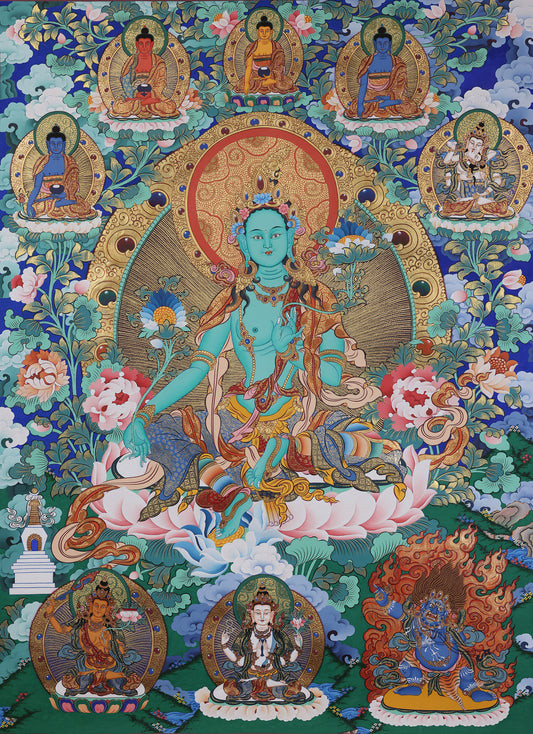
When the luster of 24K gold powder blooms on the lapis lazuli background, and when the third curve of the treasure-spitting rat’s jewel pattern is outlined by a cat-spine brush, this hand-painted Yellow Jambhala Thangka is no longer just a piece of canvas—it is the millennial heritage in the fingertips of Tibetan painters, the wealth philosophy in the faith of the Five Dhyani Buddhas of Wealth, and a cultural collection that can develop a patina over time.
In Tibetan herders’ tents and monastery halls, the image of Yellow Jambhala has never been absent. As the "head of the Five Dhyani Buddhas of Wealth" in Tibetan Buddhism, every detail of his image holds wisdom beyond materiality:
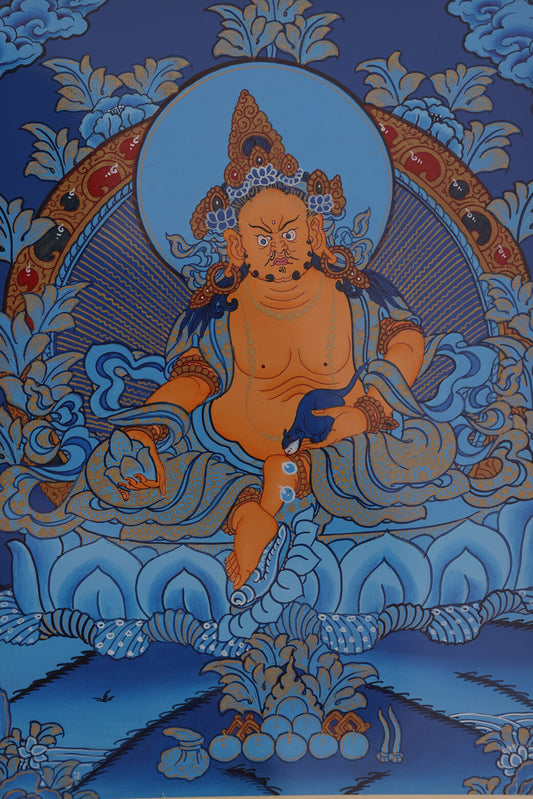
1. Religious Codes in the IconographyThe main deity in this thangka is a "standard Yellow Jambhala form" strictly painted in accordance with the Iconometric Sutra:
- His orange-yellow skin corresponds to the "earth" element in the Five Elements, symbolizing wealth as stable and enduring as the earth;
- The Five-Buddha Crown on his head represents the wisdom blessings of the Five Dhyani Buddhas—meaning Yellow Jambhala’s "wealth-attracting" is never about greed, but "mastering wealth with wisdom";
- The treasure-spitting rat (called Nure in Tibetan) held in his left arm, with jewels in its mouth, symbolizes "wealth as a favorable condition for practice": every sum of wealth you gain is a "tool" for benefiting sentient beings, not a shackle.
2. Practice Metaphors in PostureHe rests in the "auspicious posture" on a lotus throne: the left foot is curled and drawn to the abdomen (representing restraining greed), and the right foot steps on a conch (implying understanding the laws of wealth with wisdom). The Cintāmaṇi (called Laze in Tibetan) held in his right hand means "fulfilling all good wishes"—when you seek wealth with a bodhicitta mind, wealth naturally becomes a support for practice.
This is not an industrial product made by machine printing, but the painstaking work of a Regong painter over 45 days. "Handmade" in Tibetan thangkas is never a marketing slogan, but reverence engraved in every process:
1. Canvas: A Base Polished by TimeThe painter uses high-density white cotton cloth from Tibetan areas in Qinghai, repeatedly applying 3 layers of yak bone glue mixed with white clay, then polishing it with pebbles until it is "smooth as porcelain, opaque to light"—this process, called "preparing the base," is key to the thangka’s ability to resist fading and cracking for centuries. An old painter says: "If the canvas isn’t polished smooth, the pigments will fall like sand—this would be a disservice to the Wealth Buddha and the person who acquires the thangka."
2. Pigments: Colors From Mineral Veins and PlantsEvery color you see is a gift from the earth:
- The main deity’s orange-yellow hue is made of natural mineral powder of ochre and yellow ochre, ground by hand in a mortar for 72 hours until it is as fine as dust;
- The deep blue background uses lapis lazuli from eastern Tibetan copper mines, layered with "first-grade blue" and "second-grade blue" to create a sky-like gradient of "light near, dark far";
- The gold in the crown and clothing patterns is 24K gold powder ground from gold leaf, mixed with bone glue and polished repeatedly with an agate knife—this "gold tracing" process allows a painter to complete only 3 square centimeters a day, yet it makes the thangka glow softly even in a dark room.
3. Linework: The "Millimeter Precision" of a Cat-Spine Brush TipThe brush used by the painter is a unique Tibetan "cat-spine brush"—made from soft hair beside a cat’s spine, with a tip as fine as a hair. When painting the treasure-spitting rat’s whiskers, the painter must hold their breath and draw a single unbroken line; a break means discarding the draft. The "coin-line strokes" for clothing folds follow the contours of the body’s muscle texture, with every curve corresponding to the "seven-part body" proportions in the Iconometric Sutra.
An old painter says: "You chant sutras before painting a thangka. When drawing the first line, your mind must be like a lake in the snow-capped mountains—calmness brings precision."
In an era flooded with machine-printed products, the value of this Yellow Jambhala Thangka lies in its "unreplicability":
1. The "Patina" Quality of TimeNatural mineral pigments settle over time: lapis lazuli becomes deeper blue, and gold powder takes on a warm luster, like the patina of old amber—after ten years, it is not "worn out," but "alive"; every color change is a symbiosis of time and faith.
2. The "Tangibility" of CultureWhen your fingertips touch the canvas, you can feel the fine grain of the polished base; when you look closely, you can see the "brush strokes" in the gold tracing—this is not the "perfection" of industrial products, but the warmth of a human hand: a Tibetan painter, with his hands, his chanting, and his reverence for faith, has "painted" culture into a tangible carrier.
3. The "Energy Field" in SpaceTibetans say "a thangka is where the Buddha ‘dwells’"—when this Yellow Jambhala Thangka hangs in a study or tea room, it is not a decorative painting, but a "field": it reminds you that "wealth is the manifestation of good wishes" and that "you should hold what you gain with a giving heart"—this is a spiritual resonance that machine-made paintings can never provide.
Acquiring a hand-painted thangka is a "karmic connection" with a culture; caring for it is also nurturing this connection:
-
Hanging: Avoid direct sunlight (mineral pigments are sensitive to strong light); hang it in a clean, elevated position above eye level;
-
Cleaning: Use a soft brush to gently sweep away dust—never get it wet (the bone glue base will peel when exposed to water);
-
Offering: There’s no need for deliberate incense-burning; keeping a pure heart is the best offering to Yellow Jambhala.
As modern life speeds up, we need such an object that "slows down": it is 45 days of hand-painting time, a millennium of craft heritage, and the Tibetan Buddhist philosophy of "wealth and wisdom coexisting." This Yellow Jambhala Thangka is more than a collection—it is your link to Tibetan culture, a "faith totem" that can accumulate warmth over the years.
#YellowJambhalaThangka #HandPaintedThangka #TibetanBuddhistArt #MineralPigmentThangka #RegongThangkaCraft #ThangkaCollection #WealthWisdomThangka #TraditionalHandmadeCraft #TibetanCulturalCollection #24KGoldThangka