Understand Green Tara in 3 Minutes: Who is the "Goddess of Compassion" in Tibetan Buddhism?

When you feel fear or danger, call her name, and she will come immediately to save you—this is Green Tara, the savior from suffering in Tibetan Buddhism.
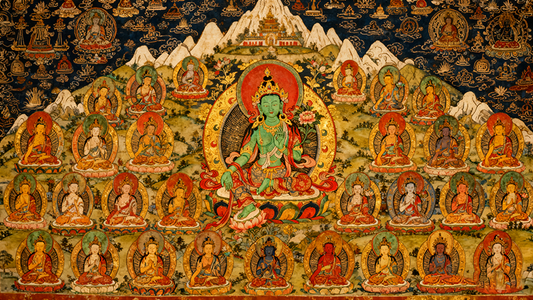
In the vast pantheon of Tibetan Buddhism, there is a female bodhisattva as亲切 as a mother. Known as the "Mother of All Buddhas," she is famous for her swift saving power. She is Green Tara, one of the most popular female bodhisattvas in Tibetan Buddhism.
Whether you are a Buddhist or not, understanding this compassionate "goddess" can open a door to the culture of Tibetan Buddhism for you.
The Origin of Green Tara: A Tear from Avalokiteshvara
The birth of Green Tara stems from a deeply moving story:
Legend has it that countless eons ago, the Bodhisattva Avalokiteshvara had already saved innumerable beings. But when she looked upon the six realms of existence and saw that the number of suffering beings had not diminished, she could not help but shed tears of sorrow.
These tears gathered into an ocean, from which a lotus flower bloomed. From this lotus, Green Tara manifested.
She vowed to Avalokiteshvara: "Please do not grieve. I vow to assist you in saving all sentient beings!" She further pledged to continue saving beings until samsara is emptied. If saving beings in a female form is more expedient, she would forever maintain a female form.
This origin story highlights that Green Tara, like Avalokiteshvara, has the core vow of saving beings with great compassion.

Green Tara's 21 Saving Vows
Green Tara is most well-known for her ability to save from "84,000 types of fears," essentially all forms of suffering. These salvations are categorized into 21 specific situations, corresponding to different emanations of the 21 Taras:
-
Salvation from the fear of natural disasters (e.g., floods, fires)
-
Salvation from the fear of human-made dangers (e.g., thieves, war)
-
Salvation from the fear of internal psychological fears (e.g., fear, anxiety)
-
Salvation from the fear of physical illness
-
Salvation from the fear of financial difficulties
-
Salvation from the fear of interpersonal conflicts
-
Salvation from the fear of evil spirit disturbances
-
Salvation from the fear of wild animal attacks
-
Salvation from the fear of legal disputes and lawsuits
-
Salvation from the fear of curses and black magic
... and so on, totaling 21 types.
In Tibetan Buddhism, when facing any difficulty, practitioners often recite Green Tara's mantra: "Oṃ Tāre Tuttāre Ture Svāhā," seeking her protection and guidance.
Recognizing Green Tara's Iconographic Features
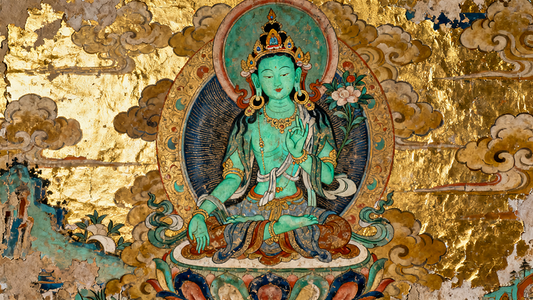
Green Tara's form is highly distinctive:
-
Green Body: Her entire body is green, symbolizing her life-giving activity and proactive saving power.
-
Half-Sitting Posture (lalitasana): Her right leg is extended, ready to step down, while her left leg is folded in meditation. This shows she is always ready to rise and save beings.
-
Holding a Blue Lotus (utpala): She holds a blue utpala lotus in her hand, symbolizing purity and wisdom.
-
Young, Beautiful Female Form: Green Tara is depicted as a sixteen-year-old maiden, representing her ever-youthful wisdom.
-
Symbols of Compassion and Wisdom: Her right hand makes the Varada Mudra (gesture of granting wishes), signifying granting protection to beings. Her left hand forms the Triratna Mudra (gesture of the Three Jewels), symbolizing the Buddha, Dharma, and Sangha.
Why Understand Green Tara Today?
In today's fast-paced, high-stress society, the qualities Green Tara represents are especially valuable:
She Symbolizes Immediate Action: Unlike some Buddhas or Bodhisattvas who may require long practice to perceive, Green Tara is renowned for her "swift salvation."
She Represents Fearless Courage: Green Tara can eliminate all fears, giving practitioners courage to face difficulties.
She Embodies Compassionate Wisdom: Green Tara teaches us that true compassion requires the guidance of wisdom.
Regardless of your personal beliefs, the story of Green Tara can offer us an insight: Facing the suffering of the world, we should not just shed sad tears but transform our compassion into active, saving action.
In Tibetan Buddhist culture, Green Tara is not merely a savior from distress but also a symbol of compassion and courage. Her story conveys a simple yet profound truth: genuine power stems from compassion, and fearlessness arises from love for all beings.
The next time you feel fear or helplessness, perhaps remember this green "Goddess of Compassion." She might bring you inner peace and the courage to face your challenges.
Tags: