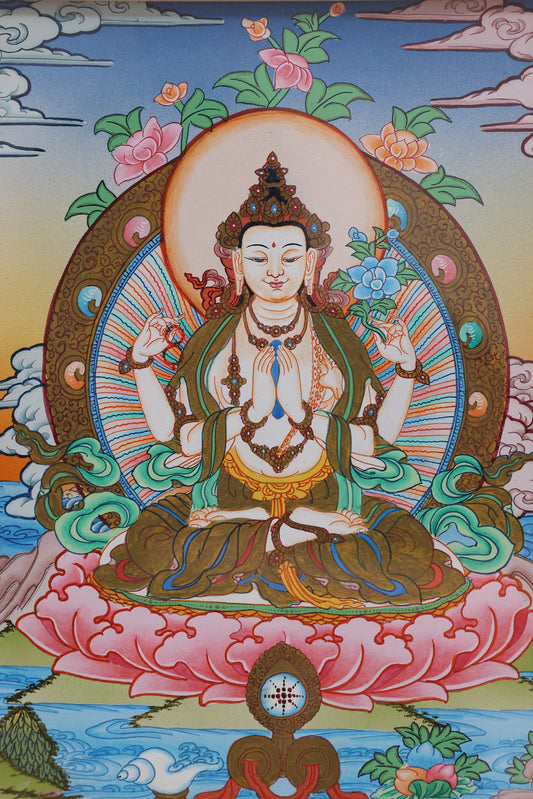
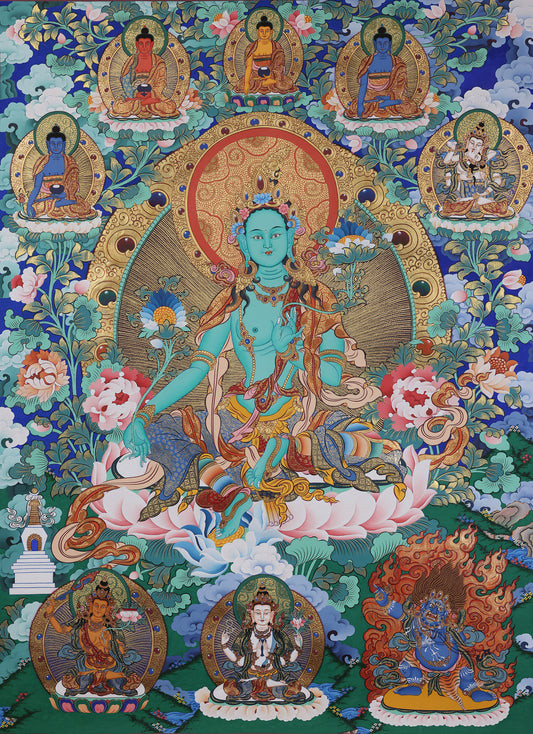
When you unfold this 20×30cm hand-painted Nepalese thangka, what rests in your palm is not just cotton cloth dyed with mineral pigments, but a microcosm where Tibetan Buddhist "compassion" faith intertwines with Himalayan artistic traditions. This Newari-style thangka, centered on the Four-Armed Avalokiteshvara, is both a vessel for religious visualization and a local interpretation of Tibetan ritual by Nepalese artisans.
In the Tibetan Buddhist system, the Four-Armed Avalokiteshvara (Tibetan: Chenrezig) is a peaceful emanation of the Bodhisattva of Compassion, revered as the "Protector of Snowy Tibet." This thangka’s core theme is "Avalokiteshvara’s Compassionate Deliverance," belonging to the esoteric "Peaceful Deity" thangka category. Its iconography strictly follows the Iconometric Canon, while incorporating the soft aesthetic of Nepalese art.
As the central deity of the "Three Protectors" (Avalokiteshvara, Manjushri, Vajrapani), every detail of the Four-Armed Avalokiteshvara carries esoteric meaning:
-
Body Color & Posture: The moon-white body symbolizes "innate purity, untainted by afflictive or cognitive obscurations." Seated in full lotus posture on a double lotus base, it represents "neither trapped in samsara nor detached from nirvana";
-
Four Hands & Implements: The central hands press palms together holding a wish-fulfilling jewel (union of wisdom and skillful means); the right rear hand holds a crystal rosary (each bead represents delivering one being from samsara); the left rear hand holds an eight-petaled white lotus (purity free from affliction);
-
Ornamentation Symbols: The five-Buddha crown represents "the wisdom of the five Dhyani Buddhas"; the Amitabha Buddha finial atop the crown signifies "Avalokiteshvara as the compassionate emanation of Amitabha"; the deer skin draped over the left shoulder symbolizes "freedom from samsara yet refusal to abandon sentient beings."
Unlike the solemnity of Tibetan thangkas, this work’s main deity bears a "Newari smile"—almond-shaped eyes drooping gently, lips soft-lined—translating divine compassion into a more humanly warm visual language.
Constrained by the 20×30cm size, this thangka does not use the detailed retinue figures common in Tibetan thangkas, but instead completes its ritual logic through symbolic configuration:
-
Explicit Symbols: Hidden within the background scrollwork are a "lotus branch" and "rosary string," corresponding to the implements of Manjushri (wisdom) and Vajrapani (power), respectively. These replace concrete forms with imagery, subtly referencing the "Three Protectors" ensemble;
-
Implicit Guardians: The "dharma wheel/wish-fulfilling jewel" motif at the base of the lotus seat implies the protection of Buddha-family retinue (such as Amitabha); the five-colored aura (red, blue, green, yellow, white) corresponds to the five Dhyani Buddhas, signifying "the convergence of all Buddhas’ compassion in Avalokiteshvara."
This simplification is not a compromise of skill, but a Newari micro-thangka tradition of "centralizing the main deity"—it functions as a portable visualization tool while maintaining ritual integrity within limited space.
This thangka is painted with local Nepalese mineral and earth pigments, whose materials and processes are material expressions of traditional craftsmanship:
-
Pigment Preparation:
- White is derived from lowland chalk, washed in three layers, with the top fine powder used for the deity’s face;
- Blue is based on "Nepali blue" (azurite), mixed with lapis lazuli powder to deepen its richness;
- Green is ground from a blend of malachite and turquoise, creating a clear, lake-like layered effect;
- Gold uses "nine-hammered" gold leaf (0.12 microns thick), applied over a garlic juice base to outline robes, producing a "rainbow halo" effect.
All pigments undergo "stone mortar rough crushing → granite millstone fine grinding → clay pot layered settling," with grinding taking up to 48 hours to ensure colors "endure for millennia without fading."
-
Canvas & Creation: Nepalese fine cotton cloth serves as the base, coated with a mixture of yak bone glue and barley flour, then repeatedly polished to a mirror finish. Creation follows the ritual order of "background first, foreground later; light colors first, dark colors later," culminating in the "eye-opening" with gold powder—a step accompanied by chanting, transforming the act of painting into a spiritual practice.
This work’s artistic language belongs to the Nepalese Newari School, distinct from Tibet’s Menri and Khyenri schools:
-
Composition: The main deity occupies 80% of the frame; background scrollwork is intricate but not distracting, lacking the landscape negative space of Tibetan thangkas—reflecting the tradition of "centering the main deity as the visual focus";
-
Color: Dominated by white, blue, and gold, accented with red to create high-contrast saturation; the "transparent layering" of mineral pigments gives the small size remarkable visual impact;
-
Lines & Form: Robes use "wave lines" to convey softness; jewelry employs the "double-line fill" technique; figures have balanced proportions and faces with Newari features, differing from the square facial structure of Tibetan thangkas.
Historically, Newari art is a "transit point" of Himalayan culture: 7th–9th century Newari artisans traveled to Tibet to build monasteries, infusing Tibetan iconography with Hindu "divine anthropomorphism"; today, this thangka is a reverse export, a micro-specimen of cultural fusion.
This 20×30cm thangka exemplifies "great faith in a small frame"—it is both a tool for Tibetan esoteric visualization, a carrier of Newari aesthetic, and a material testament to cross-regional exchange in Himalayan civilization. When your fingertips glide over the gold-leaf outlined robes, you touch not just a painting, but a "compassionate universe" forged from millennia of faith and craftsmanship.
Would you like me to compile a Four-Armed Avalokiteshvara Thangka Visualization Guide to help you understand its religious practice function?
#NepaleseThangka #NewariArt #FourArmedAvalokiteshvara #TibetanBuddhistThangka #MineralPigmentThangka #MicroThangka #HimalayanArt