The "Protective Umbrella" in Tibetan Thangka: The Aesthetics and Compassion of the Sitatapatra Thangka

The "Protective Umbrella" in Tibetan Thangka: The Aesthetics and Compassion of the Sitatapatra Thangka
When a vivid, intricately detailed thangka unfurls before you, it is never just a painting—it is a vessel of wisdom in Tibetan Buddhism, where "dharma is embodied in form." Today, we explore a thangka centered on Tibet’s beloved "ultimate protector": Sitatapatra (the White Umbrella Goddess), whose image encapsulates the compassion and power of esoteric Buddhism.

I. In Her Thousand Hands and Eyes: The Blessings of All Buddhas
The central deity of this thangka is Sitatapatra in her thousand-armed, thousand-eyed serene-fierce form—every detail is not a flight of fancy, but a tangible expression of dharma:
Her white body, pure as snow-capped peaks, symbolizes the untainted Buddha-nature. Her central face is calm yet sharp-browed, embodying the "balance of serenity and ferocity": compassion to embrace all beings, and majesty to subdue demons.
Her thousand arms fan out like a peacock’s tail, each bearing a clear eye: the "thousand hands" represent the promise to protect all beings across the six realms, while the "thousand eyes" signify the compassion to perceive the joys and sorrows of the world. In her hands, swords cut through afflictions, lotuses symbolize purity, and the Great White Umbrella (held in her main arm) is her core symbol—a "protective shield" forged from dharma, warding off war, disaster, and unseen fears.

II. A Thangka Is a "Buddha Realm Universe"
Tibetan thangkas are never "single-portrait art"—they are ordered visions of the Buddha’s realm:
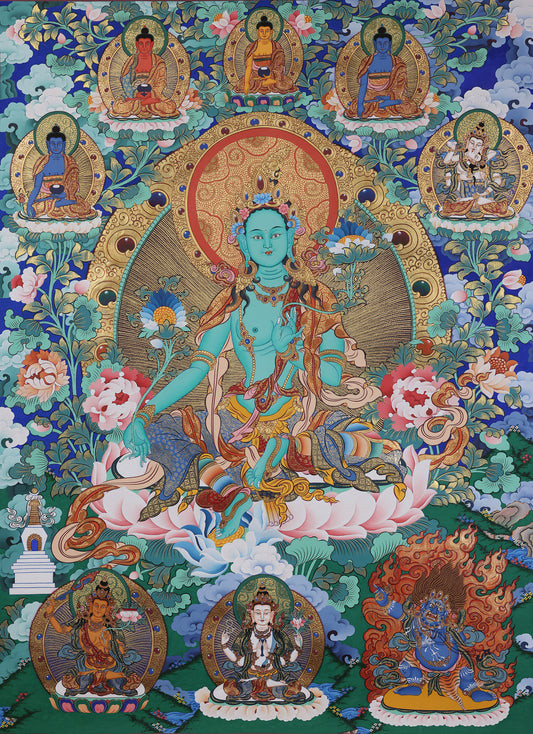
The Buddhas and Bodhisattvas above (such as the Five Dhyani Buddhas and offering goddesses) underscore Sitatapatra’s identity as the "Mother of All Buddhas"—she is not an isolated deity, but the embodiment of the compassion and deeds of all Buddhas across the three times.
The protectors and sentient beings on the sides and below: On one side stand guardians like Mahakala (symbolizing the subjugation of afflictive demons); on the other, beings of the six realms (representing that her protection knows no hierarchy).
The gilded auspicious clouds and blazing flame auras in the background carry meaning too: clouds signify "auspiciousness covering all," flames represent "burning away karmic obstacles," and even the landscapes underfoot are metaphors for "pure land manifest in the mortal world."

III. More Than Art: A "Living Faith" in Thangka
This thangka’s weight lies not in its pigments or canvas, but in its purpose:
She is a "dharma of disaster-calming": In Tibet, Sitatapatra’s mantra (sharing roots with the Shurangama Mantra in Han Buddhism) is a household "talisman of peace." Practicing her dharma or enshrining her image is a plea for "national tranquility and fearlessness for all beings."
She is a cultural bridge: Introduced to Han regions by Phags-pa (the Yuan Dynasty’s state preceptor), she remains a symbol of "protecting the nation and people"—evident in the massive thangkas of her displayed at Beijing’s Yonghe Temple.
She is a masterpiece of art: Mineral pigments ensure colors endure for decades, and the details of her thousand-hand ritual tools are rendered with precision. Tibetan artists do not just "paint an image"—they "translate the Buddha’s compassion into something visible."
When we gaze at this thangka, we see more than the grandeur of a thousand hands and eyes: we see a civilization’s ultimate expression of protection and compassion. Under that Great White Umbrella, there is no division—only the gentle promise that "all beings are held in care."

Thangka Basic Parameters
Thangka Name: Sitatapatra Thangka
Dimension: 85×120cm
Place of Origin: Regong, Qinghai, China
Pigment: Natural mineral pigments
Craftsmanship: Pure hand-painted
Main Deity: Sitatapatra (thousand-armed, thousand-eyed serene-fierce form)
Thematic Connotation: Disaster calming, evil warding, protecting all sentient beings in the six realms
Art Style: Tibetan meticulous heavy-color Thangka
Cultural Origin: Esoteric Buddhism, spread to the Han region during the Yuan Dynasty with the promotion of Imperial Preceptor Phags-pa
#ThangkaArt #Sitatapatra #TibetanBuddhismArt #BuddhistDeity #TibetanThangka #EsotericBuddhism
Tags: