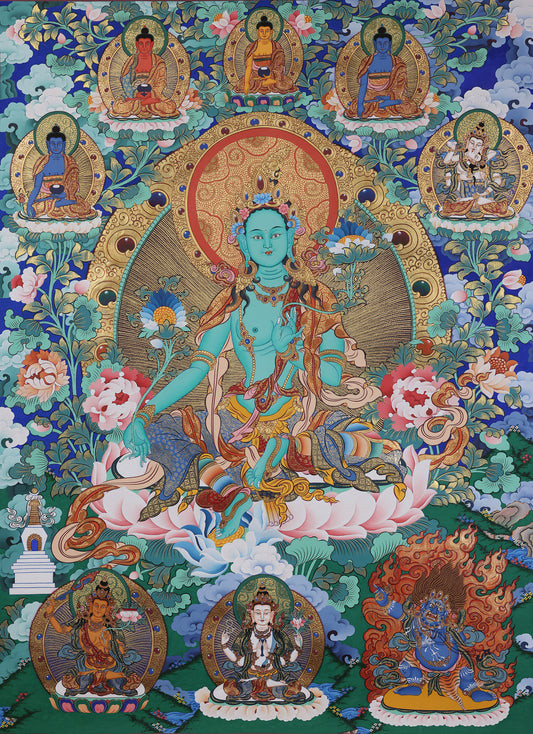
The Protector of the Snowy Lands: The Compassion Code in the Four-Armed Chenrezig Thangka of Tibetan Buddhism
wudimeng-Dec 17 2025-
0 comments
When a white, moon-like form unfolds four arms on a colorful Thangka, and the Cintāmaṇi jewel held in the palms together reflects the sunlight of the Tibetan Plateau—this is the Four-Armed Chenrezig, revered as Chenmo Ge in Tibetan Buddhism. As the "Protector of the Snowy Lands," he is not only one of the most common sacred figures in Thangka art but also the tangible form of compassion in the hearts of Tibetan believers, who chant the Six-Syllable Mantra from childhood to old age.
Gazing at this colorful Thangka, every detail of Chenrezig’s iconography holds hidden meaning:
-
Body Color and Posture: The moon-white body symbolizes "innate purity without defilement." Seated in full lotus (vajrasana) on a lotus and moon disc, it represents both transcendence (not clinging to samsara) and compassion (not abandoning sentient beings).
-
Four Arms and Implements:
The two central hands press together in anjali mudra (prayer gesture) holding a Cintāmaṇi jewel, embodying the union of wisdom and skillful means;
The right rear hand holds a crystal mala (prayer beads)—each bead rotated "liberates one sentient being from samsara";
The left rear hand holds an eight-petaled white lotus, symbolizing "purity untainted by afflictions, like a lotus rising from mud."
-
Ornaments and Crown: Adorned with a five-Buddha crown, representing the wisdom of the Five Dhyani Buddhas; a deer skin draped over the left shoulder, a vow of "compassion that does not fall into samsara"; and Amitabha Buddha (as a small figure) atop his crown, linking him to his origin as a retinue of the Western Pure Land.
In a Qianlong-era Thangka (presented by the 6th Panchen Lama) in the Palace Museum, the Four-Armed Chenrezig also appears in a "peaceful form"—his half-opened eyes "gaze upon sentient beings, and all who meet his gaze attain liberation," which is why Tibetan believers call him "liberating upon sight."
The Four-Armed Chenrezig is not an indigenous Tibetan deity; his belief trajectory holds clues to the spread of Buddhism:
-
Scriptural Roots: First recorded in the Sutra of the Great Vehicle’s Glorious Jewel King (Tibetan translation: The Sutra of the Glorious Casket), which identifies him as an esoteric emanation of Avalokiteśvara, requiring practice within a mandala and closely tied to the Six-Syllable Mantra.
-
Introduction and Localization in Tibet: After the 11th-century Indian master Atisha entered Tibet, he transmitted the "Three Deities of the Six-Syllable Mantra" practice, and the Four-Armed Chenrezig began to spread widely as its core figure. By the Yuan Dynasty, murals at Shalu Monastery had incorporated him into the esoteric lineage charts of "Atisha’s Transmission," making him one of Tibet’s "Three Protectors" (Chenrezig, Manjushri, Vajrapani), representing "great compassion."
-
The Birth of the Snowy Land Protector: Tibetans revere the Dalai Lama as an emanation of the Four-Armed Chenrezig, further elevating him to "Protector of the Snowy Lands." In the legend of the Chenrezig Temple in Jinchuan, Sichuan, the Chenrezig statue "naturally emerged from the earth," with a plow mark still visible on its forehead—a metaphor that "compassion is always beside sentient beings."
"Om Mani Padme Hum"—these six syllables are the most direct bond between the Four-Armed Chenrezig and Tibetan believers.
According to the
Sutra of the Glorious Jewel King, the merits of chanting this mantra are "countless": eliminating illness, extending life, increasing wealth, and even "sealing the gates to lower realms at death, leading to rebirth in auspicious realms." But for Tibetans, the Six-Syllable Mantra has long transcended "utilitarian merits" to become as natural as breathing: engraved on prayer wheels, inscribed on mani stones, and printed on prayer flags—all extensions of Chenrezig’s compassion.
In esoteric practice, visualization of the Four-Armed Chenrezig is a core method: practitioners visualize themselves as Chenrezig, using the tonglen (taking and sending) practice to absorb sentient beings’ suffering into themselves, then send compassion and well-being back to all beings. This practice of "using oneself as a boat to ferry others" is the embodiment of his "Four Immeasurables" (loving-kindness, compassion, joy, equanimity).
Today, the influence of the Four-Armed Chenrezig extends far beyond religion:
-
Artistic Dimension: The Four-Armed Chenrezig in Thangka is a model of the Iconometric Canon (Zozhing Chenmo)—from body proportions to implement details, it strictly follows the Treatise on Iconometric Proportions, while integrating Tibetan aesthetic preferences (such as the vibrant lotuses and gradient halos in colorful Thangkas).
-
Cultural Identity: In Tibet, "worshipping Chenrezig at home and chanting the Six-Syllable Mantra daily" is a shared cultural gene. The Chenrezig Temple in Zhuosijia, Sichuan, attracts tens of thousands of believers annually; its main Chenrezig statue is said to be "one of three sisters (along with those in the Potala Palace and Mount Wutai)"—a vivid example of localized belief.
-
Modern Significance: As urbanites encounter the Four-Armed Chenrezig through Thangkas and meditation, his spirit of "uniting compassion and wisdom" has become an anchor for coping with anxiety—just as the "jewel in his clasped hands" is both a tool to ferry others and wisdom for self-liberation.
The Four-Armed Chenrezig in this colorful Thangka is not a static painting, but compassion alive in every gust of wind and every mantra in Tibet. His four arms are a posture of embracing all beings; his white lotus is purity amid defilement; his mala is hope in samsara.
To believers, he is the "protector who liberates upon sight"; to the world, he is the gentlest cultural symbol of Tibetan Buddhism—after all, compassion is a universal language that transcends words and beliefs.
#FourArmedChenrezig #TibetanBuddhism #ThangkaArt #SixSyllableMantra #SnowyLandProtector