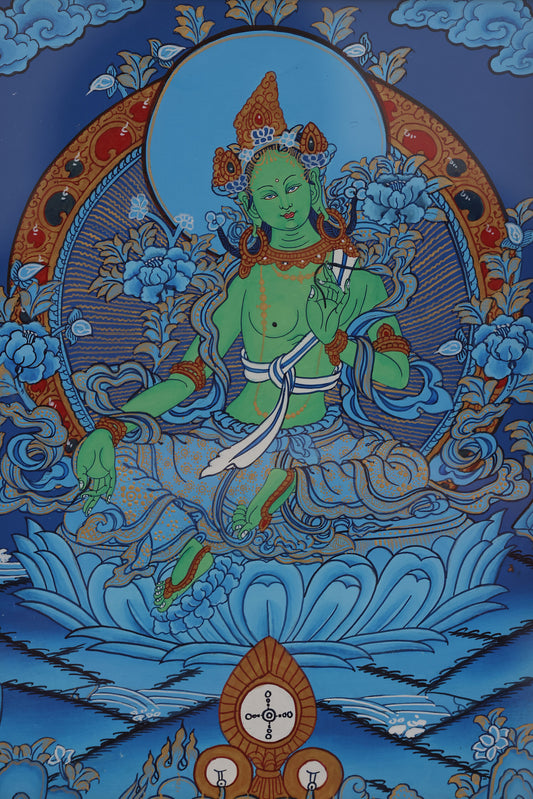
In Tibetan Buddhism, thangkas are far more than art: they are visual scriptures, meditation tools, and living symbols of spiritual protection. For practitioners in Nepal and Tibet, a small-format thangka (like this 20x30cm hand-painted piece) holds unique power: it’s a "portable sacred realm"—easy to carry, ideal for daily meditation, and infused with the "swift compassion" of its central deity: Green Tara (Tibetan: Sgrol-ljang), the most revered of the 21 Taras.
Crafted in Nepal with traditional mineral and earth pigments, this thangka merges Newari artistic heritage (Nepal’s iconic Buddhist art tradition) with Tibetan Buddhist iconographic rigor. Below, we break down its symbolism, iconography, craft, and cultural significance—revealing why even a compact thangka carries the full weight of Tibetan Buddhist doctrine.
In Tibetan Buddhism, Taras are female emanations of Avalokiteshvara (the Bodhisattva of Compassion), embodying "skillful means" (upāya-kauśalya) to liberate beings from suffering. Green Tara, the primary Tara, is known as the "Swift Liberator" (Tibetan: rGyal-ba’i sgron-me)—a title reflected in this small thangka’s purpose.
For practitioners, a 20x30cm thangka is not a temple display piece: it’s a daily spiritual talisman. Its compact size lets it fit in a travel shrine or home altar, aligning with Green Tara’s core vow: "I shall appear quickly to free beings from fear and suffering." This small format isn’t a compromise—it’s a deliberate choice to make Tara’s compassion accessible in daily life (e.g., during travel, work, or moments of stress).
This theme resonates deeply in Nepal, where Buddhism and Hinduism coexist: Green Tara is venerated not just by Tibetan Buddhists, but also by Nepalese Newars as a protector of households and travelers—blending spiritual doctrine with lived, everyday faith.
Tibetan Buddhist thangkas follow strict iconographic rules (outlined in texts like the Iconometry Manuals), and this 20x30cm piece distills Green Tara’s identity into precise, intentional details:
-
Deity Form & Posture:
Green Tara’s body is rendered in vibrant
malachite green (a mineral pigment), symbolizing youth, vitality, and the "unfading nature of compassion." She sits in
ardhasana (half-lotus pose)—not full lotus—with her right foot resting on a small lotus bloom. This posture (unique to Green Tara) signals: "I am ready to rise at once to help beings." In a 20x30cm frame, this dynamic pose avoids clutter while emphasizing her "swift action" vow.
-
Mudras & Implements:
Her right hand forms the
abhaya mudra (gesture of fearlessness)—palm open, fingers extended—symbolizing her promise to calm anxiety. Her left hand holds an
utpala lotus (blue water lily) with an unopened bud and a small vase (kalasha) at its center: the bud represents "untapped spiritual potential" (all beings’ inherent Buddhahood), while the vase holds
amrita (nectar of purification), signifying liberation from karmic suffering. Even at this small scale, the lotus and vase are rendered with fine brushwork (0.1mm tips) to preserve their symbolic weight.
-
Adornments & Background:
She wears a
five-petal crown (a Newari art hallmark), where each petal corresponds to one of the Five Dhyani Buddhas—linking her to the cosmic order of Tibetan Buddhism. The background, painted in lapis lazuli blue (mineral) and earth-blue pigments, features subtle
kalaśa scrollwork (a Newari-Hindu hybrid motif) that hides small
dakini (female wisdom beings) silhouettes: these are Green Tara’s retinue, symbolizing "hidden spiritual support" for practitioners.
What makes this thangka a heritage piece (not a mass-produced replica) is its use of traditional Nepalese mineral and earth pigments—materials that ensure the work remains vibrant for centuries (unlike synthetic alternatives).
-
Canvas & Preparation:
The base is
handwoven Nepalese cotton-linen blend fabric (sturdier than pure cotton for small frames). It’s treated with a paste of barley flour and cow bone glue, then polished with river stones until smooth (a process called
thangka priming). This thin, rigid base prevents creasing in a compact format.
-
Pigment Selection:
-
Green: Made from ground malachite (a copper carbonate mineral), mixed with green earth pigment to soften its intensity (critical for a small thangka, where bright hues can overwhelm the frame).
-
Blue: Lapis lazuli (mined in Afghanistan, traded through Nepal for millennia) blended with blue earth to reduce cost without sacrificing depth.
-
Gold: 24K gold leaf, hammered to 0.1μm thickness, applied with ox bile (a traditional adhesive) only to key details (crown, jewelry) to draw focus to Tara’s divine identity.
-
Earth pigments (yellow, brown): Sourced from Nepalese riverbeds, these matte, muted tones balance the brilliance of minerals—keeping the 20x30cm piece visually cohesive.
-
Painting Technique:
Nepalese Newari artists use
sable hair brushes (0.1–0.3mm tips) for precision. The process follows a reverse order (unlike larger thangkas): first outline Green Tara (to prioritize her as the focal point), then layer pigments (3–5 coats for depth), and finish with background details. The final "eye-opening" ritual (painting the deity’s pupils on an auspicious day) infuses the thangka with spiritual life—a step never skipped, even for small pieces.
This thangka is rooted in Nepal’s Newari artistic tradition (centered in the Kathmandu Valley), which shaped Tibetan thangka art as early as the 7th century. Its Newari traits set it apart from Tibetan-made thangkas:
-
Compact Composition: Newari thangkas prioritize the central deity (Green Tara fills 70% of the 20x30cm frame) over elaborate background scenes (common in Tibetan thangkas)—ideal for small formats.
-
Fluid Linework: Newari artists use "water-flow brushstrokes" for Tara’s robes, creating soft, curved lines that emphasize her feminine grace (vs. the starker lines of Tibetan thangkas).
-
Cultural Syncretism: The background’s lotus-makara (elephant-fish) scrollwork blends Buddhist symbolism with Hindu iconography (makara is a Hindu water deity)—a reflection of Nepal’s syncretic religious landscape.
This 20x30cm Green Tara thangka is a masterclass in "less is more"—not just in size, but in purpose. It distills Tibetan Buddhism’s core of "swift compassion" into a portable, daily tool; merges Newari craft with Tibetan doctrine; and uses mineral/earth pigments to ensure its spiritual power endures for generations.
For practitioners, it’s a talisman; for art lovers, it’s a window into Nepal’s living cultural heritage. In a world of mass-produced decor, this small thangka reminds us: great spiritual and artistic meaning often lives in the most compact, intentional forms.
#GreenTaraThangka #NepaleseBuddhistArt #TibetanBuddhistSymbolism #MineralPigmentArt #NewariArt #SmallFormatThangka #SacredTibetanArt #HandPaintedThangka