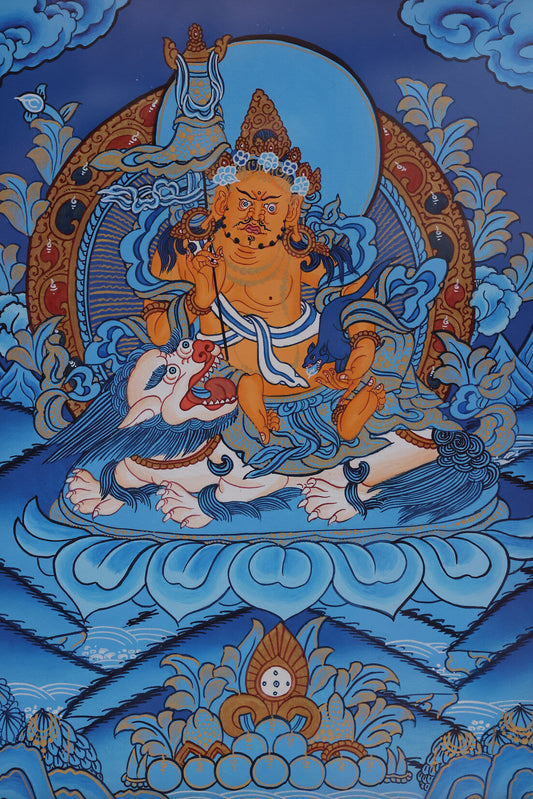
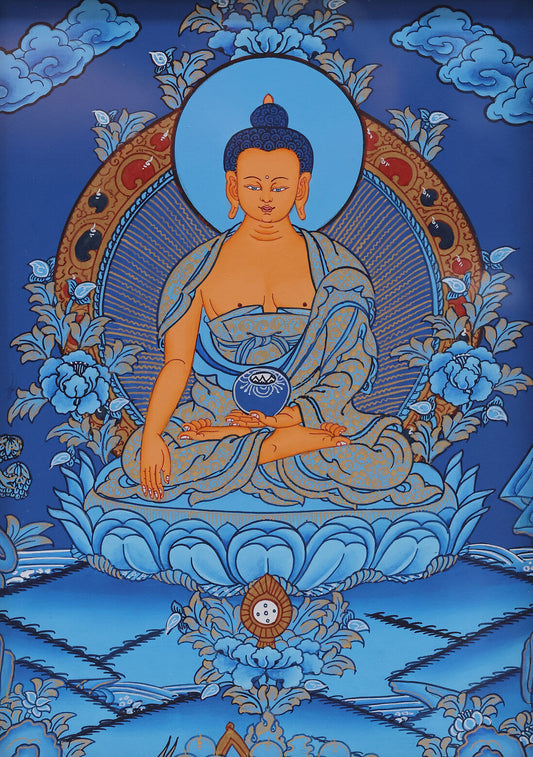
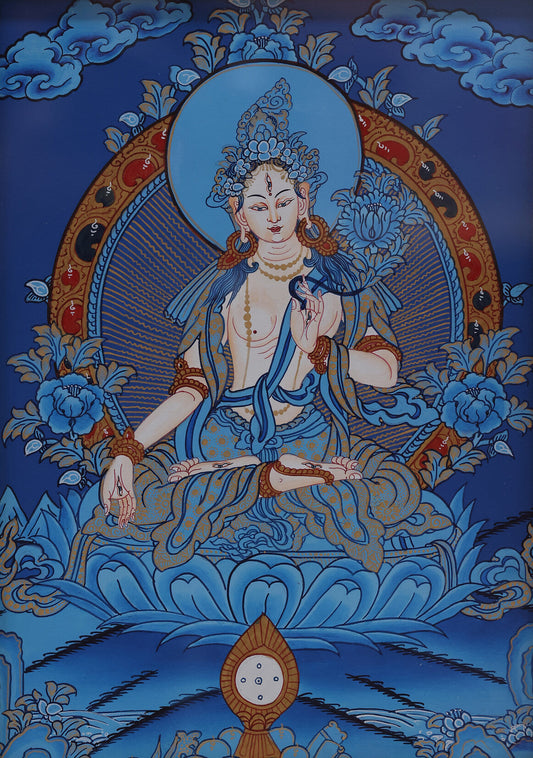
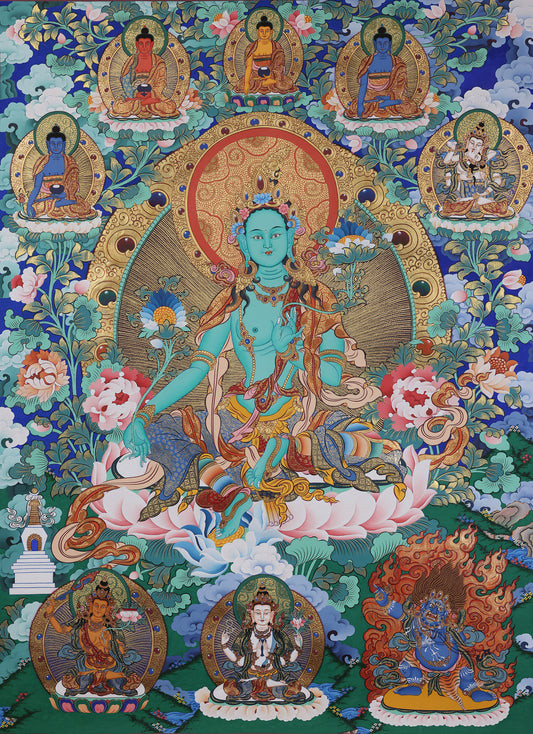
When you gaze at Amitabha in a hand-painted Tibetan thangka—his crimson form glowing like molten gold, hands in the dhyana mudra cradling a bowl of nectar, rainbow halos and lotus thrones weaving the outline of Sukhavati—you see more than a Buddha: you see the embodied symbol of "hope" and "liberation" in Tibetan Buddhism. In Tibet, Amitabha is called Tsépakmé, a name that carries the dual meanings of "Infinite Light" and "Infinite Life," and this thangka is the visual codebook of his devotional system.
Tibetan Buddhist understanding of Amitabha revolves around the duality of "light" and "life." The crimson form in this thangka is the standard iconography of Amitabha (the Buddha of Infinite Light):
-
Body Color: Crimson symbolizes flame and illumination, corresponding to his vow to "shine unobstructedly over all worlds"—as stated in the Sutra of Infinite Life: "His light illuminates the lands of the ten directions without hindrance."
-
Mudra and Ritual Implement: The hands form the Amitabha Dhyana Mudra, holding a bowl of nectar in the palms. This is both a symbol of "bestowing peace on all beings" and an echo of the "nectar abhisheka" practice in The Shortcut to Sukhavati: Amitabha Practice (a terma revealed by Padmasambhava).
-
Halo and Lotus Throne: The rainbow radial halo represents the Buddha’s light pervading space, while the eight-petaled lotus throne symbolizes "the purity of the pure land." In Tibetan thangkas, Amitabha’s lotus throne is often interwoven with pink and blue, signifying "the union of compassion and wisdom."
In Tibetan devotion, however, Amitabha (Infinite Light) is also Amitayus (Infinite Life): the latter often appears in bodhisattva attire, wearing a five-Buddha crown and holding a longevity vase, and is the object of prayers for long life and good fortune. The 18th-century Thangka of Amitabha’s Sukhavati in the Palace Museum collection depicts both the Buddha-form Amitabha and the sambhogakaya-form Amitayus, confirming the Tibetan Buddhist tradition of "one Buddha, two forms."
The foundation of Amitabha devotion lies in the forty-eight vows he made as
Dharmakara Bhikshu—a story repeatedly told in the Tibetan
Sukhavati Aspiration Prayer:
In a past eon, Dharmakara Bhikshu, a disciple of Buddha Lokesvararaja, spent five eons contemplating the merits and flaws of other Buddhas’ pure lands, then vowed: "If I attain Buddhahood, sentient beings of the ten directions who sincerely believe and wish to be reborn in my land, even with ten recitations [of my name], shall be reborn there; if not, I will not attain perfect enlightenment." (
Sutra of Infinite Life)
In the Tibetan context, this vow is invested with special significance as "salvation in the Age of Degeneration." Rinpoche Danzhen Rongbu has taught: "Beings in the Age of Degeneration are burdened by afflictions, making rebirth in other pure lands difficult. Amitabha’s vows are a shortcut prepared for ‘bonded ordinary beings.’" This is why Tibetan villagers, even amid farm work, carve the mantra "Om Ami Dewa Hrih" (or the extended "Om Ami Dewa Ayisdeh Hung Sheh") into prayer wheels—they believe each turn of the wheel connects them to Sukhavati.
In Tibetan Buddhism, Amitabha practice is not limited to "name-recitation" but integrates tantric visualization and ritual, with core elements including:
Based on Padmasambhava’s terma, practitioners first visualize themselves as Chenrezig (Avalokiteshvara), with a crimson Amitabha appearing on a lotus-moon seat before them. The syllable
"Sheh" at the Buddha’s heart emits light, inviting all Buddhas of the ten directions to merge into the main deity—this "self-other exchange" visualization aims to unify one’s own mind with the Buddha’s compassion and wisdom.
The Shortcut to Sukhavati: Amitabha Practice, translated by Khenpo Sodargye, specifies that reciting the mantra 300,000 times grants the siddhi of "Buddha’s presence and blessing," eliminating premature death and ensuring one is guided by the Buddha at the time of passing.
Tibet also has a unique Amitabha Sleep Practice: before sleeping, visualize oneself as Amitabha, or visualize the Buddha resting atop one’s head, and fall asleep in the state of "non-duality between one’s own mind and the Buddha’s mind." Jamyang Khyentse Wangpo records in Essential Practices: Garland of Jewels that practitioners of this method "experience no pain at death, are embraced by the Buddha in the bardo, and are certain to be reborn in Sukhavati."
Tibetan monasteries often hold Sukhavati Assemblies, where devotees gather to recite the Sukhavati Aspiration Prayer and offer tormas (ritual cakes) of 酥油 (butter) and 糌粑 (roasted barley flour). This collective practice not only accumulates merit but also makes "rebirth in Sukhavati" a shared spiritual pursuit—like the scene at Lhasa’s Shoton Festival, when a giant Amitabha thangka is unfurled and ten thousand people prostrate: a tangible expression of devotional power.
While both traditions venerate Amitabha, Han and Tibetan devotion differ significantly:
-
Practice Focus: Han Pure Land Buddhism centers on "Buddha-name recitation," while Tibetan practice emphasizes "visualization" and "mantra blessing";
-
Iconographic Differences: Han Amitabha is often golden, holding a lotus throne, while Tibetan Amitabha is typically crimson, cradling a nectar bowl;
-
Attendant Configuration: Han traditions pair Amitabha with Guanyin (Avalokiteshvara) and Shizhi (Mahasthamaprapta), while Tibetan traditions often use Guanyin and Vajrapani, forming a Tibetan "Western Trinity."
Yet their core is the same: faith in the possibility of "ordinary beings entering the pure land"—just as Master Yinguang’s teaching that "relying on the Buddha’s compassionate power, one can be reborn with karmic obstructions" aligns with the Tibetan doctrine of "guidance through vows," both affirming the shared hope of liberation for all beings.
At the bottom of this hand-painted thangka, seven colorful wish-fulfilling jewels (Cintāmaṇi) are depicted—representing Amitabha’s "seven sacred treasures": faith, precepts, shame, remorse, learning, generosity, and wisdom. Tibetan people believe that offering such a thangka not only accumulates merit but also lets the light of Sukhavati enter ordinary life.
In Tibetan mountain passes, pastures, and even nomads’ tents, you will always find such thangkas: the crimson Amitabha smiles, his rainbow halo piercing the canvas to merge with the snow-capped mountains and prayer flags outside. For them, this Buddha is not a distant idol, but a companion "present whenever remembered"—as a Tibetan folk song sings: "Amitabha’s light is fire in the snow, a star in the dark, the path to our next life."
Would you like me to put together a simplified step-by-step guide to Tibetan Amitabha practices?
#TibetanBuddhism #AmitabhaBuddha #ThangkaArt #SukhavatiPureLand #TantricBuddhism #Amitayus #BuddhistPractices #TibetanSpirituality #BuddhaVows #RebirthInSukhavati #Sukhavati #TantricPractice