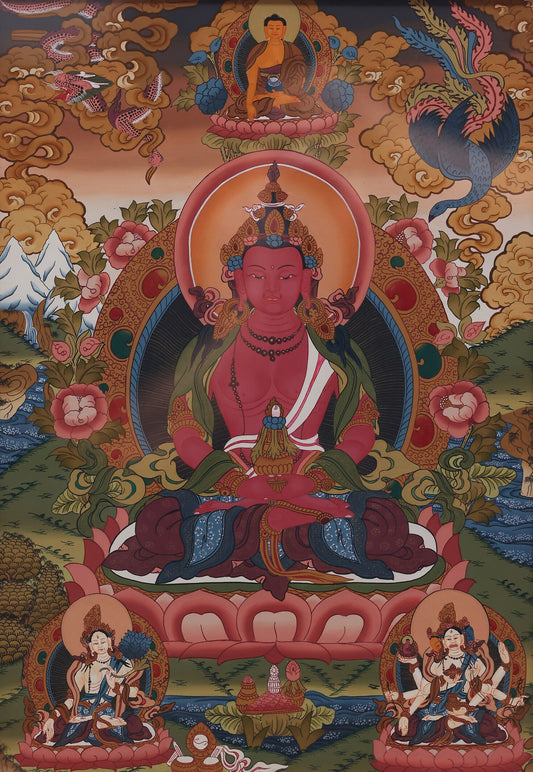
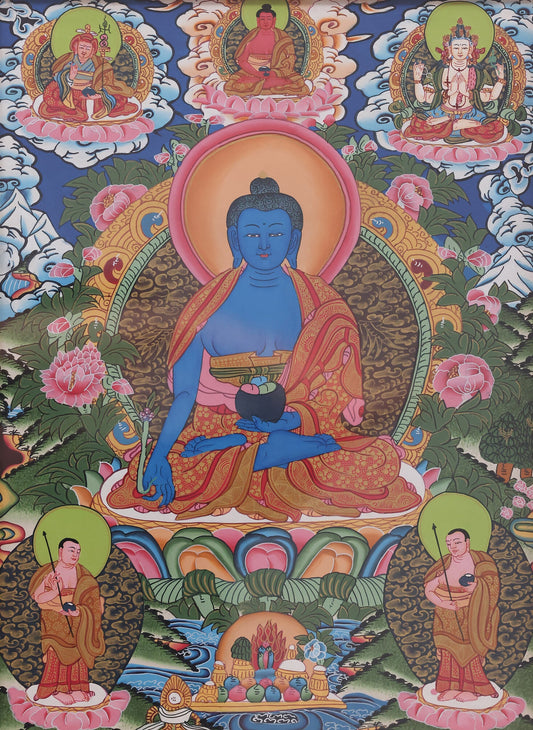
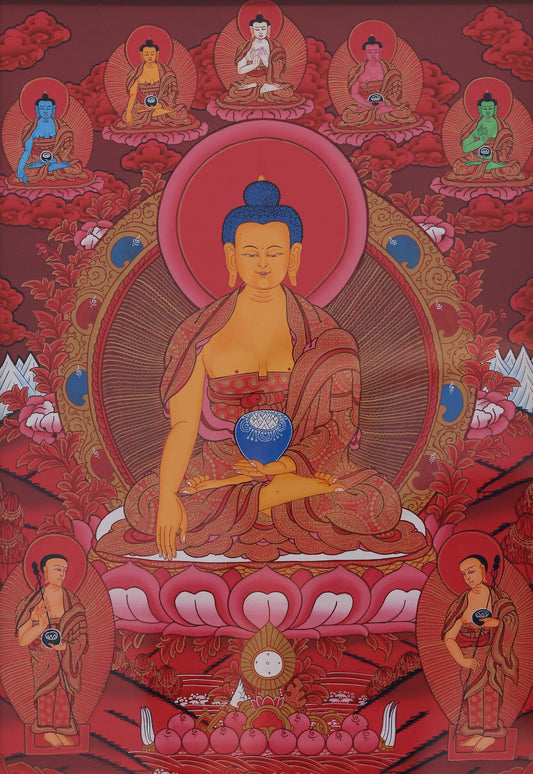
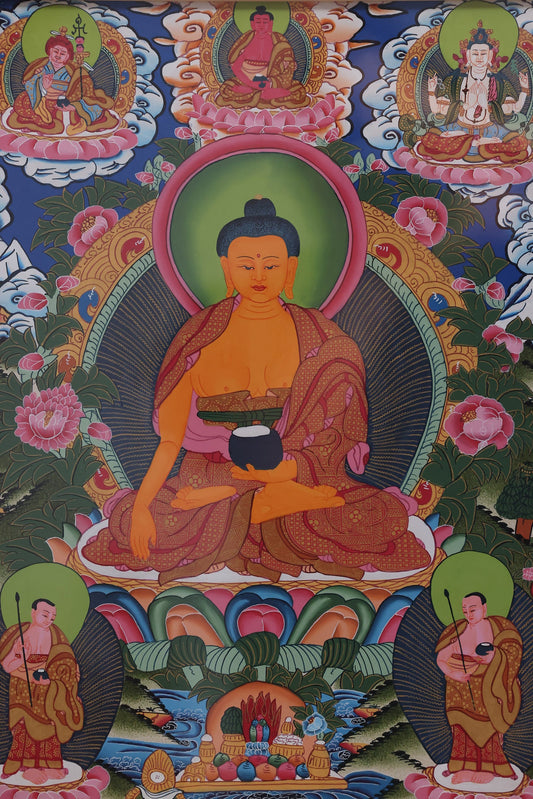
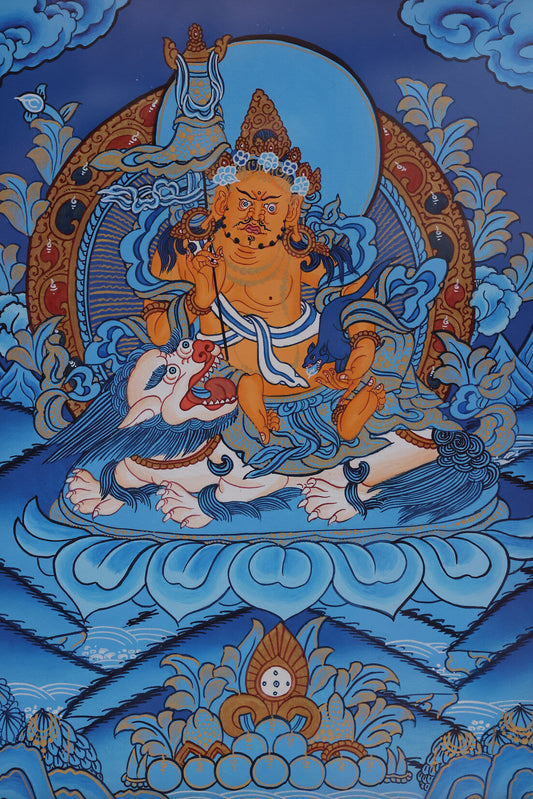
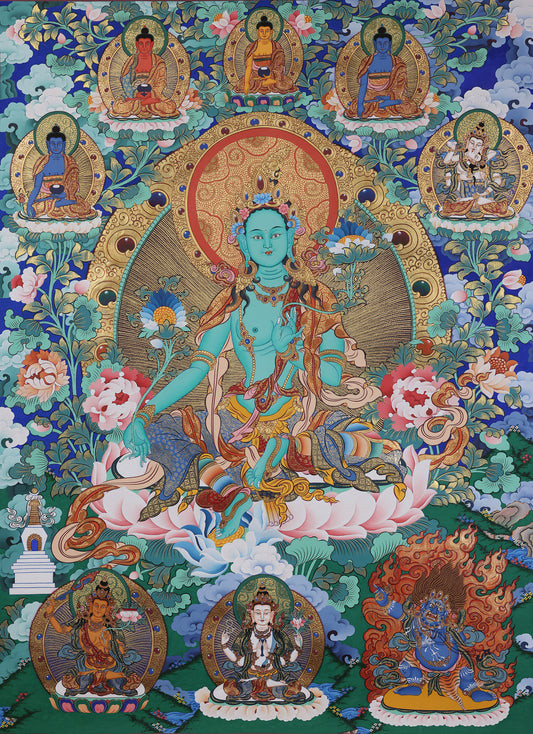
When the cinnabar background and gilded lines of Regong Red Thangka unfold on the canvas, a female bodhisattva with a moon-like form and seven eyes watching the world slowly emerges—this is White Tara, who carries the dual aspirations of "salvation" and "longevity" in Tibetan Buddhism. In Tibetan, she is called Drolma Karmo, both an incarnation of the left-eye tears of Avalokiteshvara and the most revered "Longevity Salvation Goddess" among the 21 Taras. Every detail of this Red Thangka White Tara holds the concrete expression of "compassion" and "wisdom" in Tibetan Buddhism.
The Tibetan Buddhist scripture Origin of Tara records White Tara’s initial origin: In the "Luminous World" of the beginningless eons, when Buddha Shakyamuni (Garuḍa-svara) dwelled in the world, Princess Yeshe Dawa (Moon of Wisdom) of the Naktso Wo Kingdom offered the Three Jewels with supreme good roots. The monks advised her to transform from female to male for better practice, but the princess made a shocking vow: "I will liberate sentient beings in female form until the end of the void."
After eons of practice, she became "Tara"; in the more widely circulated Tibetan legend, White Tara is the incarnation of Avalokiteshvara’s left-eye tears—shed when he saw the suffering of sentient beings in samsara. This tear contained both the bodhisattva’s great compassion and the power of salvation, eventually condensing into White Tara: white in form, with seven eyes watching the world.
Alongside Green Tara (incarnated from Avalokiteshvara’s right-eye tears), she is the core of the 21 Taras, but her unique aspirations lie in "calming disasters" and "extending longevity." Together with Amitayus and Ushnishavijaya, she forms the "Three Longevity Deities," becoming the spiritual anchor for Tibetans to pray for health and long life.
The Regong Red Thangka White Tara before you is a masterpiece of the "Red Thangka" school in Tibetan thangka art—using mineral pigments like cinnabar and ochre for the background, with gilded lines outlining the sacred form, blending solemnity and grandeur. White Tara’s design is a metaphor for Buddhist philosophy in every aspect:
She has one eye on her forehead, one on each palm, and one on each sole—seven eyes total, earning her the title "Seven-Eyed Goddess." The forehead eye "observes all Buddha lands," while the other six "illuminate sentient beings in the six realms." This is not a mythic exaggeration, but the concretization of Buddhism’s "unconditional great compassion, equal-bodied great mercy": she sees the suffering you dare not speak of, and witnesses all hardships in samsara.
Her body is as white as moonlight on a snow-capped peak, symbolizing "the purity and innocence of dharma nature"; she sits cross-legged on a double lotus seat. The lotus, "rising unstained from mud," signifies that she maintains her original nature amid worldly suffering and can guide sentient beings out of the mire of afflictions.
-
Right Hand: Varada Mudra (Gesture of Granting Wishes): Palm facing downward, fingers extended—representing "fulfilling sentient beings’ good wishes"; she will protect the health and peace you seek.
-
Left Hand: Holding a Utpala Flower: The stem curves to her ear, with a vase resting on the blossom. The nectar in the vase symbolizes "nourishing sentient beings with compassion, dispelling illness and afflictions."
The cinnabar background of Red Thangka itself carries the Tibetan cultural meaning of "warding off evil and blessing," perfectly aligning with White Tara’s aspiration to calm disasters.
Tibetans’ faith in her is never abstract worship, but a tangible spiritual connection. Practicing White Tara’s dharma and reciting her mantra (Om Tare Tuttare Ture Mama Ayur Puncane Gyana Pujana Punca Nye Svaha) is believed to bring numerous merits:
-
Longevity and Disaster Calming: Dispels plagues and illnesses, extends lifespan—this is the origin of her title "Longevity Salvation Goddess."
-
Wish-Fulfillment and Protection: Grants requests for children, wealth, and especially protects women and children—Tibetan mothers often enshrine White Tara thangkas for newborns, praying for them to avoid misfortune.
-
Wisdom Growth: As the incarnation of "Princess Wisdom Moon," practitioners gain awakened wisdom and break free from ignorance and afflictions.
In Tibetan mass mantra-recitation ceremonies, chanting White Tara’s mantra hundreds of millions of times prays for the longevity of eminent monks and eliminates obstacles for all sentient beings—this collective spiritual practice allows her compassion to transcend the individual and become a community’s spiritual bond.
Many confuse White Tara and Green Tara, but they are like "twin compassion" of Avalokiteshvara:
-
Aspiration Focus: White Tara specializes in "calming disasters and extending longevity"; Green Tara focuses on "rescuing from hardship and aiding endeavors."
-
Form Distinction: White Tara is white, has seven eyes, and sits cross-legged; Green Tara is green, has two eyes, and sits in half-lotus (right foot hanging down, ready to rise and save).
-
Symbolic Color: White represents "purity," green represents "vitality"—yet both center on "salvation."
They are not two separate deities, but two manifestations of the same compassion—like a mother who both heals her child (White Tara) and reaches out when the child is in danger (Green Tara).
In a religious system dominated by male deities, White Tara’s presence is unique: she attained Buddhahood in female form and protects sentient beings with motherly tenderness, breaking the prejudice that "women cannot become saints."
Tibetan women feel particularly close to her: farmers’ wives enshrine her thangka by the stove to pray for their family’s safety; nuns (Jomo) practice with her as their principal deity, upholding the vow to "liberate in female form" by the oil lamp and ancient Buddha; even modern urban women wear White Tara pendants, seeking compassionate protection amid busy lives.
Her "female power" is not confrontational, but inclusive and nurturing—like the nectar in her hand, silently nourishing every life in need.
As the gilded lines of the Regong Red Thangka glow warmly under the light, White Tara’s seven eyes still watch you calmly. She is not a distant deity, but a symbol of "tangible compassion" in Tibetan Buddhism: every breath, every hardship of yours is within her observation; her aspirations are already hidden in the cinnabar background of the thangka, in every recitation of her mantra.
#WhiteTara #TibetanBuddhism #RedThangka #ThreeLongevityDeities #TaraFaith #BuddhistArt