Green Tara: The Swift Echo of Buddhas' Compassion, the Ultimate Reliance in Crisis

In the pantheon of Tibetan Buddhism, Green Tara has always held a special and lofty position. With her jade-like green form and compassionate, gentle countenance, she has become the symbol of "the most timely salvation" in the hearts of countless believers. When people face natural disasters like landslides and earthquakes, find themselves in the dilemma of having no way out, or sink into the mental mire of lingering afflictions, the invocation of "Om Tare Tuttare Ture Soha" can always arouse the most solid strength within. What kind of spiritual connotation does this Bodhisattva, known as "the embodiment of all Buddhas' activities", carry? What profound meanings lie behind her image? And why has this millennia-old mantra become a spiritual code to transcend suffering? Today, let us step into the compassionate world of Green Tara and explore her trans-temporal power of salvation.
1. Radiance of the Green Neck: The Symbolic Image and Spiritual Meaning of Green Tara
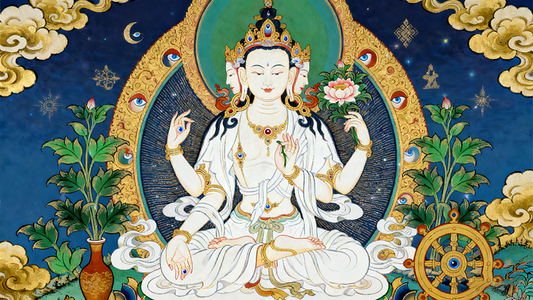
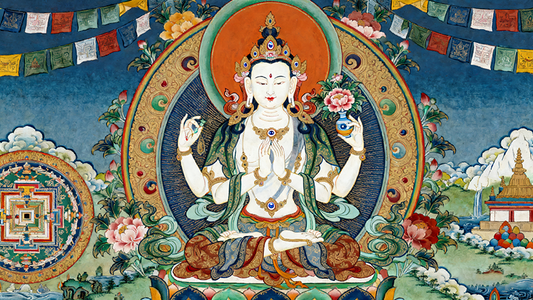
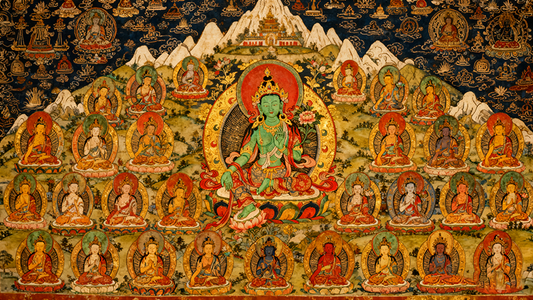
Those who encounter Green Tara for the first time are always drawn to her distinctive and unique image. Different from the majestic and solemn Buddhas in traditional Buddhist statues, Green Tara's form exudes a kind and warm power, with every detail embodying profound teachings and compassionate commitments. In the thangkas, murals, and statue art of Tibetan Buddhism, Green Tara's image follows relatively fixed norms, which are not merely artistic creations but the concrete manifestation of the compassion and wisdom of all Buddhas.
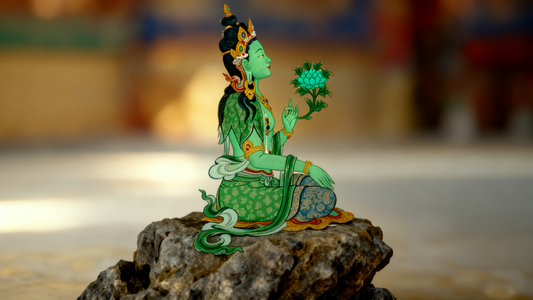
The core symbol of Green Tara is the emerald green radiance emanating from her entire body. In Buddhist culture, green symbolizes life, hope, and healing—like an oasis in the desert that brings vitality to the lost, or the tender shoots of early spring that represent rebirth amidst suffering. This color is not chosen arbitrarily but stems from her characteristic of "swift salvation"; the "vitality and freshness" implied by green precisely symbolize her ability to respond to sentient beings' prayers in the shortest time. She takes the form of a young maiden, with smooth and glowing skin, a compassionately smiling face, and eyes as clear as autumn pools—able to perceive all the sufferings of sentient beings while being filled with unbiased tenderness. This maiden form does not refer to worldly immaturity but symbolizes "primordial purity" and "uncontaminated compassion", meaning her salvation is free from any discriminatory thoughts, as pure and powerful as a newborn life.
In the detailed features of the statues, Green Tara's adornments and postures also hold profound meanings. She wears a five-Buddha crown, symbolizing her command over the wisdom and power of all Buddhas, as she is the embodiment of the collective activities of all Buddhas. Her round earrings represent her ability to hear all calls of sentient beings—no matter how faint the prayer is, she can perceive it. She is dressed in celestial garments and adorned with precious ornaments such as necklaces and armlets. These solemn decorations are not meant to flaunt grandeur but symbolize the boundless merits she possesses—each treasure serves as a skillful means to save sentient beings.
The most representative feature is Green Tara's posture of "sitting cross-legged on a lotus moon disc". The lotus, which grows unsullied from mud, symbolizes that although she abides in the cyclic world of samsara, she remains untainted by afflictions. The cool and bright moon disc represents that her compassion can dispel the burning anguish of sentient beings' sufferings. Her right hand forms the "wish-fulfilling mudra" with the palm facing outward, as if transmitting the power of salvation to sentient beings and promising that "all sincere prayers will be fulfilled". Her left hand holds a blooming blue utpala flower, with its stem winding up to her ear. In Buddhism, the utpala flower symbolizes "rarity and preciousness", implying that her salvation is as valuable as this flower yet equally accessible to all sentient beings. In some statues, Green Tara's left foot is slightly lowered in a "half-lotus posture", known as the "salvation posture", symbolizing that she is always ready to rise up to save sentient beings without hesitation—this is also the intuitive
manifestation of her "swift response".
In the folk beliefs of Tibet, Green Tara's image has long transcended the scope of religious statues to become a cultural symbol. Her figure can be found everywhere—in herders' yurts, in the halls of monasteries, and in the portable thangkas of believers. People believe that as long as they hold her image in their hearts, they will receive her protection in times of crisis. This belief is not blind worship but stems from trust in "compassion" itself, and Green Tara is the most vivid embodiment of "compassion".
2. The Esoteric Meaning of the Mantra: The Source of Power in "Om Tare Tuttare Ture Soha"
If Green Tara's image is the external manifestation of compassion, then her core mantra "Om Tare Tuttare Ture Soha" is the condensation and carrier of compassionate power. This concise mantra, known as the "salvation mantra" in Tibetan Buddhism, has helped countless believers overcome dangers over thousands of years. It acts as a spiritual link connecting the prayers of sentient beings with Green Tara's compassion. Many people wonder why a seemingly simple mantra can exert such tremendous power. Behind this lies not only the essence of Buddhist teachings but also the profound connection between language and mindset.
First, we need to understand the essence of "mantras" in Buddhism. In the tradition of Tibetan Buddhism, mantras are not mysterious "magical incantations" but "the embodiment of all Buddhas and Bodhisattvas' merits" and "the sonic manifestation of wisdom and compassion". Each syllable corresponds to a specific merit of the Bodhisattva; the process of reciting a mantra is essentially using the vibration of sound to arouse resonance between one's own being and the Bodhisattva's merits, thereby purifying the mind and gaining strength. Each syllable of Green Tara's mantra has a clear meaning, and together they form a complete connotation of salvation.
The opening syllable "Om" is the most fundamental and core syllable in Buddhist mantras, known as the "primordial sound of the universe". It symbolizes "the origin of all phenomena", represents Green Tara's wisdom and Dharmakaya, and signifies that the practitioner connects with the universal compassionate power from the very beginning, laying the foundation for prayers. This syllable is like a key to open the door, quickly purifying the practitioner's body and mind and focusing their thoughts on the frequency of compassion.
The subsequent "Tare" is the core part of Green Tara's mantra and the direct manifestation of her "salvation" attribute. In Sanskrit, "Ta" means "to escape" or "to transcend", while "Re" represents "suffering"; together, they mean "escaping from suffering". The word "Tare" appears three times in the mantra, corresponding respectively to "escaping from the suffering of the three poisons—greed, anger, and delusion", "escaping from the suffering of birth, old age, illness, and death", and "escaping from the suffering of cyclic samsara". These three levels of salvation cover all predicaments of sentient beings from worldly afflictions to ultimate suffering, embodying the comprehensiveness and thoroughness of Green Tara's salvation.
What is particularly special is that different prefixes are added before the three "Tare"s, forming a progressive structure of "Tare, Tuttare, Ture". This structure is not a simple repetition but symbolizes the "gradual strengthening" and "immediate response" of Green Tara's salvific power. The first "Tare" is "perceiving suffering", representing her instant awareness of sentient beings' predicaments; the second "Tuttare" is "initiating salvation", representing her immediate activation of the vows and actions of salvation; the third "Ture" is "perfecting salvation", representing her ability to completely resolve sentient beings' sufferings without leaving any remnants. This progressive syllabic design appropriately demonstrates her characteristic of "swift response"—from perception to action, and then to the perfect resolution, the entire process is seamless and unhesitant.
The concluding syllable "Soha" in the mantra is a common ending in Buddhist mantras, meaning "accomplishment", "auspiciousness", and "swift perfection". It is not only a blessing for the prayer but also a "confirmation of faith"—signifying that the practitioner's prayers will surely be fulfilled under Green Tara's compassionate protection. At the same time, it reminds the practitioner to face salvation with firm faith and believe that the power of compassion can overcome all sufferings.
Beyond the meaning of the syllables, the power of Green Tara's mantra also stems from
"the blessing of the lineage" and "the concentration of the mind". In Tibetan Buddhism, the transmission of mantras is "oral instruction from master to disciple"; when each guru passes the mantra to a disciple, they also impart the compassionate spirit and essential practice principles contained within it. This lineage is like an unbroken thread of energy, continuously accumulating and strengthening the mantra's power among believers of successive generations. For practitioners, the key to reciting the mantra lies not in "the number of repetitions" but in "the purity and concentration of the mind". When reciting the mantra, if one can simultaneously visualize Green Tara's image and arouse sincere compassion and faith, the power of the mantra will align with the mind, producing extraordinary effects.
In Tibetan folk tales, there are countless records of the mantra's efficacy. A herder lost in a snowstorm saw a blue bird, an incarnation of Green Tara, guiding the way after reciting the mantra; a traveler who slipped off a cliff miraculously grabbed a life-saving vine when reciting the mantra in a moment of crisis; countless people have gained inner peace and the strength to overcome difficulties through reciting the mantra amidst illness and disaster. These stories may have legendary overtones, but they reflect people's yearning for compassion in the face of suffering and the powerful role of the mantra as a "spiritual pillar". As a guru once said: "The power of the mantra is essentially the power of faith and compassion. When you recite it with a pure mind, you are resonating with Green Tara's compassion, and at that moment, your own compassion will also be awakened—that is the most fundamental salvation."

3. Swift Salvation: Why Green Tara is the "Primary Reliance" in Times of Crisis
Among numerous Buddhas and Bodhisattvas, the fact that Green Tara is regarded by believers as "the swiftest reliance in times of crisis" is no coincidence. This perception stems not only from her inherent vow qualities and the personal experiences of countless believers in practice but also contains a profound Buddhist philosophy: "The speed of compassion originates from selfless vows."
Green Tara's "swift salvation" first originates from her "vow to liberate sentient beings". According to scriptures such as "The Origin of Green Tara", Green Tara manifested from the tears of Avalokiteshvara Bodhisattva. When Avalokiteshvara Bodhisattva saw sentient beings suffering deeply in samsara, he was filled with great compassion, and his tears, upon falling to the ground, transformed into Green Tara. Green Tara made a great vow before all Buddhas: "May my body be green, endowed with compassionate power, to swiftly save all suffering sentient beings without hesitation or weariness." This vow is the fundamental source of her "swift response"—for her very existence is for the sake of "immediate salvation", and every one of her vows is directed towards "preventing sentient beings from enduring even a moment more of suffering".
Compared with other Buddhas and Bodhisattvas, Green Tara's salvation focuses more on "worldly crises and immediate predicaments". For example, Manjushri Bodhisattva symbolizes wisdom, mainly blessing sentient beings to dispel ignorance; Samantabhadra Bodhisattva symbolizes vow-powered practice, mainly guiding sentient beings to uphold good deeds; while Green Tara's core vow is to "provide direct protection to sentient beings in their most critical moments". This difference in vows makes her the first choice for believers in "emergencies". When facing predicaments that cannot be resolved by one's own strength, people will always invoke Green Tara first, for they believe that this Bodhisattva, characterized by "swiftness", will never leave sentient beings helpless in suffering.
Green Tara's "swiftness" is also reflected in her "skillful means of salvation". She never hinders sentient beings' prayers with "profound doctrines" or "complex rituals". Whether one is a scholar or illiterate, rich or poor, as long as they pray with a sincere heart, they will receive her protection. In Tibet, both the elderly and children can recite her mantra proficiently; even ordinary people who do not understand complex visualization can receive blessings as long as they see her image or hear her name. This "universality" and "accessibility" enable her salvation to "reach quickly" every person in need, without delay due to cumbersome formalities.
From a psychological perspective, the reason Green Tara can provide strength in times of crisis is that her "compassionate image" and "immediate response" qualities can quickly alleviate people's anxiety and fear. When facing sudden crises, people often fall into a state of "helplessness" and "loss of control". Invoking Green Tara essentially establishes a
"connection with the powerful force of compassion"—this connection can provide people with psychological security, allowing them to calm down and find solutions to problems. Many people feel "instant inner peace" after reciting the mantra in critical moments. This is not "magic taking effect", but because the focused prayer diverts anxious emotions and activates one's own potential. This is also a skillful way of Green Tara's "salvation"—awakening inner strength through external invocation.
In the practice system of Tibetan Buddhism, Green Tara's "swift salvation" is not "passively waiting for protection" but "actively practicing compassion". Gurus often teach their disciples: "Invoking Green Tara is not only about seeking her salvation but also about learning her compassionate heart and extending a helping hand when others are in distress." Because the "embodiment of all Buddhas' activities" in Green Tara essentially refers to the "embodiment of compassionate activities"—all her salvific actions are the natural expression of compassion. Therefore, the true "invocation of Green Tara" is to become a "Green Tara-like person", taking swift action to help suffering sentient beings around us. This is the best inheritance of her salvific spirit.
In modern society, the "sufferings" people face may no longer be the traditional natural disasters and man-made calamities, but more "modern predicaments" such as workplace pressure, interpersonal conflicts, and mental anxiety. However, Green Tara's salvific power remains applicable. When you toss and turn at night, troubled by work, reciting the mantra can calm you down and help you find a wise solution; when you are wronged in interpersonal relationships, visualizing her compassion can help you let go of resentment and resolve conflicts with a tolerant heart; when you lose hope in life, her image can rekindle your love for life. For her compassion has never been confined to a certain type of suffering but covers all "physical and mental sufferings" of sentient beings, and her "swift response" has never slowed down with the changes of the times.
4. Conclusion: Let Compassion Be the Background of Life
The reason Green Tara has transcended thousands of years to become a spiritual reliance in the hearts of countless people is essentially because she represents the most inherent longing of humanity—the yearning for compassion and the transcendence of suffering. Her green form is a symbol of life and hope; her mantra is a carrier of compassion and power; her swift salvation is a respect and tenderness for every life.
For believers, Green Tara is a real savior and a reliable Bodhisattva; for non-believers, she is a cultural symbol of "the spirit of compassion", reminding us that in this world full of uncertainties, compassion is the most powerful force, and helping others is the most meaningful way of life. Whether reciting the mantra, visualizing her image, or practicing compassion, the core lies in "filling one's heart with love and kindness". When we can, like Green Tara, respond to others' sufferings with swift action and treat all things in the world with pure compassion, we ourselves will become "embodiments of compassion", illuminating others while warming our own lives.
Finally, may we all remember the compassionate spirit of Green Tara, and with the inspiration of the prayer "Om Tare Tuttare Ture Soha", practice compassion and pass on kindness in our lives. No matter what difficulties we encounter, we should firmly believe that compassion is never far away, and salvation is always at hand. Just as the smile of Green Tara conveys—where there is light in the heart, the road ahead will never be dark; where there is compassion in the heart, suffering will eventually be transcended.
Balises:
Précédent
Twenty-One Manifestations, Myriad Compassion: An In-Depth Interpretation of the Twenty-One Taras' Wisdom and Power
Suivant
White Tara: The Pure Light of Wisdom and Longevity That Reveals Life's True Essence