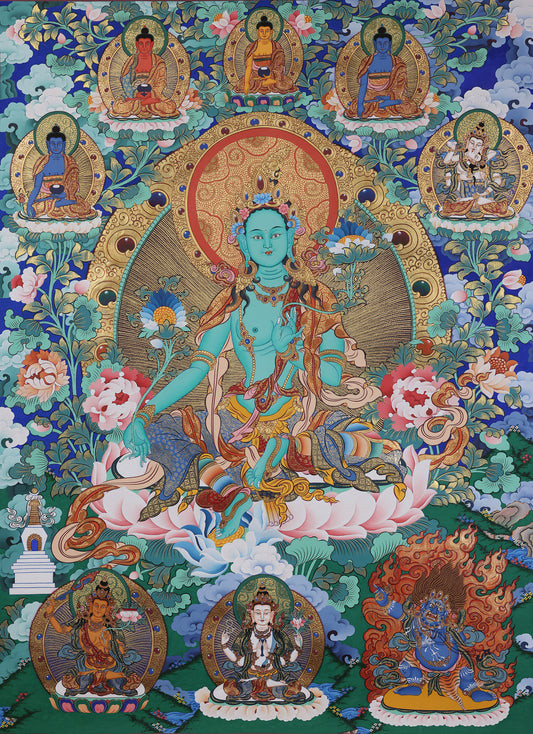
Core Specifications
- Deity: Yellow Dzambhala (Zambala Serpo)
- Origin: Tibet
- Size: 4×5cm
- Pigments: Natural Mineral Pigments
- Case: Dunhuang Nine-Colored Deer Silver Case
- Grade: Collectible
1. Deity Culture: Yellow Dzambhala – The Symbol of Wealth & Compassion in Tibetan Buddhism
As the head of the Five Wealth Deities in Tibetan Buddhism, Yellow Dzambhala (known as "Zambala Serpo" in Tibetan) is not merely a "god of wealth" but a spiritual symbol of balance between compassion and prosperity:
-
Iconographic Codes: Its golden-yellow skin corresponds to the "Earth" element in the Five Elements, representing stable and extensive wealth. The plump, compact figure is not a sign of greed but embodies the compassion to "embrace all suffering beings," aligning with the life philosophy that "a broad mind attracts good fortune."
-
Symbolism of Ritual Tools: The right hand holds a Cintāmaṇi (wish-fulfilling gem), symbolizing the fulfillment of sentient beings’ reasonable desires (encompassing both material and spiritual blessings). The left hand cradles a treasure-spitting rat (filled with jewels in its mouth), representing "generosity as the source of wealth"—giving rather than hoarding, reflecting Buddhism’s concept of "gain through giving." The right foot steps on a white conch, signifying "retrieving treasures from the sea" and mastering the laws of wealth through wisdom.
-
Cultural Evolution: Originating from Kubera, the wealth deity in ancient Indian Brahmanism, it later integrated into Tibetan Esoteric Buddhism as a "treasure protector." Since the Yuan Dynasty, it has been endowed with the folk attribute of "protecting the prosperity of communities," and is now one of the most revered wealth deities in Tibet.
2. Craftsmanship Value: The Millennium Heritage of Tibetan Natural Mineral Pigments
This pendant is painted with traditional Tibetan natural mineral pigments, the core secret to thangkas’ long-lasting vibrancy:
-
Rarity of Raw Materials: Pigments are sourced from unique minerals and plants in the Tibetan Plateau (e.g., azurite for Tibetan blue, realgar, orpiment, pearl powder). They undergo 7 processes including crushing, grinding (particle size refined to 5-20μm), sedimentation, and sorting, taking over a week. For example, the Tibetan blue pigment, associated with copper ores, requires special techniques to separate impurities, costing dozens of times more than chemical pigments.
-
Dual Nature of Art & Science: Research by the Chinese Academy of Sciences shows these mineral pigments not only have high color saturation and lightfastness exceeding 100 years but also their trace elements resonate subtly with the human biofield—an "spiritual material" irreplaceable by chemical alternatives.
-
Collectible Standard: It meets the "≥65% natural mineral pigment content" requirement for collectible grade in the 2025 Thangka Evaluation Standard by China Intangible Cultural Heritage Protection Center, with material costs far surpassing ordinary thangkas.
3. Case Design: Cultural Integration of Dunhuang Nine-Colored Deer Silver Case
The "Dunhuang Nine-Colored Deer Silver Case" blends Tibetan culture with Dunhuang Buddhist art:
-
Buddhist Symbolism of the Nine-Colored Deer: As a classic Buddhist image in Dunhuang Mogao Grottoes, each color of the nine-colored deer carries meaning: white represents the pure Buddha heart, gold symbolizes the light of wisdom, blue corresponds to the vastness of the Dharma realm, and green implies the vitality of practice. The nine-colored deer pattern on the silver case echoes Yellow Dzambhala’s "compassionate protection" attribute while adding the spiritual core of "integrity and justice."
-
Material & Craftsmanship: The silver case uses traditional chiseling techniques, with decorative details restoring Dunhuang mural styles. It combines ornamentation and protection, allowing the miniature thangka to be worn daily without damaging the painting core.
4. Collectible Dimension: The Scarcity Value of 4×5cm Miniature Thangka
In the thangka collection market, small-sized collectible works are emerging as a trend:
-
Spatial Philosophy: Though only 4×5cm, the pendant fully presents the Tibetan cosmology of "Three Realms and Five Directions"—the clouds and snow-capped mountains above correspond to the "Heavenly Realm," the lotus platform where the deity sits represents the "Human Realm," and the treasure patterns at the bottom symbolize the "Earthly Realm," making it a "condensed Tibetan cultural universe."
-
Market Data: In China Guardian Auctions 2025, a 20×30cm Yellow Dzambhala thangka sold for 1.86 million RMB. Miniature collectible thangkas, due to "portability + craftsmanship difficulty," have seen an annual price growth rate of 28.3% in recent years.
-
Certification Standards: As a Tibet-made collectible work, it meets "dual-track certification" (intangible cultural heritage inheritance techniques + natural materials) and is a representative of the "stable collection" category in the 2025 Regong Thangka Market Value Evaluation Report.
5. Wearing & Practice: The Spiritual Significance of Portable Thangka
In Tibetan tradition, portable thangkas (in gau box form) are not just ornaments but spiritual aids for practice:
-
Visualization Value: The image of Yellow Dzambhala can serve as a visualization object for practitioners, helping cultivate the Bodhicitta to "benefit sentient beings with wealth" rather than clinging to material gain.
-
Psychological Regulation: Studies by the Psychology Department of Peking University confirm that the color harmony of natural mineral pigments effectively reduces anxiety and regulates mental states.
-
Cultural Carrier: Wearing this pendant embodies the Tibetan Buddhist concept of "life as practice"—integrating cultural beliefs into daily life while inheriting intangible cultural heritage techniques.
This Yellow Dzambhala Thangka pendant is a triple fusion of Tibetan traditional craftsmanship, Tibetan Buddhist doctrine, and Dunhuang art. It is both a portable "amulet of wealth wisdom" and a miniature collectible artwork with long-term appreciation potential.
Would you like me to prepare a Yellow Dzambhala Thangka Pendant Collection Identification Checklist for you?
#TibetThangkaPendant #YellowDzambhala #CollectibleThangka #NaturalMineralPigmentThangka #TibetanBuddhismArt #DunhuangNineColoredDeer #MiniatureThangkaArt