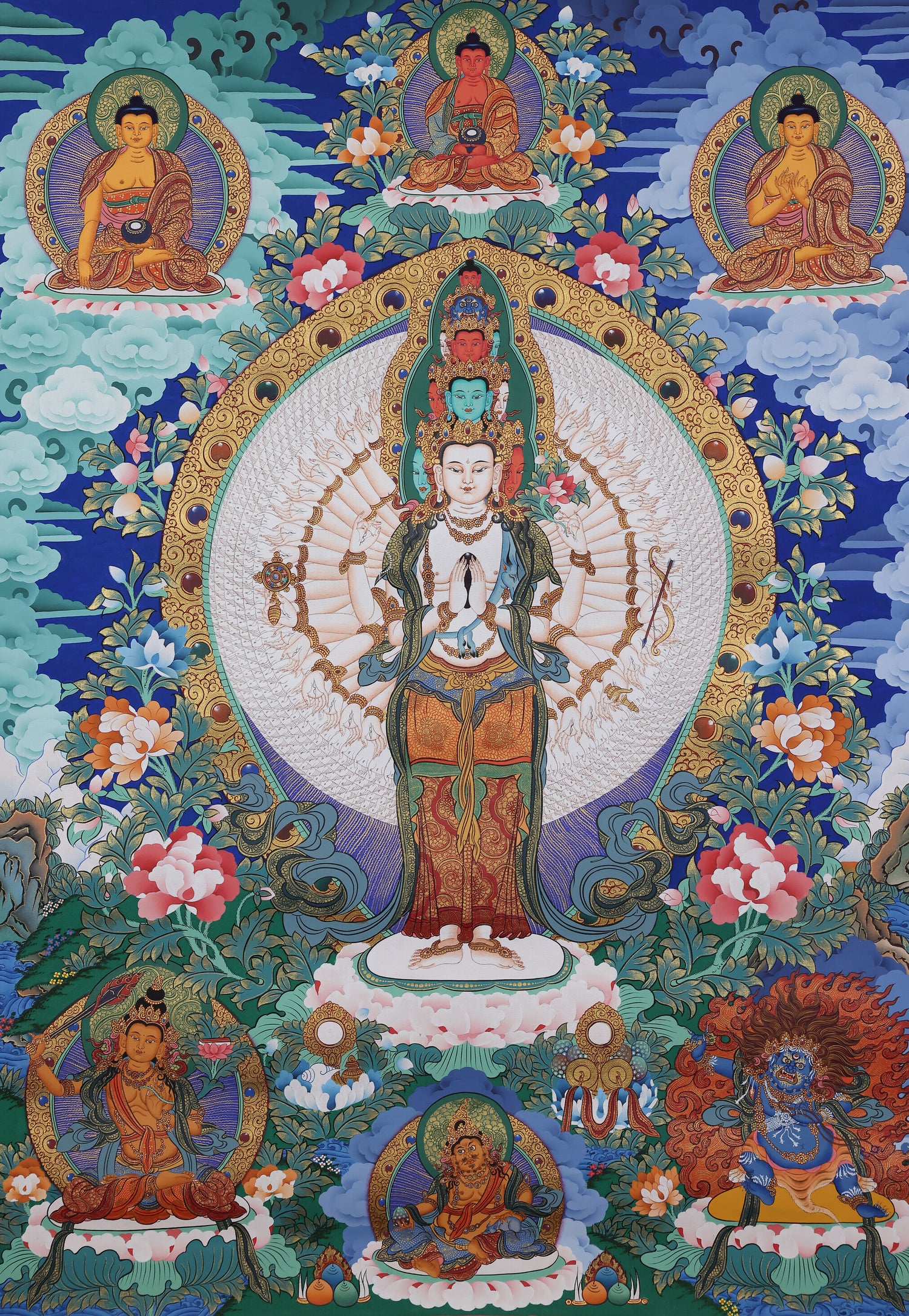
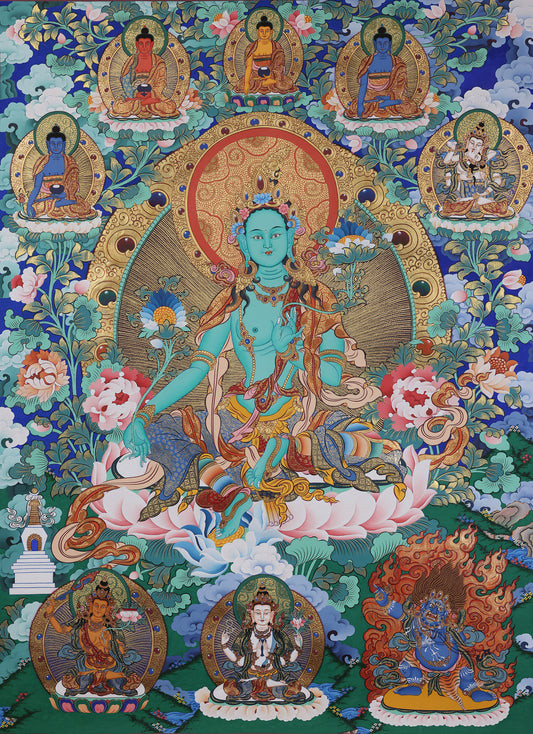
In Tibetan Buddhism, thangkas are often called “mobile temples”—portable, vividly rendered sacred artworks that bridge the spiritual and physical worlds. For Himalayan communities (and global art and spirituality enthusiasts), few thangkas embody this duality as beautifully as the Nepalese hand-painted White Tara thangka (48x66cm, crafted with natural mineral and earth pigments) we’re exploring today.
Rooted in Newari (Nepal’s indigenous artisan tradition) and Tibetan Buddhist iconography, this piece isn’t just a painting: it’s a visual manifesto of compassion, liberation, and timeless craftsmanship. Let’s dive into its layers—from spiritual themes to brushstroke techniques.
At its heart, this thangka depicts the pure land of White Tara (Dolma Karmo in Tibetan)—the “Buddha-Mother of Longevity and Liberation,” and the foremost of the 21 Taras (female bodhisattvas of compassion).
White Tara is believed to be an incarnation of Avalokiteshvara (the Bodhisattva of Compassion), born from his tears of grief for sentient beings’ suffering. Her thangka’s theme centers on her dual role:
-
Relieving suffering: She protects against the “Eight Great Fears” (e.g., fire, wild animals, spiritual ignorance).
-
Fulfilling blessings: She grants longevity, health, and safe childbirth (a reason she’s widely venerated by women in Himalayan cultures).
The 48x66cm medium size is intentional: it’s designed for home shrine display, making this “pure land” accessible to daily spiritual practice—turning a private space into a site of connection with Tara’s compassionate power.
Tibetan Buddhist thangkas follow strict guidelines from the Iconometry Sutras (texts dictating sacred proportions), and this White Tara adheres to every detail—each element carries spiritual meaning:
White Tara’s most iconic feature is her seven eyes: one on her forehead (gazing at the Buddha realms) and one on each palm and sole (watching over the six realms of samsara). This isn’t decorative: it symbolizes her omniscient compassion—she sees suffering wherever it exists, and responds instantly.
Her alabaster skin aligns with her “pacifying” (shanti) spiritual role: white represents purity, clarity, and the dissolution of negative karma. Her form (modeled after a 16-year-old maiden) follows the “nine cubits” proportion rule (108 finger-widths tall), balancing divine grace with relatable human softness.
She sits in the ardhasana (half-lotus) pose—one foot grounded on a lotus, the other folded—signaling she is not detached from the world (unlike full-lotus meditative poses) but actively engaged in liberation.
- Her right hand forms the abhaya mudra (fearless gesture): a promise of safety and ease for all who call on her.
- Her left hand holds a stem of the utpala (blue lotus), which blooms in three stages (bud, half-open, full) to represent the Three Jewels (Buddha, Dharma, Sangha)—the foundation of Tibetan Buddhist practice.
Her aura layers encode spiritual hierarchy:
- Inner black radiating halo: Dispels ignorance (the root of suffering).
- Middle turquoise scroll halo: Symbolizes life-giving purity.
- Outer golden lotus halo: Connects her to the pure land’s abundance, separating her from the mundane world.
No thangka exists in isolation—its attendant figures anchor White Tara to a larger spiritual lineage and protective system:
-
Top: Amitabha BuddhaThe small red Buddha above White Tara is Amitabha (the Buddha of the Western Pure Land). As Avalokiteshvara’s teacher (and White Tara’s spiritual ancestor), he represents the thangka’s lineage root—linking Tara’s compassion to the core of Buddhist enlightenment.
-
Left Attendant: Saraswati (or Fire-Protection Tara)The pale yellow figure holding an utpala lotus is Saraswati (the bodhisattva of wisdom) or a specialized Tara form (Fire-Protection Tara). She embodies the wisdom needed to understand Tara’s teachings and avoid self-inflicted suffering.
-
Right Attendant: Blue Yaksha GuardianThe indigo figure holding a ritual vase is a Yaksha guardian—his mild “wrathful” expression isn’t aggression, but the power to repel obstacles (illness, misfortune) that block spiritual progress.
-
Bottom: Dharma WheelThe eight-spoked wheel at the base (resting on a lotus in flowing water) represents the Eightfold Path—Tara’s compassion is not just a feeling, but a path of ethical action to reach liberation. The water symbolizes the purification of negative karma.
This thangka’s longevity (it can last 100+ years) and vibrancy come from Newari artisans’ unbroken, centuries-old techniques:
The base is Nepalese linen (sturdier than Tibetan cotton), treated with 3 layers of cowhide glue and white clay paste—sanded smooth to create a uniform, absorbent surface for pigments.
Every hue comes from earth and stone (no synthetic dyes):
-
Red: Crushed cinnabar (HgS), processed in 18 steps to deepen its tone and resist fading (used for Amitabha’s robes).
-
Blue: Afghan lapis lazuli (ground to 5–20μm particles), graded by brightness (used for the Yaksha and lotuses).
-
Green: Malachite (CuCO₃・Cu (OH)₂), mixed with blue 铜矿 for depth (used for foliage).
-
Gold: 24K gold foil, hammered to 0.12μm thickness (used for halos and ornaments)—symbolizing divine light and imperishability.
Pigments are mixed with 5-year-old cowhide glue (aged to improve flexibility) in a 3:1 ratio—ensuring they bond to the linen without cracking.
Newari artisans follow 12 strict steps:
- Canvas treatment
- Proportion sketching (per Iconometry Sutras)
- Pigment grinding
- Base color application (3–5 layers)
- Detail shading (with squirrel-hair brushes)
- Gold linework
- “Opening the eyes” (the final, sacred step—artisans meditate before painting the deities’ eyes to infuse them with life)
This thangka isn’t just “Tibetan art”—it’s a product of Newari (Nepal’s Kathmandu Valley indigenous) style, which blends Tibetan iconography with Indian and local influences:
-
Vibrant, dense decoration: No blank space—clouds (curled, Newari-specific motifs), peonies (symbolizing worldly blessings), and pine trees (longevity) fill the background, creating a sense of “abundant pure land.”
-
Soft, humanized forms: Unlike the starker lines of Tibetan thangkas, Newari thangkas use “orchid leaf” brushstrokes for flowing robes and layered plant-dye shading for skin—making deities feel both divine and relatable.
-
Cultural fusion: The lotus species, cloud patterns, and guardian’s attire all reflect Nepal’s local flora and folklore—proof of Himalayan culture’s cross-border exchange.
This 48x66cm White Tara thangka is more than art: it’s a living tradition. It carries the compassion of White Tara, the skill of Newari artisans, and the shared spiritual heritage of Tibet and Nepal. For practitioners, it’s a mobile temple; for art lovers, it’s a window into how Himalayan communities turn faith into tangible beauty.
#WhiteTaraThangka #NepaleseThangkaArt #TibetanBuddhistThangka #HandPaintedThangka #MineralPigmentThangka #NewariThangkaStyle #SpiritualHimalayanArt