Nepal Red Thangka of Black Jambhala: Decoding the Tibetan Buddhist Wealth Philosophy, Ancient Craftsmanship, and Newari Art Style in a Miniature Mandala

$499.00 USD
Thangka name: Red Tang Black God of Wealth
size: 20cm×30cm
origin: Nepal
Ask a Question

Hurry Up! Only 100 left in stock!

Estimate delivery times: 12-26 days (International), 3-6 days (United States).

Return within 45 days of purchase. Duties & taxes are non-refundable.

Red thangka depicting Black Jambhala, the Tibetan Buddhist wealth deity, symbolizing prosperity, abundance, and protection
Nepal Red Thangka of Black Jambhala: Decoding the Tibetan Buddhist Wealth Philosophy, Ancient Craftsmanship, and Newari Art Style in a Miniature Mandala
$499.00 USD
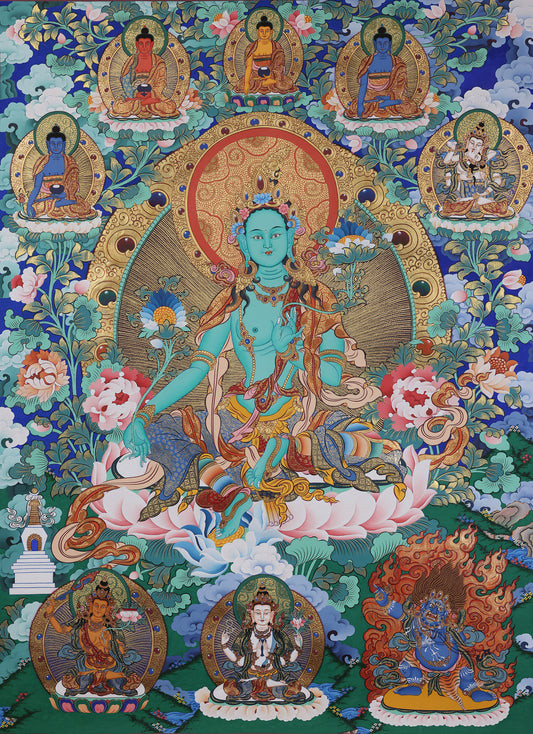
When a 20×30cm Nepalese Red Thangka of Black Jambhala is laid out on a desk, it is far more than a "fortune-seeking wall hanging"—it is a miniature mandala of Tibetan Vajrayana Buddhism, embodying the principle of "guiding sentient beings through wrathful form, dispelling hardship through wealth." It is a product of Nepalese artists’ ancient craftsmanship, where mineral pigments converse with the earth, and a vivid expression of how Tibetan Buddhist faith integrates into daily life.
I. Tibetan Buddhist Wealth Philosophy: Black Jambhala Is Not a "God of Wealth"—He Is an Incarnation of Compassion and Wisdom
Within the Tibetan Buddhist pantheon of the Five Wealth Gods, Black Jambhala (Tibetan: Zambala Lönpo) is fundamentally an incarnation of compassion and wisdom manifest by Akshobhya Buddha (the Buddha of the East) to alleviate the suffering of poverty. The "red background" of this thangka already signals its core theme: in Tibetan Vajrayana thangkas, red corresponds to "vitality and the deterrent power of wrathful deities," echoing both Black Jambhala’s wrathful form (meant to subdue the three poisons of greed, anger, and delusion) and the underlying meaning of "converging good fortune."
Unlike the secular conception of a "god of wealth," Black Jambhala’s "bestowal of wealth" is a skillful means (upāya): when devotees enshrine this thangka, they do not merely pray for material abundance. Instead, they seek to "eliminate obstacles such as enemies, theft, and illness," using wealth as a medium to achieve "peace of body and mind, and the ability to practice diligently." This reflects the Vajrayana logic of "using desire to lead beings toward enlightenment": first, satisfy sentient beings’ virtuous wishes with wealth, then guide them to avoid attachment to wealth, and ultimately lead them toward liberation.
II. Symbols of the Main Deity: Purity and Guidance Within Wrath
Every detail of Black Jambhala at the center of the thangka is a Vajrayana code rooted in the Iconographic Measurements Scripture (Zholyig):
  • Form: Cyan-blue skin, three eyes, red hair and beard: The cyan-blue skin symbolizes "innate purity, free from all attachments"; the vertical third eye on the forehead represents "seeing past, present, and future karma"; the red hair and beard, like flames, signify "burning away afflictions and subduing demons."
  • Implements: Kapala bowl and treasure-vomiting rat: The right hand holds a kapala (a bowl made from a human skull), not as a symbol of violence, but as a vessel of wisdom that "dispels the delusion of ‘permanence, pleasure, self, and purity’ through the image of life and death." The left arm cradles a nüli (treasure-vomiting rat), whose mouth holds a wish-fulfilling jewel (Cintāmaṇi), symbolizing "inexhaustible wealth to fulfill all virtuous wishes."
  • Posture: Treading a human figure, coiled by a serpent: The feet pressing on a prostrate human figure symbolize "crushing the karmic obstacles of poverty"; the green serpent (one of the Eight Dragon Kings) coiled around his body represents "mastery over rain and subterranean treasures," implicitly linking wealth to the vitality of nature.
  • Ornaments: Five-Buddha crown and flaming aura: The Five-Buddha crown indicates his identity as an "incarnation of the Five Dhyani Buddhas"; the flaming aura (interwoven with red and gold) serves as both a "field of divine power" and a metaphor for "burning away obstacles with the fire of wisdom."
III. Background: A Vajrayana Cosmos in a Single Image
Though this small thangka lacks elaborate retinue deities, its minimalist background constructs a Vajrayana cosmology:
  • Prostrate figure and jewel pile: The prostrate human figure embodies the "materialization of poverty’s karmic obstacles"; treading upon it symbolizes "smashing the root causes of hardship." The pile of wish-fulfilling jewels beside the figure visualizes "the transformation of karmic obstacles into merit."
  • Moon disc and serpent: The white moon disc beneath Black Jambhala symbolizes "emptiness wisdom"—wealth must be rooted in non-attachment to serve as a support for practice, not a source of affliction. The coiled green serpent is a metaphor for "mastery over the sources of wealth," aligning with Black Jambhala’s reputation as the "swiftest to bestow wealth."
IV. Ancient Craftsmanship: A Millennium of Tradition in Earthly Pigments
Painted with "mineral and earth pigments," every step of this thangka is a devotional practice by Nepalese artists:
  • Canvas: Purification with Aconitum juice: White cotton cloth is soaked in Aconitum (wolfsbane) juice (to repel insects and preserve the fabric) and repeatedly polished until its surface is silk-like. Even for a 20×30cm thangka, canvas preparation takes 3–5 days, part of the "pre-painting ritual."
  • Pigments: Gifts from nature:
    • The cyan-blue hue comes from lapis lazuli (imported from Central Asia): Processed via "rough crushing → fine grinding with a buffalo-horn mortar → water separation," the finest powder is used for the face, medium-grade for the body, and coarse particles for the background. Pyrite impurities in lapis lazuli create natural "golden speckles," lending a sacred texture to the skin.
    • The red background uses cinnabar ore: Washed with white liquor, ground repeatedly, and mixed with yak bone glue, its stability ensures the color will not fade for centuries—embodying both "good fortune and deterrence."
    • Gold details (aura, ornaments) use 24K gold leaf: Hammered until paper-thin, ground into powder, and mixed with honey, it outlines patterns symbolizing "the light of Buddha-nature."
  • Technique: The Rhythm of Newari Art: Created via "charcoal sketch → light ink outlining → layered pigment blending → gold line detailing," the style features fluid, decorative lines. The contours of Black Jambhala’s muscles and scrollwork patterns extend the artistic tradition of Nepalese textiles into thangka painting.
V. Style: Fusion of Newari and Tibetan Aesthetics
This thangka blends the Nepalese Newari school with Tibet’s Menri style:
  • Compact composition: The main deity occupies over 80% of the 20×30cm space, aligning with the Newari tradition of "central deity supremacy" and suiting personal enshrinement.
  • Vibrant colors: The red-gold base contrasts sharply with cyan-blue and black, reflecting the Newari school’s "bold use of color."
  • Wrath with kindness: Though a wrathful deity, Black Jambhala’s rounded facial features (a hallmark of Newari art) subtly convey "compassionate guidance."
Conclusion
This small Red Thangka of Black Jambhala is a three-dimensional carrier of "faith, craftsmanship, and symbolism": it interprets compassion through wrath, guides practice through wealth, and preserves a millennium of tradition in earthy pigments. For devotees, it is a "portable mandala"; for viewers, it is a window into Tibetan Buddhism’s "seeing the infinite in the finite"—every stroke of mineral pigment is a dialogue between nature and faith.

#NepaleseThangka #BlackJambhalaThangka #TibetanBuddhistArt  #NewariArtSchool #MineralPigmentThangka #RedThangkaAnalysis #VajrayanaArt #HandpaintedThangka #BuddhistWealthPhilosophy

Discover the perfect Tibetan Buddhist Thangka that matches your wishes, lifestyle, and space. Each Thangka carries spiritual meaning and brings blessings when placed correctly.

1. Define Your Intention

Wealth & Success → Yellow Dzambhala (Wealth Deity)

Compassion & Peace → Avalokiteshvara, Green Tara

Wisdom & Learning → Manjushri

Health & Healing → Medicine Buddha

Longevity & Family Protection → White Tara

2. Choose by Identity

Entrepreneurs & Business Owners → Wealth Deities for prosperity.

Students & Scholars → Wisdom Deities for focus and clarity.

Healers & Yoga Practitioners → Medicine Buddha for energy and balance.

Families & Homemakers → Tara Deities for harmony and safety.

Collectors & Art Lovers → Rare Mandalas or Masterpiece Thangkas.

3. Match Your Space

Home Shrine / Meditation Room → Medium Thangkas (60–80 cm).

Office / Business Hall → Large Thangkas for prosperity and authority.

Living Room / Study → Decorative Thangkas for peace and beauty.

4. Authentic Craftsmanship

Hand-painted with natural mineral pigments and fine canvas, each Thangka reflects Tibetan artistry and spiritual power. Verified sources ensure quality and respect for tradition.

✨ Choose your Thangka with heart — it’s not just art, but a blessing for your life.

Different people have different needs, and choosing the right Thangka can provide spiritual support, protection, good fortune, and blessings. Below are Thangka recommendations for various roles:

1. Entrepreneurs

  • Needs: Wisdom, wealth, health, career success.
  • Recommended Thangkas:
    Manjushri: Enhances decision-making and business wisdom.
    Wealth Deity: Brings wealth and prosperity.
    Medicine Buddha: Supports health and reduces stress.
    Mahakala: Protects business from competition and challenges.

2. Successful Individuals

  • Needs: Inner peace, family harmony, longevity.
  • Recommended Thangkas:
    Amitabha Buddha: Brings inner peace and tranquility.
    Avalokiteshvara (Guanyin): Promotes family harmony and happiness.
    Amitayus (Long Life Buddha): Prays for good health and long life.
    Manjushri: Continues to enhance wisdom.

3. Housewives/Husbands

  • Needs: Family harmony, protection, health.
  • Recommended Thangkas:
    Avalokiteshvara: Increases family happiness and harmony.
    Protector Deities: Safeguards the family from external disturbances.
    White Tara: Blesses the family with health.

4. Students and Scholars

  • Needs: Wisdom, focus, academic success.
  • Recommended Thangkas:
    Manjushri: Boosts learning, memory, and wisdom.
    Sakyamuni Buddha: Helps with concentration and spiritual practice.
    Jixiang Tianmu: Brings academic good luck and exam success.

5. Artists and Creative Professionals

  • Needs: Inspiration, creativity, artistic achievement.
  • Recommended Thangkas:
    Manjushri: Stimulates creative thinking and inspiration.
    Vajrapani: Helps overcome creative blocks.
    Maitreya: Brings a relaxed and optimistic attitude, easing stress.

6. Travelers and Adventurers

  • Needs: Protection, good luck, success in adventures.
  • Recommended Thangkas:
    Hayagriva: Provides strong protection during travels and clears obstacles.
    Mahakala: Brings good fortune and protection, especially for adventurers.
    Vajrasattva: Helps overcome difficulties and challenges during the journey.

7. Elderly Individuals

  • Needs: Health, longevity, spiritual peace.
  • Recommended Thangkas:
    Amitayus: Prays for long life and good health.
    Medicine Buddha: Promotes healing and physical well-being.
    Avalokiteshvara: Brings compassion and inner peace in later years.

8. Corporate Executives

  • Needs: Leadership, wisdom, teamwork, and business success.
  • Recommended Thangkas:
    Manjushri: Enhances leadership skills and decision-making.
    Wealth Deity: Brings success and prosperity to the business and team.
    Avalokiteshvara: Promotes harmony and balance within the team.

9. Health and Fitness Enthusiasts

  • Needs: Good health, vitality, energy.
  • Recommended Thangkas:
    Medicine Buddha: Enhances physical health and vitality.
    White Tara: Brings health and rejuvenation.
    Vajrasattva: Clears health challenges and boosts energy.

10. Politicians

  • Needs: Leadership, wisdom, peace.
  • Recommended Thangkas:
    Manjushri: Enhances leadership abilities and decision-making.
    Vairocana Buddha: Helps maintain inner peace and wisdom.
    Avalokiteshvara: Promotes societal peace and family harmony.

For all orders exceeding a value of 100USD shipping is offered for free.

Returns will be accepted for up to 10 days of Customer’s receipt or tracking number on unworn items. You, as a Customer, are obliged to inform us via email before you return the item.

Otherwise, standard shipping charges apply. Check out our delivery Terms & Conditions for more details.

Returns will be accepted for up to 10 days of Customer’s receipt or tracking number on unworn items. You, as a Customer, are obliged to inform us via email before you return the item, only in the case of:

– Received the wrong item.
– Item arrived not as expected (ie. damaged packaging).
– Item had defects.
– Over delivery time.
– The shipper does not allow the goods to be inspected before payment.

The returned product(s) must be in the original packaging, safety wrapped, undamaged and unworn. This means that the item(s) must be safely packed in a carton box for protection during transport, possibly the same carton used to ship to you as a customer.

Recently Viewed

Don't forget! The products that you viewed. Add it to cart now.

Pairs well with

Enhance your selection with perfectly matched accessories and complementary products..

People Also Bought

Here’s some of our most similar products people are buying. Click to discover trending style.