I. Thematic Foundation | A Visual Vessel of Pure Land Faith
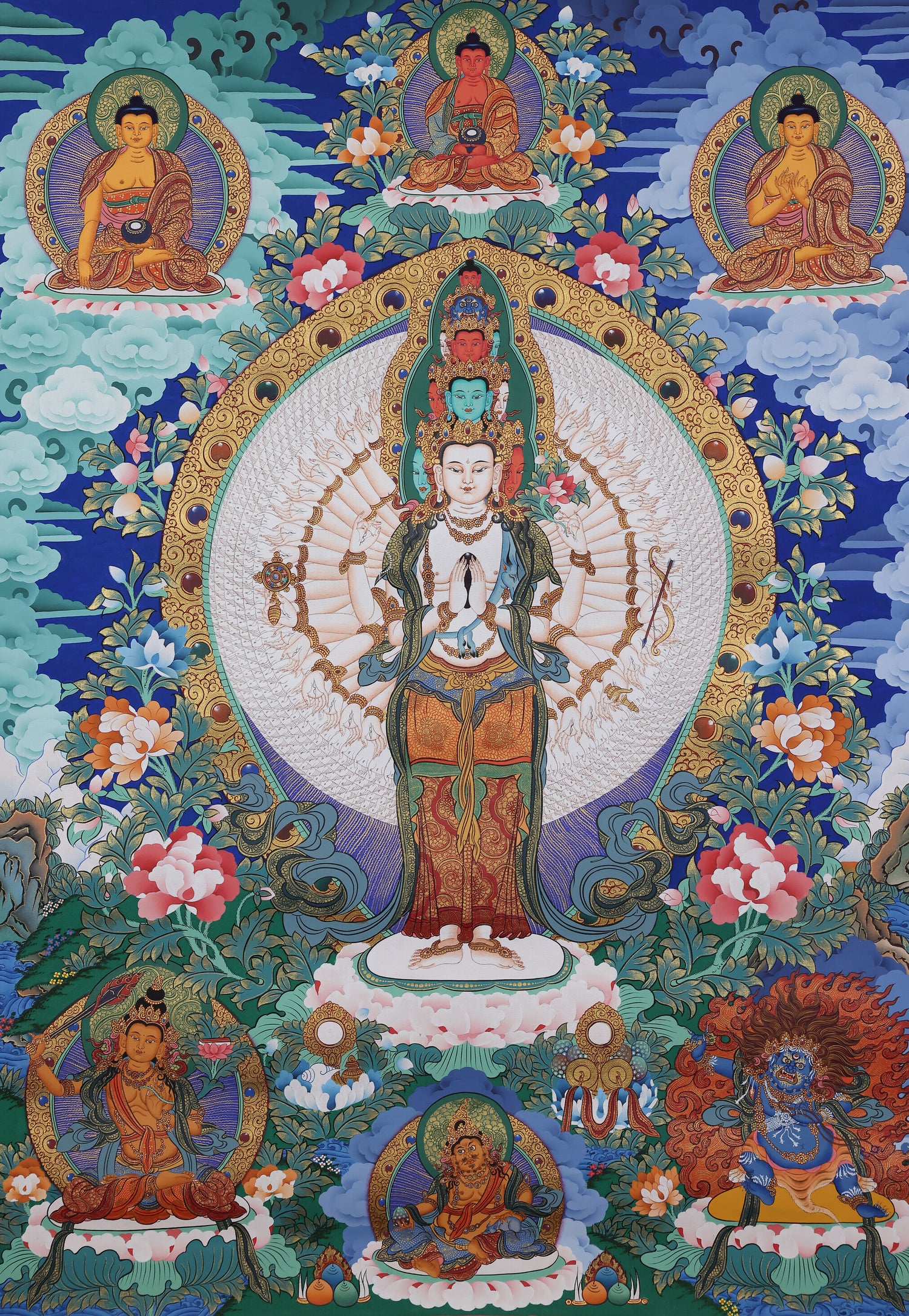
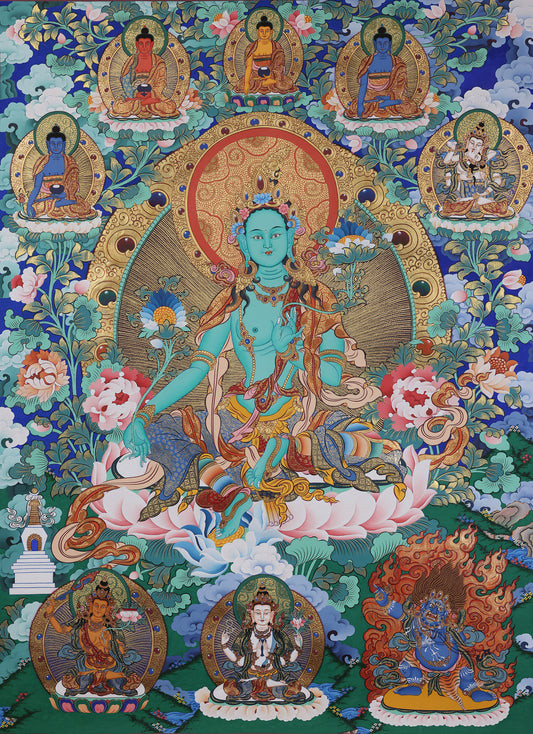
This thangka is centered on the “Amitabha Buddha Pure Land Welcoming Scene”, a profound visual expression of the Western Pure Land belief system within Tibetan Buddhism. Amitabha Buddha, known in Tibetan as the Buddha of Infinite Light, is revered as the lord of the Western Pure Land (Sukhāvatī) and the primary guide who leads sentient beings beyond the cycle of suffering and rebirth toward liberation.
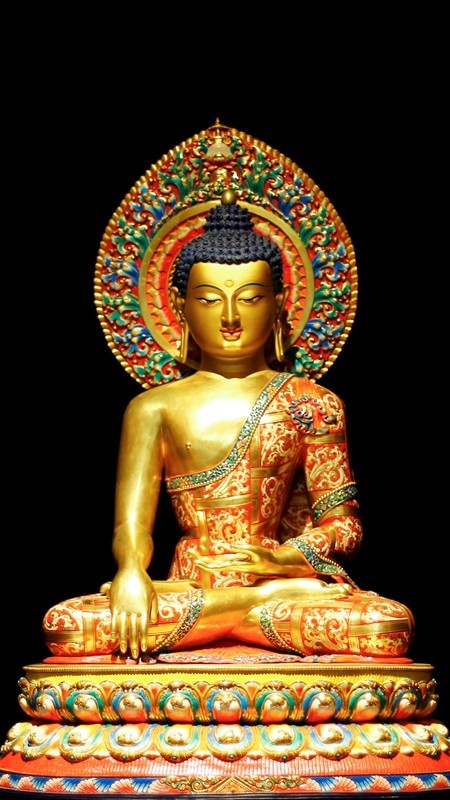
The composition faithfully conveys the Pure Land doctrine through precise iconography. Amitabha Buddha appears with a red body, seated upon a lotus throne, symbolizing his primal vow of infinite light illuminating all realms. Unlike Shakyamuni Buddha, who manifests the Earth-touching mudra in the human world, Amitabha Buddha forms the Dhyāna Mudra while holding a begging bowl, signifying the offering of nectar-like Dharma that nourishes beings and welcomes them into the Pure Land.
From a cosmological perspective rooted in Tibetan Buddhist teachings of the Three Realms and Five Directions, the painting is structured as follows:
-
The upper realm is adorned with golden-red lotus scrolls and auspicious clouds, representing the Realm of Eternal Tranquil Light;
-
The central realm features Amitabha Buddha seated in meditative stillness, symbolizing the Realm of True Reward and Adorned Virtue;
-
The lower realm, containing attendant deities and ritual offerings, corresponds to the Realm Where Ordinary and Enlightened Beings Coexist.
Together, these layers form a spiritual narrative of transition—from the mundane world toward rebirth in the Pure Land—making this thangka a vital support for daily devotional practice as well as end-of-life Pure Land contemplation.
II. Principal Deity | The Sacred Symbolism of Red-Body Amitabha Buddha
At the center of the composition stands Amitabha Buddha, depicted strictly according to the canonical proportions of the Iconometry Sutras, adhering to the 37:25 golden ratio, ensuring both doctrinal accuracy and visual harmony.
Body Color
The Buddha’s body is rendered in a luminous crimson red, the definitive color of Amitabha in Tibetan Buddhism, symbolizing infinite light and the dissolution of karmic afflictions. Layers of mineral coral red and cinnabar are carefully applied to create a warm, flesh-like sacred radiance.
Mudra and Attributes
Both hands form the Meditation Mudra, holding a bowl filled with ambrosial nectar (Amrita), representing the nourishment of wisdom and the compassionate acceptance of all beings.
Robes and Ornamentation
Amitabha wears a traditional monastic robe draped over one shoulder. The robe’s folds are adorned with hand-applied gold lotus scroll patterns. Gold signifies the indestructibility of Dharma, while lotus motifs symbolize purity untouched by defilement.
Halo and Aura
The thangka features a classic three-layer halo system:
-
An inner green body aura decorated with the Eight Auspicious Symbols, signifying the perfection of the Pure Land;
-
A middle golden head halo adorned with scrolling vines, representing the continuity of Buddhist teachings;
-
An outer rainbow cloud aura, symbolizing the Buddha’s light illuminating all realms.
Lotus Throne
The Buddha sits upon a thousand-petaled red lotus throne. Red petals symbolize liberation from suffering, while the golden lotus core signifies the attainment of enlightenment, in direct correspondence with descriptions found in the Contemplation Sutra.
III. Attendant Deities | A Functional System of Compassion and Wisdom
The lower portion of the thangka presents attendant deities and offerings, forming a complete Western Pure Land spiritual support system.
Left Attendant | Mahāsthāmaprāpta Bodhisattva (Yellow Body)
The yellow body color represents the increase of merit and virtuous power. Holding a lotus, Mahāsthāmaprāpta embodies the strength of Amitabha’s vows and safeguards practitioners from regression on the spiritual path.
Right Attendant | Four-Armed Avalokiteśvara (Blue Body)
The blue body signifies pacification and obstacle removal. Holding a nectar vase and prayer beads, this form of Avalokiteśvara represents boundless compassion cleansing karmic obscurations. Together with Mahāsthāmaprāpta, they form a balanced system of wisdom and compassion in union.
Lower Offerings
Below the lotus throne appear treasure vases, white geese symbolizing purity, and subtle depictions of the Seven Precious Treasures—traditional Pure Land offerings representing abundance, spiritual joy, and the absence of worldly scarcity.
IV. Sacred Craftsmanship | The Union of Mineral Pigments and Devotional Practice
This thangka belongs to the Rebgong (Regong) School, renowned for its adherence to traditional hand-painted methods. Each piece undergoes twelve sacred processes, reflecting the principle that materials themselves are part of spiritual practice.
Canvas Preparation
High-altitude cotton cloth is soaked in aged natural animal glue, stretched and polished until silk-smooth, ensuring both pigment adhesion and long-term durability.
Mineral Pigments
-
Red body tones are created using Tibetan coral red and cinnabar, refined through water flotation grinding to achieve ultra-fine particles;
-
Green halos are formed using malachite and turquoise, layered for natural gradients;
-
Gold detailing employs 24K Kashmiri gold leaf ground into gold slurry, producing enduring brilliance.
Artistic Techniques
Extremely fine line work is executed using natural graphite. Facial modeling employs the traditional “three-shade, three-blend” method, maintaining the sacred flatness characteristic of Tibetan thangka art.
Eye-Opening Ritual
The final step involves painting the Buddha’s eyes, symbolizing the awakening of enlightened awareness and transforming the artwork into a consecrated ritual object.
V. Cultural Significance | A Living Heritage of Faith and Art
This Amitabha thangka functions both as a sacred object for Pure Land contemplation and as a preserved legacy of Tibetan artistic heritage. Its mineral pigments exhibit exceptional lightfastness, while its complete craftsmanship ensures longevity across generations.
In Tibetan Buddhism, a thangka is never a static image—it is a living vessel of faith. Through mineral pigments as ink and devotion as its essence, this Amitabha Pure Land thangka transforms the aspiration for rebirth in the Western Paradise into a tangible, contemplative, and transmissible form—embodying the profound unity of spiritual belief and material culture.
#AmitabhaBuddha
#AmitabhaThangka
#TibetanBuddhistThangka
#PureLandBuddhism
#PureLandThangka#HandPaintedThangka
#MineralPigmentArt
#24KGoldThangka
#TraditionalThangka
#RegongThangka#TibetanBuddhism
#BuddhistArt
#SacredArt
#MeditationArt
#DevotionalArt#SpiritualHomeDecor
#BuddhistAltar
#ReligiousArtwork
#FineArtCollection