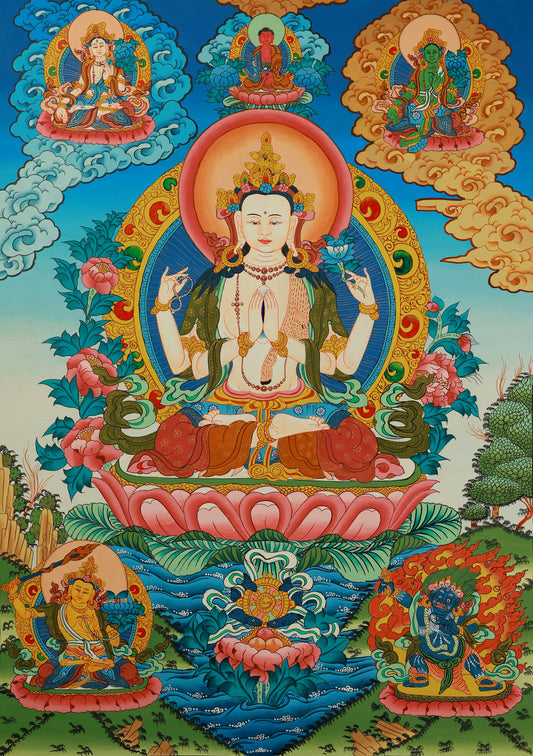
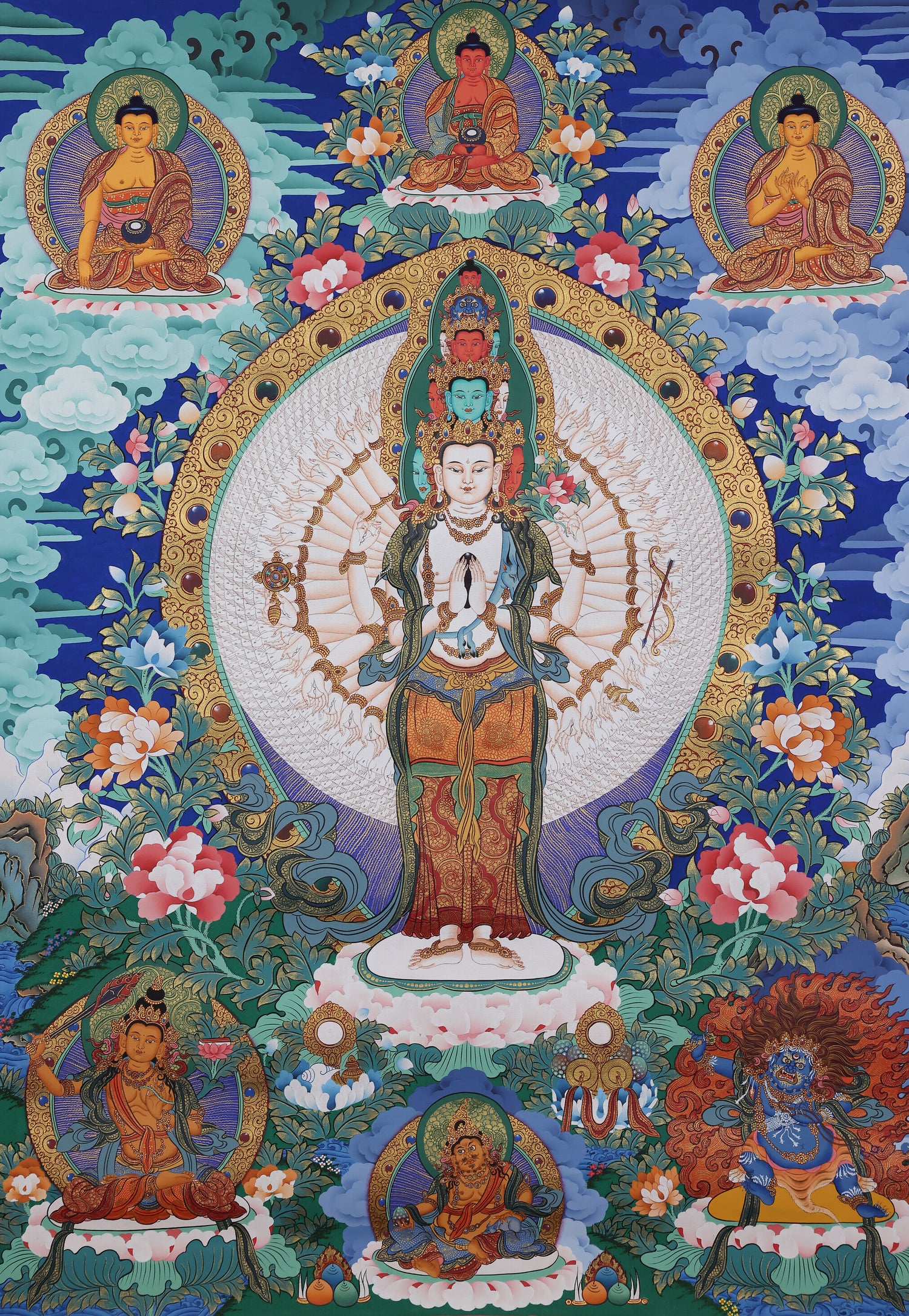
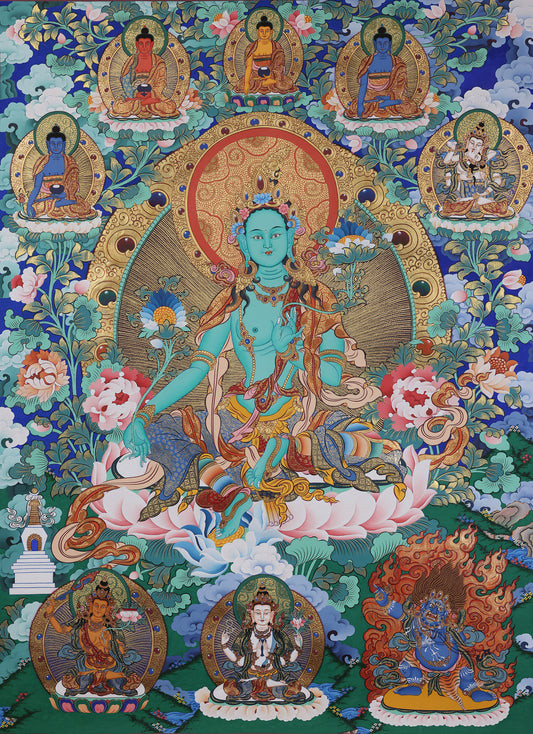
This purely hand-painted Thangka is a sacred masterpiece centered on Four-Armed Avalokiteshvara (Chenrezig) as the principal deity within a Mandala of Compassion and Spiritual Protection. Created in the refined tradition of Regong Thangka painting, it embodies the core Tibetan Buddhist teachings of great compassion, wisdom, and the union of merit and insight.
More than a visual artwork, this Thangka functions as a sacred contemplative support for spiritual practice and a profound cultural expression of how Tibetan Buddhism unites faith, ritual, and art into a single living tradition.
I. The Spiritual Core: A Compassion-Centered Tibetan Esoteric System
The central theme of this Thangka is “The Vow Power and Protective Network of Four-Armed Avalokiteshvara.” Its spiritual foundation lies in the deep localization of Avalokiteshvara devotion within Tibetan Buddhism.
In Tibetan culture, Four-Armed Avalokiteshvara is revered as the “Lord of the Snow Land,” the personification of boundless compassion. Depicting the principal deity together with attendant deities and auspicious symbols forms a complete Mandala of Practice, centered on compassion and supported by wisdom, merit, and protective forces.
This compositional structure follows the tantric logic of “principal deity and retinue”, while simultaneously responding to the practitioner’s deepest aspirations:
liberation from suffering, inner stability, and harmonious worldly conditions.
From a doctrinal perspective, the theme contains three interwoven layers of meaning:
-
The Four Arms represent the four enlightened activities — pacifying suffering, increasing merit, magnetizing beings, and subduing obstacles — expressing how compassion addresses all dimensions of sentient needs.
-
The Mandala Structure, with the principal deity at the center and supporting figures surrounding him, reflects the tantric path of practice: the deity as the core, supportive conditions as wings.
-
The Thangka as a Visualization Tool enables practitioners to align their own minds with Avalokiteshvara’s compassionate vow power. This embodies a key Tibetan Buddhist method:
“Using form to reveal the Dharma, using imagery to carry the path.”
II. The Principal Deity: Four-Armed Avalokiteshvara as a Ritualized Icon of Compassion and Purity
At the center of the composition sits Four-Armed Avalokiteshvara (Chenrezig), depicted in strict accordance with classical texts such as the Iconometric Treatises and traditional meditation manuals.
Every detail is a visual translation of Buddhist doctrine:
Sacred Body Symbolism
-
Pure white body, luminous like the full moon, symbolizes innate purity and freedom from both emotional and cognitive obscurations.
-
Five-Buddha crown represents the blessing of the Five Wisdom Buddhas, indicating that true compassion is grounded in wisdom.
-
Amitabha Buddha appears atop the crown, affirming Avalokiteshvara’s lineage and pointing toward rebirth in the Pure Land through devotion.
Hand Gestures and Ritual Implements
-
Central hands hold a wish-fulfilling jewel (Cintamani), symbolizing the union of wisdom and skillful means — illuminating reality while responding compassionately to beings.
-
Right upper hand holds a crystal mala, each bead representing the liberation of a sentient being, expressing compassion without limit.
-
Left upper hand holds an eight-petaled white lotus, symbolizing purity untouched by samsaric defilements and the power to uplift beings mired in suffering.
Posture and Lotus Throne
Avalokiteshvara sits in full vajra posture upon a thousand-petaled lotus and moon disc throne:
-
Vajra posture signifies unwavering meditative stability.
-
The lotus represents transcendence beyond worldly defilement.
-
The moon disc embodies the cooling, soothing nature of compassion that alleviates the burning afflictions of beings.
Together, they express the Bodhisattva ideal:
“Remaining pure within suffering, practicing compassion within the impure world.”
III. Attendant Deities and Auspicious Elements: The Network of Compassionate Support
Surrounding the central deity is a complete Mandala of Compassionate Support, arranged according to the tantric cosmology of the three realms.
Upper Deities: Lineage and Vow Transmission
At the top appear Amitabha Buddha (center), White Tara (left), and Green Tara (right):
-
Amitabha Buddha affirms the unbroken lineage of Avalokiteshvara.
-
White Tara, born from Avalokiteshvara’s tears, governs longevity and the pacification of illness.
-
Green Tara, swift and active, governs protection and the increase of beneficial activities.
Together, they form a triangle of compassionate protection, addressing health, longevity, and life’s endeavors.
Lower Protectors: Merit and Obstacle Removal
At the bottom appear Yellow Jambhala (left) and a wrathful Dharma protector (right):
-
Yellow Jambhala is not a worldly god of wealth, but a guardian of meritorious resources, reflecting the tantric view that material stability supports spiritual practice.
-
The wrathful protector, often blue in form, subdues inner and outer obstacles. His presence balances Avalokiteshvara’s peaceful compassion with the forceful wisdom that overcomes ignorance and affliction.
This union illustrates ultimate compassion — gentle in essence, yet powerful in wisdom.
Decorative Motifs as Visual Dharma
-
Endless lotus scrolls symbolize compassion that never withers.
-
Verdant leaves signify vitality and the life-giving force of compassionate action.
-
Blue and golden clouds represent pure space and radiant merit, symbolizing compassion permeating the universe.
These elements are not mere ornamentation, but visual expressions of doctrine, ensuring that every part of the Thangka carries spiritual meaning.
IV. Painting Process: The Regong Tradition of Ritual Precision and Artistic Mastery
This Thangka is a pure hand-painted Regong masterpiece, created through a process that is both ritual practice and artistic discipline.
Sacred Canvas Preparation
Aged pure cotton cloth is carefully treated through insect-proofing and sun-drying, followed by multiple layers of animal-hide glue, mineral gesso, and medicinal compounds. The surface is then polished with shells until mirror-smooth — symbolizing the preparation of a pure foundation for sacred imagery.
Iconometric Drafting
After ritual prayers, the artist uses traditional measuring tools to establish proportions according to canonical standards. Deviations beyond one millimeter are unacceptable, as accurate proportions are believed to preserve spiritual efficacy.
Mineral Pigmentation: The Palette of Compassion
Natural pigments derived from over 108 mineral and organic substances — including cinnabar, lapis lazuli, malachite, and gold — are hand-ground for days and bound with medicinal glue.
-
Avalokiteshvara’s white body is built through multiple translucent layers of pearl powder and chalk, achieving a moon-like radiance.
-
Cloud and lotus motifs are rendered in subtle gradients, symbolizing compassion unfolding from purity into the world.
Line Work and Gold Detailing
Using Regong’s signature iron-line and gold-line techniques, thousands of precise strokes are applied per square inch.
24K gold highlights ritual objects and ornaments, symbolizing the illuminating power of wisdom.
Eye-Opening Ceremony
The final step, “opening the eyes,” is performed in a state of deep concentration. The gentle gaze, downcast eyes, and serene smile embody Avalokiteshvara’s compassionate presence. Traditionally, this step is synchronized with monastic rituals, believed to awaken the Thangka’s spiritual vitality.
Conclusion: A Living Vessel of Compassion
This Thangka transcends the category of religious art. It is a three-dimensional expression of Tibetan Buddhist compassion:
-
The image of Avalokiteshvara embodies compassion itself.
-
The surrounding deities provide supportive conditions for compassionate activity.
-
The Regong craftsmanship serves as the vessel through which compassion is transmitted.
For practitioners, it is a powerful support for meditation and devotion.
For collectors, it is an authentic embodiment of Tibetan cultural heritage.
For all who encounter it, this Thangka stands as a testament to a civilization that meets suffering with compassion and transcends affliction through wisdom.
#FourArmedAvalokiteshvara
#ChenrezigThangka
#TibetanBuddhistThangka
#HandPaintedThangka
#RegongThangka
#TibetanSacredArt
#BodhisattvaThangka
#CompassionMandala
#TibetanBuddhism
#SpiritualProtection
#MeditationArt
#SacredVisualization
#TraditionalThangkaPainting
#MineralPigmentArt
#AuthenticThangka
#HimalayanArt
#AuthenticThangka
#ShrineRoomArt
#MeditationSpace
#HealingAndWellness
#SpiritualPractice
#ArtCollectors