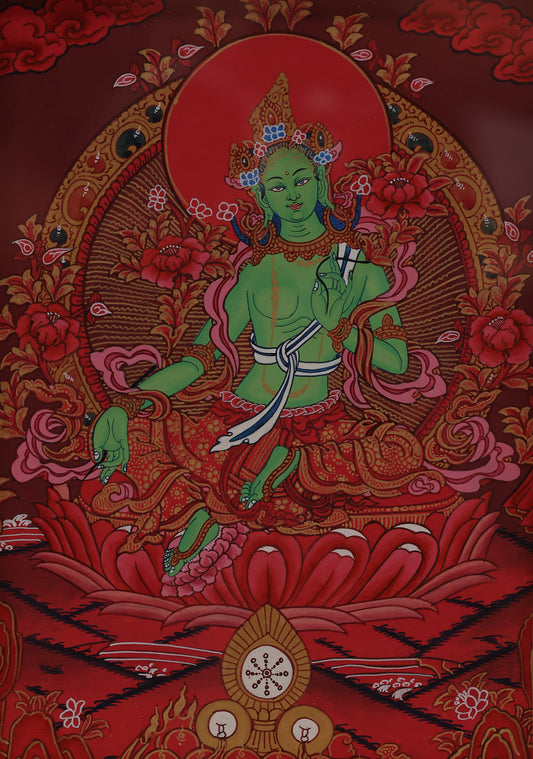
Nestled in the Himalayan crossroads of Nepal, the 20×30cm hand-painted Green Tara red thangka isn’t just a work of art—it’s a portable shrine, a vessel of compassionate energy, and a testament to centuries of Newari artistic legacy. Rooted in Tibetan Buddhist devotion yet steeped in Nepalese cultural identity, this small but profound piece encapsulates the essence of “swift liberation” (the core vow of Green Tara) while showcasing the meticulous craftsmanship of Kathmandu Valley’s master thangka painters.
At the heart of this thangka is Green Tara (Sanskrit: Sitātapatrā; Tibetan: Drolma), the most revered female bodhisattva in Tibetan Buddhism. Her origin story ties to Avalokiteshvara (the Bodhisattva of Compassion): legend holds that Green Tara emerged from a single tear of Avalokiteshvara as he grieved the suffering of sentient beings, vowing to remain in samsara (the cycle of rebirth) to offer immediate aid—earning her the title “Mother of Liberation” and “Swift-acting Savior.”
In practice, Green Tara is invoked to overcome the “Eight Great Fears” (lion, elephant, snake, thief, fire, water, demon, imprisonment) and to cultivate compassion, healing, and spiritual clarity. For Newari communities, she also bridges local goddess worship (e.g., Nepalese Durga traditions) with Buddhist devotion, making her a universal figure of protection across Himalayan cultures.
Every detail of this thangka adheres to the Iconographic Canon of Tibetan Buddhism (based on texts like the Iconometry Sutra), while infusing Newari artistic flair:
-
Green Skin & Form
Tara’s 翡翠绿 (emerald green) complexion isn’t just aesthetic: in Tibetan Buddhist symbolism, green corresponds to the
wind element (representing swift action) and
vitality (symbolizing healing). Her “sixteen-year-old maiden form” (a standard for female bodhisattvas) balances divine serenity with youthful warmth—a hallmark of Newari portraiture, which softens rigid Tibetan iconography with human-like grace.
-
Posture & Hand Gestures
She sits in
lalita asana (the “royal ease” pose): one leg folded, the other extended downward, foot resting on a lotus petal. This posture (unique to Tara) signifies she is
always ready to rise to aid beings. Her right hand forms the
Varada Mudra (the “Gesture of Granting Wishes”), palm outward to bestow blessings; her left hand holds a stem of the
utpala (blue lotus), which blooms with buds, half-opened flowers, and full blossoms—symbolizing past, present, and future liberation.
-
Ornaments & Backdrop
She wears a
five-jewel crown (representing the Five Dhyani Buddhas, whose wisdom she embodies) and “eight auspicious ornaments” (earrings, necklaces, armbands)—rendered with 24K gold gilding and mineral pigments (cinnabar for reds, malachite for greens) that catch light to mimic the luster of real jewels. Behind her, a
red sunburst halo (a Newari twist on Tibetan
aura iconography) frames her figure, while blooming red lotuses (a symbol of purified desire in Buddhism and a sacred flower of Nepal) surround the lotus throne.
This thangka is a product of the Newari Paubha tradition (the Nepalese term for thangka), a style distinguished by its intricate detail, vibrant mineral pigments, and fusion of Buddhist and Hindu artistic elements. Here’s how it’s made:
-
Canvas Preparation
The base is hand-woven Nepalese cotton, treated with a paste of
yak bone glue and
chalk powder (repeatedly applied and sanded to create a smooth, paper-like surface). This ensures the pigments adhere and resist fading—even after decades.
-
Mineral & Earth Pigments
Every color is derived from natural materials:
-
Green: Ground malachite (a copper carbonate mineral) mixed with bone glue;
-
Red: Cinnabar (mercury sulfide) for the backdrop (a Newari signature, symbolizing life force);
-
Gold: 24K gold leaf, ground into a paste and applied with fine squirrel-hair brushes for gilding (used for ornaments, halos, and sacred symbols like the dharma wheel at the base of the lotus throne).
-
Linework & Detailing
Newari painters use
wolf-hair brushes (as thin as a single hair) to outline figures with “iron wire” precision, then layer pigments in
translucent washes (a technique borrowed from Nepalese Malla-era court painting) to create soft, lifelike shading—unlike the flat, symbolic coloring of traditional Tibetan thangkas. The 20×30cm size demands extraordinary patience: a single thangka takes 2–3 weeks to complete, with each petal, jewel, and halo line painted by hand.
For Tibetan Buddhists and Newari practitioners alike, a 20×30cm thangka serves a practical spiritual purpose: it’s a traveling altar. Devotees carry such thangkas in ghau boxes (wooden shrine containers) during pilgrimages, place them on home altars for daily meditation, or gift them as blessings for births, marriages, or journeys. Its small size doesn’t diminish its power—in Himalayan traditions, intention (not scale) defines a sacred object’s efficacy.
This thangka embodies the cultural syncretism of the Kathmandu Valley:
- It follows Tibetan Buddhist iconography (e.g., the Five-Jewel Crown, Dharma Wheel) but softens it with Newari aesthetic sensibilities (e.g., lifelike portraiture, red-dominated backdrops);
- It uses materials sacred to both Buddhism and Hinduism (cinnabar, gold, lotus flowers), reflecting Nepal’s pluralistic spiritual landscape;
- It preserves a dying art: fewer than 50 master Newari thangka painters remain in Kathmandu, making pieces like this not just devotional objects, but cultural heritage.
This 20×30cm Green Tara red thangka is a microcosm of Himalayan spirituality: it tells the story of a bodhisattva’s vow to save beings, the legacy of Newari craftsmanship, and the fusion of cultures that defines Nepal. Whether displayed as art, used in meditation, or carried as a portable shrine, it reminds us that compassion—like the thangka itself—can be both small and infinitely powerful.
#GreenTaraThangka #NepalNewariArt #TibetanBuddhistArt #HandPaintedThangka #HimalayanCraftsmanship #GreenTaraMeaning #NewariPaubha #MineralPigmentThangka #PortableAltar #HimalayanSpirituality