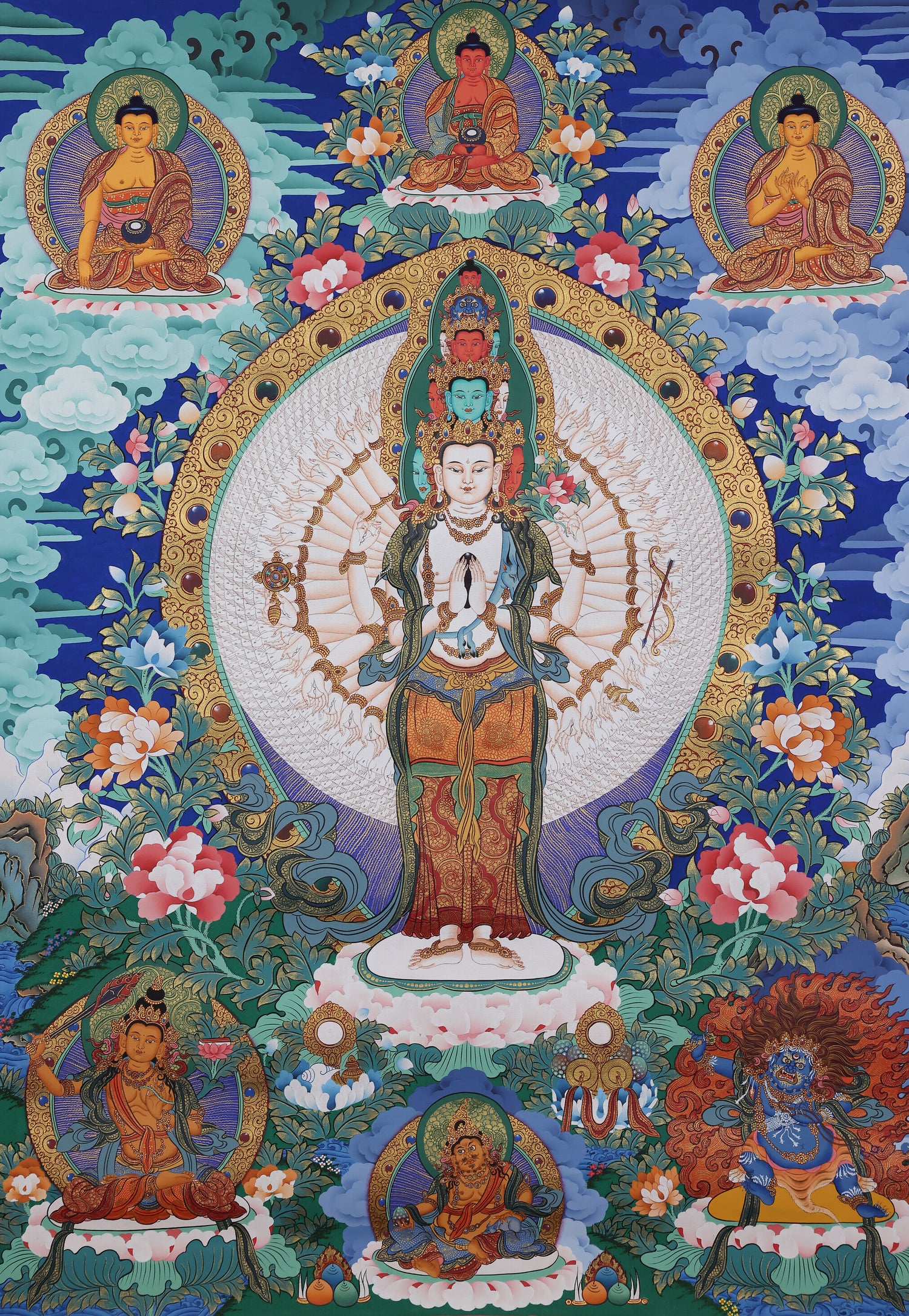
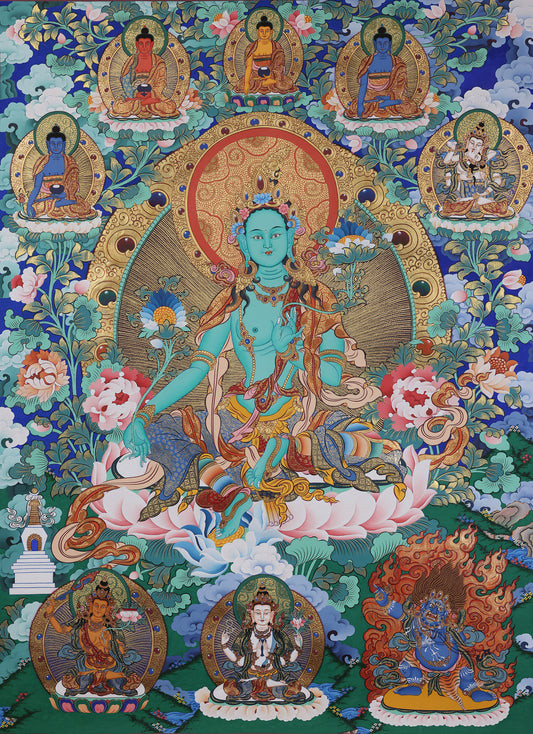
In the visual system of Tibetan Buddhism, a thangka is never merely a painting. It is a spiritual map—a sacred medium through which faith, meditation, lineage, and cosmology are visually unified. This hand-painted Tibetan Buddhist thangka depicting the Refuge Field of Padmasambhava (Guru Rinpoche) represents one of the most profound and authoritative iconographic systems within the Nyingma school (the Ancient School) of Tibetan Buddhism.
This artwork is not only an object of devotion but also a complete visualization of lineage refuge, serving as a focal point for meditation, offerings, and the accumulation of merit.
I. Core Theme: The Spiritual Meaning of the Refuge Field of Padmasambhava
In Tibetan Buddhist tradition, a Refuge Field is not the depiction of a single deity. Rather, it is a comprehensive visual mandala that gathers Buddhas, bodhisattvas, lineage masters, meditational deities, and Dharma protectors into a unified composition. It represents the Total Field of Merit—a sacred domain where all enlightened qualities converge.
This thangka places Padmasambhava (Guru Rinpoche) at its center, reflecting his irreplaceable role in Tibetan Buddhist history. In the 8th century, Guru Rinpoche was invited to Tibet by King Trisong Detsen, where he helped establish Samye Monastery, ordained the first Tibetan monks, and harmonized Indian Vajrayana Buddhism with indigenous Tibetan spiritual traditions. For this reason, he is revered as the founder of Tibetan Vajrayana Buddhism.
Thus, this Refuge Field thangka is both an expression of devotion to Guru Rinpoche himself and a visual affirmation of refuge in the complete Nyingma lineage and its enlightened transmission.
II. The Central Deity: Iconography and Symbolism of Padmasambhava
At the center of the composition stands Padmasambhava, depicted in strict accordance with classical iconometric texts and Nyingma ritual prescriptions. Every detail of his appearance conveys profound symbolic meaning.
Guru Rinpoche wears the iconic Lotus Hat (also known as the King’s Crown), symbolizing his dual nature as an awakened Buddha and a sovereign guide who skillfully leads sentient beings. He is dressed in monastic robes beneath a richly colored cloak, dominated by red and blue hues—colors that embody the Vajrayana balance of compassion and wrathful power. His complexion is luminous, and his expression combines serene compassion with commanding authority, reflecting his ability to subdue obstacles while guiding beings toward liberation.
His ritual implements further deepen the symbolism:
-
Kapala (skull cup) in his left hand, containing the nectar of immortality, represents the realization of emptiness and the transcendence of birth and death.
-
Khatvanga (trident staff) resting against his left shoulder is one of Guru Rinpoche’s most essential attributes. Its elements symbolize cosmic order and spiritual realization: the crossed vajra represents Mount Meru and the five elements; the vase signifies inexhaustible wisdom nectar; the three severed heads (white, red, and blue-green) represent the transformation of ignorance, desire, and anger, as well as the unity of the three bodies—Dharmakaya, Sambhogakaya, and Nirmanakaya.
-
Five-pronged vajra in his right hand is raised toward the sky, symbolizing the destruction of all obstacles to enlightenment and the blessing of the Five Buddha Wisdoms.
Padmasambhava sits in the royal posture upon a double lotus throne. The lower pink lotus petals signify the purity of the innate mind, untouched by worldly defilements, while the upper white petals represent the perfected purity of enlightenment. Behind him, radiant halos rendered with mineral pigments and gold leaf depict flames of wisdom and multicolored clouds of the pure realms, emphasizing his sacred presence.
III. Attendant Deities: Visualizing the Nyingma Lineage and Spiritual Protection
Surrounding the central figure is a carefully structured assembly of attendant deities, forming a visual map of lineage transmission and spiritual protection.
Above Guru Rinpoche appears Amitabha Buddha, symbolizing the ultimate source of his enlightened nature. Padmasambhava is traditionally regarded as an emanation of the body, speech, and mind of Amitabha, Avalokiteshvara, and Shakyamuni Buddha; Amitabha here represents his Dharmakaya essence.
Flanking the central deity are two principal figures:
-
Shantarakshita, wearing monastic robes and holding ritual implements, represents the transmission of sutra teachings, ethical discipline, and philosophical foundations.
-
Yeshe Tsogyal, depicted in white robes with hands joined in reverence, is Guru Rinpoche’s foremost disciple and consort. She embodies the principle of skillful means in Vajrayana practice and is regarded as the source of the dakini lineage within the Nyingma tradition.
Below the central throne are offerings symbolizing both worldly and transcendent generosity, and in some compositions wrathful protectors such as Vajrakilaya may appear, representing the safeguarding of the Dharma and the removal of spiritual obstacles.
IV. Painting Techniques: A Masterpiece of Newari–Menri Fusion
This thangka is a fully hand-painted masterpiece, integrating the refined aesthetics of the Nepalese Newari tradition with the structural discipline of the Tibetan Menri school.
The canvas is prepared using traditional cotton cloth, meticulously processed through washing, stretching, sizing, grounding, and repeated polishing. This ensures a smooth, durable surface capable of preserving the artwork for generations.
All pigments are derived from natural minerals—azurite, malachite, cinnabar, and pure gold. These materials are carefully ground, washed, and refined to achieve rich saturation and long-lasting brilliance. Blue mineral pigments symbolize emptiness, red embodies compassion, and gold represents the eternal radiance of the Dharma.
Line work combines iron-wire lines for structural precision with silk-thread lines for delicate details. Facial features are rendered with single, uninterrupted strokes, demonstrating the high technical mastery characteristic of advanced Newari thangka painting.
Shading techniques employ both dry and wet blending to create depth and vitality, while gold detailing is meticulously applied and polished to produce a subtle, luminous glow.
The final and most sacred step is the Eye-Opening Ceremony, during which the pupils are painted in a ritual context involving purification, incense, and prayer. This rite symbolizes the transformation of the painting from an artistic object into a living spiritual presence.
V. Cultural Value: A Visual Encyclopedia of Tibetan Buddhist Faith
This Padmasambhava Refuge Field thangka is far more than a decorative artwork. It is a visual encyclopedia of Nyingma Buddhist doctrine, lineage, and practice. Artistically, it exemplifies the harmonious integration of mineral pigments, gold leaf, precise line work, and balanced composition. Spiritually, it serves as a powerful support for meditation, devotion, and the accumulation of merit.
Whether enshrined in a home altar, meditation space, or included in a refined Buddhist art collection, this thangka embodies the Tibetan Buddhist aspiration toward awakening and liberation. It is a timeless work that unites faith, culture, and sacred art into a single, profound expression.
#Padmasambhava
#GuruRinpoche
#TibetanBuddhistThangka
#RefugeFieldThangka
#NyingmaTradition
#HandPaintedThangka
#TibetanArt
#SacredBuddhistArt
#MineralPigmentArt
#GoldLeafThangka
#VajrayanaBuddhism
#BuddhistMeditationArt
#SpiritualProtection
#FieldOfMerit
#BuddhistRefuge
#BuddhistHomeAltar
#MeditationRoomDecor
#SpiritualWallArt
#CollectibleThangka
#AuthenticThangka