Nepalese Hand-Painted White Tara Thangka: The Symbiosis of Tibetan Buddhist Faith and Newari Art

$599.00 USD
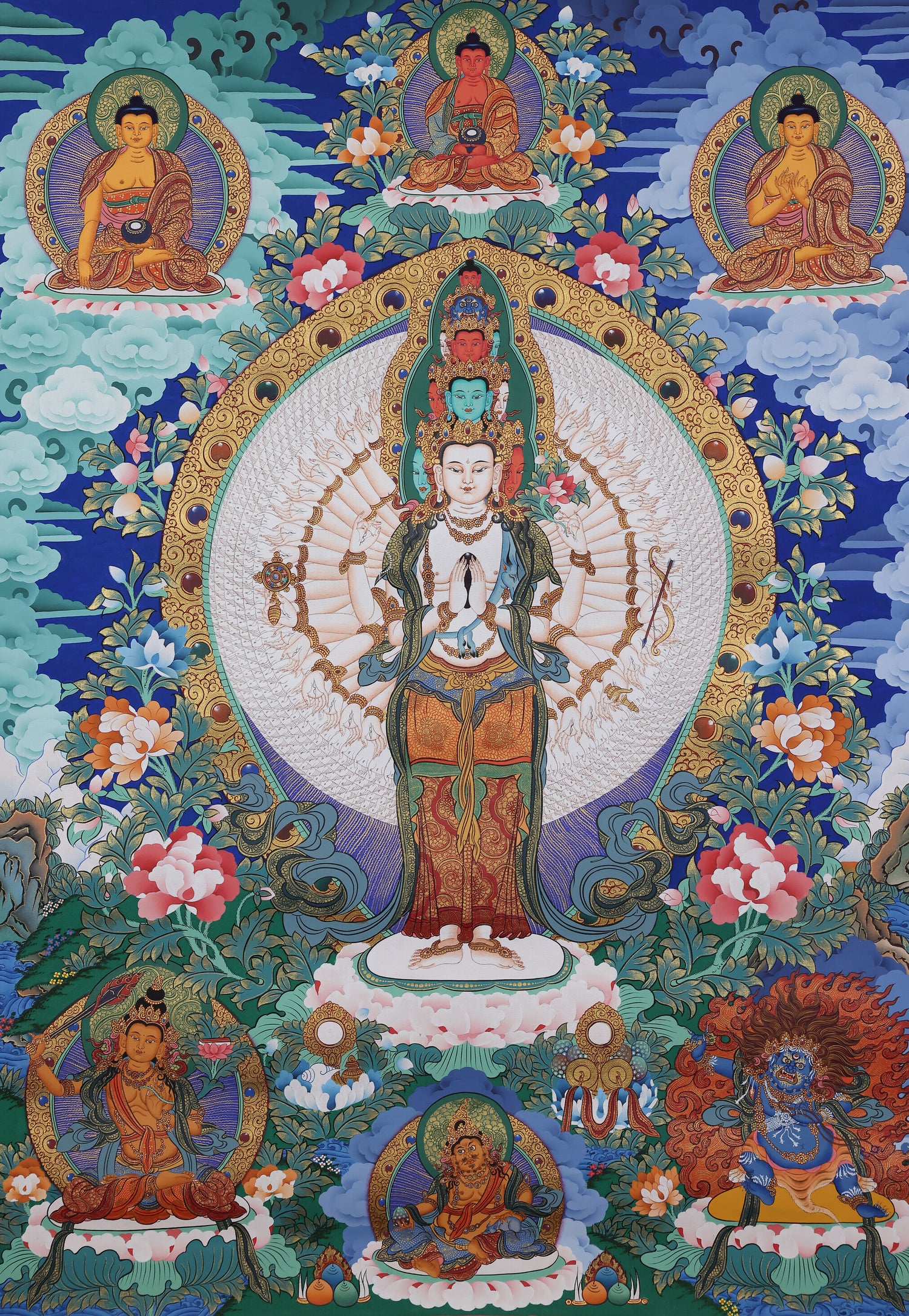
Thangka name: Colorful Tang White Tara
size: 47cm×64cm
origin: Nepal
Ask a Question

Hurry Up! Only 100 left in stock!

Estimate delivery times: 12-26 days (International), 3-6 days (United States).

Return within 45 days of purchase. Duties & taxes are non-refundable.

White Tara Tibetan Thangka with vibrant colors, symbolizing compassion and healing.
Nepalese Hand-Painted White Tara Thangka: The Symbiosis of Tibetan Buddhist Faith and Newari Art
$599.00 USD
537 Products
192 Products
46 Products
11 Products
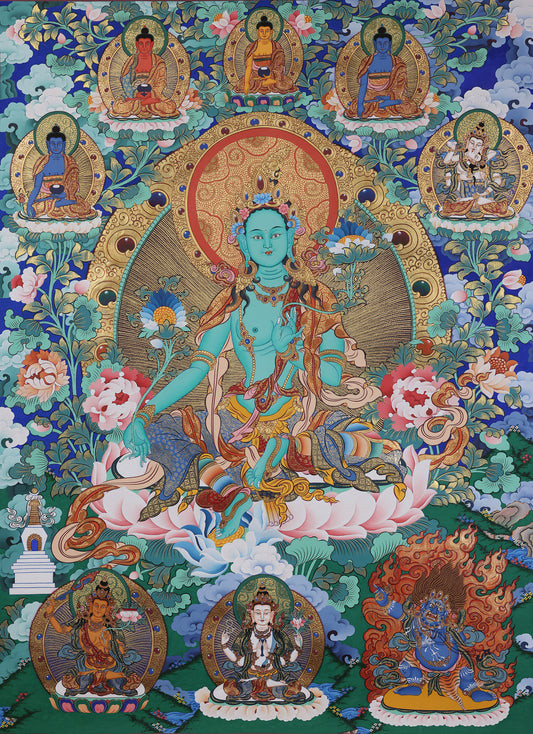
When a 47×64cm hand-painted Nepalese colored thangka unfolds before you, what you see is not just a vividly colored painting, but a symbiosis of Tibetan Buddhism’s compassionate faith and the millennial heritage of Newari art. Centered on White Tara, this thangka uses the rich texture of mineral pigments and ritualized iconographic details to construct a spiritual space that is both sacred and imbued with regional aesthetic traits—it is a "portable temple" and a microcosm of the intersection of art and faith in the Himalayan cultural sphere.

I. The Main Deity: White Tara’s Symbolic Code of Compassion

As one of the most central manifestations among Tibetan Buddhism’s "Twenty-One Taras," White Tara (said to emanate from the left tear of Avalokiteshvara) is depicted in this thangka as the standard "Seven-Eyed Buddha-Mother" form, adhering strictly to the Iconographic Measurement Sutra. Every detail embodies spiritual meaning:

  • The Seven Eyes: Compassion Without Blind Spots

    The deity’s all-white form symbolizes "the purity of untainted compassion." One eye on the forehead and one on each hand and foot (seven total) correspond to the doctrine of "watching over all Buddha-fields and sentient beings in the six realms"—this is not ornamentation, but a religious promise that "no suffering goes unseen."
  • Posture and Implements: The Tangibility of Salvation

    She sits cross-legged on a double lotus throne: the lower red lotus represents "transcendence of the mundane (rising unsoiled from mud)," while the upper white lotus mirrors her "intrinsic purity." Her right hand forms the Varada Mudra (palm outward), promising to "fulfill sentient beings’ virtuous wishes"; her left hand holds an utpala flower (with a stem extending to her ear) via the Tri-Ratna Mudra, with a nectar vase resting in the flower’s bloom. The vase’s nectar symbolizes "purifying afflictions and bestowing longevity," aligning with White Tara’s core merits of "alleviating disasters and rescuing from the eight hardships."
  • Ornamentation: Blending Ritual and Regional Aesthetic

    She wears a Newari-style floral wreath crown (distinct from the metal crowns of Tibetan thangkas), adorned with a red coral necklace and golden armlets, draped in a blue-and-gold celestial robe. These ornaments adhere to the religious norms of "bodhisattva attire" while incorporating the opulence of Nepalese art, balancing sacredness and aesthetic appeal.

II. Attendant Deities: Constructing White Tara’s Sacred Realm

The thangka’s background and attendants are not "supporting roles"—they use spatial narrative to fully embody White Tara’s spiritual system:

  • Attendants: Complementary Salvation Functions

    The golden "Vase-Bearing Goddess" on the left, holding a nectar vase, echoes White Tara’s merit of "bestowing peace"; the blue "Blue Tara" (one of the Twenty-One Taras) on the right, whose blue form symbolizes "subduing demons"—together, they form the two wings of White Tara’s salvific system: one for "comfort" and one for "protection."
  • Mythical Beasts and Nature: Extending Spiritual Symbols

    The red dragon in the upper left is both the mount of the Vairocana Buddha (associated with the East in Tibetan Buddhism) and a metaphor for "compassion as life-giving rain" (dragons govern precipitation). The blue peacock in the upper right symbolizes "purifying afflictions" (via the image of peacock feathers sweeping dust) and is linked to the Ratnasambhava Buddha lineage. The background’s swirling clouds (gold-orange gradient), peonies (a Nepalese native flower), and lotuses (the Buddhist symbol of purity) fuse regional aesthetics with religious symbolism naturally.
  • Dharma Wheel at the Base: Closing the Loop Between Doctrine and Practice

    The eight-spoked Dharma Wheel (a symbol of the Buddha’s teachings) beneath the lotus throne reinforces White Tara’s identity as a "Buddha emanation" and completes the spiritual logic: from doctrine (the Dharma Wheel) to salvific practice (White Tara).

III. Craftsmanship and Style: The Artistic Soul of Newari Colored Thangkas

Half the value of this thangka lies in faith, the other in craftsmanship—it is a living example of the Nepalese Newari school tradition:

(1) Mineral Pigments: Devotion That Endures Centuries

The artist uses natural minerals and earth pigments from the Himalayas:

  • White comes from "Rinbung white clay" (from Tibet’s Rinbung County, prized for its fineness);
  • Blue is ground from Afghan lapis lazuli, layered to create the robe’s gradient;
  • Red blends cinnabar and red coral powder, giving the lotus throne a solemn, rich texture;
  • Gold is made from ground pure gold leaf mixed with glue, used for linework and ornaments (the Dharma Wheel, crown)—this is not just an aesthetic choice, but a religious tradition of "offering the most precious substance."

These pigments require four steps: crushing, water-grinding, drying, and layering, taking up to 15 days—their stability ensures the thangka’s colors remain vibrant for centuries.

(2) Newari Style: Regional Traits Distinct from Tibetan Thangkas

This thangka belongs to the Nepalese Newari colored thangka style, with clear differences from Tibet’s Menri and Karma Gadri schools:

  • Color: Harmony in High-Saturation Contrast

    Warm tones dominate, with stark contrasts between the deity’s white, the lotus throne’s red, and the robe’s blue—balanced by golden linework, unlike the "low-saturation, coordinated" aesthetic of Tibetan thangkas.
  • Form: Soft, Concrete Regional Temperament

    The deity’s facial lines lean toward a "youthful, rounded softness," and attendants/mythical beasts (e.g., peacock feathers, dragon scales) are rendered more concretely—distinct from the "solemn grandeur" and "symbolic forms" of Tibetan thangkas.
  • Composition: Opulent Yet Uncluttered Full-Scene Aesthetics

    It retains the Newari tradition of "decorative clouds and flora" while incorporating the Tibetan "full-scene composition," resulting in a rich yet orderly image—a model of regional artistic fusion.

Conclusion: Thangkas as Symbiosis of Faith and Art

This 47×64cm White Tara thangka is never "just a painting": to believers, it is a spiritual medium for meditation; to art lovers, it is a treasure where Newari craftsmanship meets Tibetan faith. With the weight of mineral pigments, the rigor of ritual iconography, and the vitality of regional style, it proves that thangkas are the most unique spiritual and artistic vessels in the Himalayan cultural sphere.

When you gaze at its seven eyes, you see not just artistic details, but the warm faith of Tibetan Buddhism’s "all-pervading compassion."

# Nepalese White Tara Thangka #Tibetan Buddhist Thangka Analysis #Newari Art School #Mineral Pigment Thangka #Hand-Painted Colored Thangka #White Tara Iconographic Symbolism #Thangka Art Craftsmanship #Himalayan Cultural Art #Thangka Attendant Deities #Buddhist Art Collection
Discover the perfect Tibetan Buddhist Thangka that matches your wishes, lifestyle, and space. Each Thangka carries spiritual meaning and brings blessings when placed correctly.

1. Define Your Intention

Wealth & Success → Yellow Dzambhala (Wealth Deity)

Compassion & Peace → Avalokiteshvara, Green Tara

Wisdom & Learning → Manjushri

Health & Healing → Medicine Buddha

Longevity & Family Protection → White Tara

2. Choose by Identity

Entrepreneurs & Business Owners → Wealth Deities for prosperity.

Students & Scholars → Wisdom Deities for focus and clarity.

Healers & Yoga Practitioners → Medicine Buddha for energy and balance.

Families & Homemakers → Tara Deities for harmony and safety.

Collectors & Art Lovers → Rare Mandalas or Masterpiece Thangkas.

3. Match Your Space

Home Shrine / Meditation Room → Medium Thangkas (60–80 cm).

Office / Business Hall → Large Thangkas for prosperity and authority.

Living Room / Study → Decorative Thangkas for peace and beauty.

4. Authentic Craftsmanship

Hand-painted with natural mineral pigments and fine canvas, each Thangka reflects Tibetan artistry and spiritual power. Verified sources ensure quality and respect for tradition.

✨ Choose your Thangka with heart — it’s not just art, but a blessing for your life.

Different people have different needs, and choosing the right Thangka can provide spiritual support, protection, good fortune, and blessings. Below are Thangka recommendations for various roles:

1. Entrepreneurs

  • Needs: Wisdom, wealth, health, career success.
  • Recommended Thangkas:
    Manjushri: Enhances decision-making and business wisdom.
    Wealth Deity: Brings wealth and prosperity.
    Medicine Buddha: Supports health and reduces stress.
    Mahakala: Protects business from competition and challenges.

2. Successful Individuals

  • Needs: Inner peace, family harmony, longevity.
  • Recommended Thangkas:
    Amitabha Buddha: Brings inner peace and tranquility.
    Avalokiteshvara (Guanyin): Promotes family harmony and happiness.
    Amitayus (Long Life Buddha): Prays for good health and long life.
    Manjushri: Continues to enhance wisdom.

3. Housewives/Husbands

  • Needs: Family harmony, protection, health.
  • Recommended Thangkas:
    Avalokiteshvara: Increases family happiness and harmony.
    Protector Deities: Safeguards the family from external disturbances.
    White Tara: Blesses the family with health.

4. Students and Scholars

  • Needs: Wisdom, focus, academic success.
  • Recommended Thangkas:
    Manjushri: Boosts learning, memory, and wisdom.
    Sakyamuni Buddha: Helps with concentration and spiritual practice.
    Jixiang Tianmu: Brings academic good luck and exam success.

5. Artists and Creative Professionals

  • Needs: Inspiration, creativity, artistic achievement.
  • Recommended Thangkas:
    Manjushri: Stimulates creative thinking and inspiration.
    Vajrapani: Helps overcome creative blocks.
    Maitreya: Brings a relaxed and optimistic attitude, easing stress.

6. Travelers and Adventurers

  • Needs: Protection, good luck, success in adventures.
  • Recommended Thangkas:
    Hayagriva: Provides strong protection during travels and clears obstacles.
    Mahakala: Brings good fortune and protection, especially for adventurers.
    Vajrasattva: Helps overcome difficulties and challenges during the journey.

7. Elderly Individuals

  • Needs: Health, longevity, spiritual peace.
  • Recommended Thangkas:
    Amitayus: Prays for long life and good health.
    Medicine Buddha: Promotes healing and physical well-being.
    Avalokiteshvara: Brings compassion and inner peace in later years.

8. Corporate Executives

  • Needs: Leadership, wisdom, teamwork, and business success.
  • Recommended Thangkas:
    Manjushri: Enhances leadership skills and decision-making.
    Wealth Deity: Brings success and prosperity to the business and team.
    Avalokiteshvara: Promotes harmony and balance within the team.

9. Health and Fitness Enthusiasts

  • Needs: Good health, vitality, energy.
  • Recommended Thangkas:
    Medicine Buddha: Enhances physical health and vitality.
    White Tara: Brings health and rejuvenation.
    Vajrasattva: Clears health challenges and boosts energy.

10. Politicians

  • Needs: Leadership, wisdom, peace.
  • Recommended Thangkas:
    Manjushri: Enhances leadership abilities and decision-making.
    Vairocana Buddha: Helps maintain inner peace and wisdom.
    Avalokiteshvara: Promotes societal peace and family harmony.

For all orders exceeding a value of 100USD shipping is offered for free.

Returns will be accepted for up to 10 days of Customer’s receipt or tracking number on unworn items. You, as a Customer, are obliged to inform us via email before you return the item.

Otherwise, standard shipping charges apply. Check out our delivery Terms & Conditions for more details.

Returns will be accepted for up to 10 days of Customer’s receipt or tracking number on unworn items. You, as a Customer, are obliged to inform us via email before you return the item, only in the case of:

– Received the wrong item.
– Item arrived not as expected (ie. damaged packaging).
– Item had defects.
– Over delivery time.
– The shipper does not allow the goods to be inspected before payment.

The returned product(s) must be in the original packaging, safety wrapped, undamaged and unworn. This means that the item(s) must be safely packed in a carton box for protection during transport, possibly the same carton used to ship to you as a customer.

Recently Viewed

Don't forget! The products that you viewed. Add it to cart now.

Pairs well with

Enhance your selection with perfectly matched accessories and complementary products..

People Also Bought

Here’s some of our most similar products people are buying. Click to discover trending style.