Blog Article: Nepalese Hand-Painted Thangka of Red Amitabha Buddha: Decoding Its Tibetan Buddhist Symbolism, Artistry, and Cultural Roots

$499.00 USD
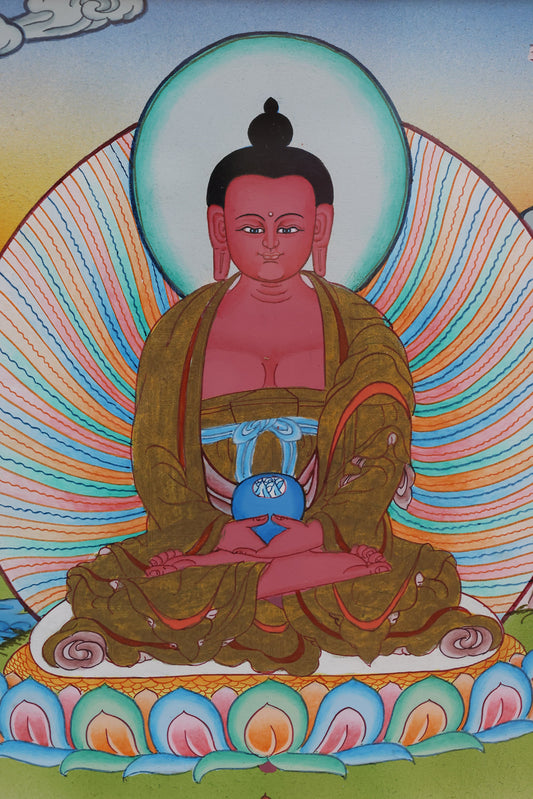
Thangka Name: Amitabha Buddha in colorful robes
size: 25cm×35cm
origin: Nepal
Ask a Question

Hurry Up! Only 100 left in stock!

Estimate delivery times: 12-26 days (International), 3-6 days (United States).

Return within 45 days of purchase. Duties & taxes are non-refundable.

Colorful Tibetan Thangka of Amitabha Buddha, hand-painted in traditional Buddhist art style.
Blog Article: Nepalese Hand-Painted Thangka of Red Amitabha Buddha: Decoding Its Tibetan Buddhist Symbolism, Artistry, and Cultural Roots
$499.00 USD
When you hold a 25x35cm hand-painted Nepalese thangka—its colors still vibrant from mineral pigments, its lines softened by generations of artistic tradition—you’re not just holding a work of art: you’re holding a portable portal to Tibetan Buddhist cosmology. This small scroll, crafted in Nepal using age-old Paubha techniques, centers on one of Tibetan Buddhism’s most revered figures: the Red Amitabha Buddha (also called Amitabha, the Buddha of Infinite Light). Let’s unpack its spiritual symbolism, artistic craft, and cultural roots.

The Theme: A Portal to the Western Pure Land

This thangka’s core theme is rooted in Tibetan Buddhist Pure Land devotion: Amitabha Buddha, the Western Buddha of the Five Dhyani Buddhas, presides over Sukhavati (the Western Pure Land)—a realm free of suffering, where practitioners aspire to be reborn through devotion to Amitabha.

Unlike large temple thangkas (used for public ceremonies), this 25x35cm piece is a personal devotional thangka: designed for individual meditation, daily worship, or travel. Its compact size means the focus stays tightly on Amitabha himself—no distractions, just the Buddha’s form as a focal point for visualization practice (a key Tibetan Buddhist method for cultivating wisdom and compassion).

The Main Deity: Red Amitabha Buddha’s Iconographic Language

Every detail of Amitabha’s form follows the strict rules of Tibetan Buddhist iconography (codified in texts like the Iconometric Sutras), turning aesthetics into spiritual communication:

  1. Body Color & Auspicious Marks: Amitabha’s vivid red body isn’t arbitrary—it symbolizes gentle power and all-encompassing compassion (red is associated with life, warmth, and the Buddha’s ability to “gather” beings into his Pure Land). His face bears the 32 Major Marks of a Buddha: a white curl between his brows (symbolizing wisdom light), long 耳垂 (signs of great merit), and a swastika on his chest (a symbol of eternal well-being, long before its modern misuse).
  2. Mudra & Ritual Object: His hands rest in the Dhyana Mudra (meditation gesture), holding a longevity vase (or kalasha)—a vessel filled with “nectar of enlightenment” that represents Amitabha’s role as the Buddha of Infinite Life (he’s often linked to Amitayus, the Buddha of Longevity, in Tibetan tradition). The vase’s blue hue (from lapis lazuli powder) adds another layer: blue symbolizes spiritual purity in Himalayan art.
  3. Robe & Lotus Seat: He wears a monastic robe (one shoulder bare, a style associated with Buddhist monks) in earthy yellow and ochre—colors that evoke humility and connection to the natural world. He sits on an eight-petaled lotus moon seat: the lotus represents enlightenment (growing pure from muddy waters), while the moon symbolizes the “unstained” nature of the Pure Land.
  4. Auras: A teal nimbus (head halo) frames his face (symbolizing clear wisdom), while a radiating rainbow aura (blue, red, orange) expands outward—this is a signature of Nepalese thangkas (Tibetan thangkas often use simpler, gold-lined auras), representing Amitabha’s light reaching all beings.

Retinue Deities: Simplification for Personal Practice

You might notice something missing: the Western Trinity (Amitabha flanked by Chenrezig/Guanyin and Mahasthamaprapta, his traditional attendants). This “solo Buddha” design is intentional:

  • Function first: Small personal thangkas prioritize visualization of the main deity—no need for elaborate retinues when the goal is one-on-one spiritual focus.
  • Size constraints: A 25x35cm canvas can’t accommodate the intricate details of attendant deities (common in larger temple thangkas).
  • Cultural influence: Nepalese thangkas draw from Indian “solitary Buddha” traditions, unlike Tibetan thangkas, which often feature dense, multi-figure compositions.

For a full Western Trinity thangka, you’d need a piece 50cm or larger—but this small scroll’s simplicity is part of its purpose: it’s a companion, not a ceremonial centerpiece.

Craftsmanship: The Paubha Technique (Mineral & Earth Pigments)

This thangka is a masterclass in Nepalese Paubha (the local term for thangka) craftsmanship, using materials that have endured for centuries:

  1. Canvas Preparation:

    Nepalese Paubha artists use fine local cotton, treated with a mix of bone glue and white clay (unlike Tibetan thangkas, which use linen and lime paste). The canvas is smoothed with a seashell until all texture disappears—this creates a surface that holds mineral pigments without bleeding, while remaining lightweight enough for travel.
  2. Pigment Making:

    Every color comes from the earth (or semi-precious stones):
    • Red (Amitabha’s body): A blend of cinnabar (for vibrancy) and red earth (for warmth), ground to a fine powder and mixed with bone glue (to make it water-resistant and fade-proof).
    • Yellow (robe): Realgar (a mineral) and yellow ochre (earth pigment), balanced for a soft, earthy tone.
    • Blue (aura/vase): Lapis lazuli (mined in Afghanistan, traded through Nepal), ground to 200+ mesh for a luminous, deep blue—this is one of the costliest pigments in Himalayan art.
    • White (lotus): Rinbu white clay (from northern Nepal), softer than the conch powder used in Tibetan thangkas.
  3. Painting Process:
    • Linework: First, charcoal lines mark the Buddha’s proportions (120 “finger-widths” tall, per the Iconometric Sutras), then ink lines define the form.
    • Layering: Colors are applied from light to dark (white lotus first, then yellow robe, then red body), with 24-hour drying time between layers to prevent smudging.
    • “Opening the Face”: The final (and most sacred) step: a master artist paints the eyes (slightly upward, to symbolize “watching over all beings”), lips, and brow curl—usually on an auspicious Tibetan calendar day, as Paubha painting is seen as a spiritual practice, not just a craft.

Style: Nepalese Paubha vs. Tibetan Thangka

This thangka’s look sets it apart from Tibetan thangkas—here’s how:

  • Color: Nepalese Paubha uses bright, gradient auras (rainbow hues) instead of Tibetan thangkas’ solid or gold-lined auras, reflecting Indian art’s emphasis on emotional color.
  • Lines: Soft, curved lines (especially in the robe) replace Tibetan thangkas’ sharp, angular lines—an echo of Nepal’s connection to Gandhara (ancient Indian) art.
  • Background: A simple pale blue with cloud motifs (Tibetan thangkas often feature detailed landscapes or palaces) keeps the focus on Amitabha, perfect for a personal devotional piece.

Why This Thangka Matters

This small scroll isn’t just decor: it’s a bridge between art, spirituality, and culture. Its mineral pigments carry the weight of Himalayan geology; its lines follow millenia-old religious rules; its size makes it a companion for daily practice. For Nepalese artists, painting Paubha is a form of devotion; for practitioners, it’s a way to carry the Pure Land with them, wherever they go.
#NepaleseThangka #AmitabhaBuddha #TibetanBuddhistArt #PaubhaPainting #SacredArt #HimalayanArt #BuddhistIconography #MineralPigmentArt

Discover the perfect Tibetan Buddhist Thangka that matches your wishes, lifestyle, and space. Each Thangka carries spiritual meaning and brings blessings when placed correctly.

1. Define Your Intention

Wealth & Success → Yellow Dzambhala (Wealth Deity)

Compassion & Peace → Avalokiteshvara, Green Tara

Wisdom & Learning → Manjushri

Health & Healing → Medicine Buddha

Longevity & Family Protection → White Tara

2. Choose by Identity

Entrepreneurs & Business Owners → Wealth Deities for prosperity.

Students & Scholars → Wisdom Deities for focus and clarity.

Healers & Yoga Practitioners → Medicine Buddha for energy and balance.

Families & Homemakers → Tara Deities for harmony and safety.

Collectors & Art Lovers → Rare Mandalas or Masterpiece Thangkas.

3. Match Your Space

Home Shrine / Meditation Room → Medium Thangkas (60–80 cm).

Office / Business Hall → Large Thangkas for prosperity and authority.

Living Room / Study → Decorative Thangkas for peace and beauty.

4. Authentic Craftsmanship

Hand-painted with natural mineral pigments and fine canvas, each Thangka reflects Tibetan artistry and spiritual power. Verified sources ensure quality and respect for tradition.

✨ Choose your Thangka with heart — it’s not just art, but a blessing for your life.

Different people have different needs, and choosing the right Thangka can provide spiritual support, protection, good fortune, and blessings. Below are Thangka recommendations for various roles:

1. Entrepreneurs

  • Needs: Wisdom, wealth, health, career success.
  • Recommended Thangkas:
    Manjushri: Enhances decision-making and business wisdom.
    Wealth Deity: Brings wealth and prosperity.
    Medicine Buddha: Supports health and reduces stress.
    Mahakala: Protects business from competition and challenges.

2. Successful Individuals

  • Needs: Inner peace, family harmony, longevity.
  • Recommended Thangkas:
    Amitabha Buddha: Brings inner peace and tranquility.
    Avalokiteshvara (Guanyin): Promotes family harmony and happiness.
    Amitayus (Long Life Buddha): Prays for good health and long life.
    Manjushri: Continues to enhance wisdom.

3. Housewives/Husbands

  • Needs: Family harmony, protection, health.
  • Recommended Thangkas:
    Avalokiteshvara: Increases family happiness and harmony.
    Protector Deities: Safeguards the family from external disturbances.
    White Tara: Blesses the family with health.

4. Students and Scholars

  • Needs: Wisdom, focus, academic success.
  • Recommended Thangkas:
    Manjushri: Boosts learning, memory, and wisdom.
    Sakyamuni Buddha: Helps with concentration and spiritual practice.
    Jixiang Tianmu: Brings academic good luck and exam success.

5. Artists and Creative Professionals

  • Needs: Inspiration, creativity, artistic achievement.
  • Recommended Thangkas:
    Manjushri: Stimulates creative thinking and inspiration.
    Vajrapani: Helps overcome creative blocks.
    Maitreya: Brings a relaxed and optimistic attitude, easing stress.

6. Travelers and Adventurers

  • Needs: Protection, good luck, success in adventures.
  • Recommended Thangkas:
    Hayagriva: Provides strong protection during travels and clears obstacles.
    Mahakala: Brings good fortune and protection, especially for adventurers.
    Vajrasattva: Helps overcome difficulties and challenges during the journey.

7. Elderly Individuals

  • Needs: Health, longevity, spiritual peace.
  • Recommended Thangkas:
    Amitayus: Prays for long life and good health.
    Medicine Buddha: Promotes healing and physical well-being.
    Avalokiteshvara: Brings compassion and inner peace in later years.

8. Corporate Executives

  • Needs: Leadership, wisdom, teamwork, and business success.
  • Recommended Thangkas:
    Manjushri: Enhances leadership skills and decision-making.
    Wealth Deity: Brings success and prosperity to the business and team.
    Avalokiteshvara: Promotes harmony and balance within the team.

9. Health and Fitness Enthusiasts

  • Needs: Good health, vitality, energy.
  • Recommended Thangkas:
    Medicine Buddha: Enhances physical health and vitality.
    White Tara: Brings health and rejuvenation.
    Vajrasattva: Clears health challenges and boosts energy.

10. Politicians

  • Needs: Leadership, wisdom, peace.
  • Recommended Thangkas:
    Manjushri: Enhances leadership abilities and decision-making.
    Vairocana Buddha: Helps maintain inner peace and wisdom.
    Avalokiteshvara: Promotes societal peace and family harmony.

For all orders exceeding a value of 100USD shipping is offered for free.

Returns will be accepted for up to 10 days of Customer’s receipt or tracking number on unworn items. You, as a Customer, are obliged to inform us via email before you return the item.

Otherwise, standard shipping charges apply. Check out our delivery Terms & Conditions for more details.

Returns will be accepted for up to 10 days of Customer’s receipt or tracking number on unworn items. You, as a Customer, are obliged to inform us via email before you return the item, only in the case of:

– Received the wrong item.
– Item arrived not as expected (ie. damaged packaging).
– Item had defects.
– Over delivery time.
– The shipper does not allow the goods to be inspected before payment.

The returned product(s) must be in the original packaging, safety wrapped, undamaged and unworn. This means that the item(s) must be safely packed in a carton box for protection during transport, possibly the same carton used to ship to you as a customer.

Recently Viewed

Don't forget! The products that you viewed. Add it to cart now.

Pairs well with

Enhance your selection with perfectly matched accessories and complementary products..

People Also Bought

Here’s some of our most similar products people are buying. Click to discover trending style.