Nepalese Hand-Painted White Tara Thangka: An Artistic Vessel of Tibetan Buddhist Compassion (Full Analysis of a 48×66cm Mineral Pigment Color Thangka)

$599.00 USD
Thangka name: Colorful Tang White Tara
size: 48cm×66cm
origin: Nepal
Ask a Question

Hurry Up! Only 100 left in stock!

Estimate delivery times: 12-26 days (International), 3-6 days (United States).

Return within 45 days of purchase. Duties & taxes are non-refundable.

A colorful Tibetan Thangka of White Tara, symbolizing compassion and purity.
Nepalese Hand-Painted White Tara Thangka: An Artistic Vessel of Tibetan Buddhist Compassion (Full Analysis of a 48×66cm Mineral Pigment Color Thangka)
$599.00 USD
537 Products
192 Products
46 Products
11 Products
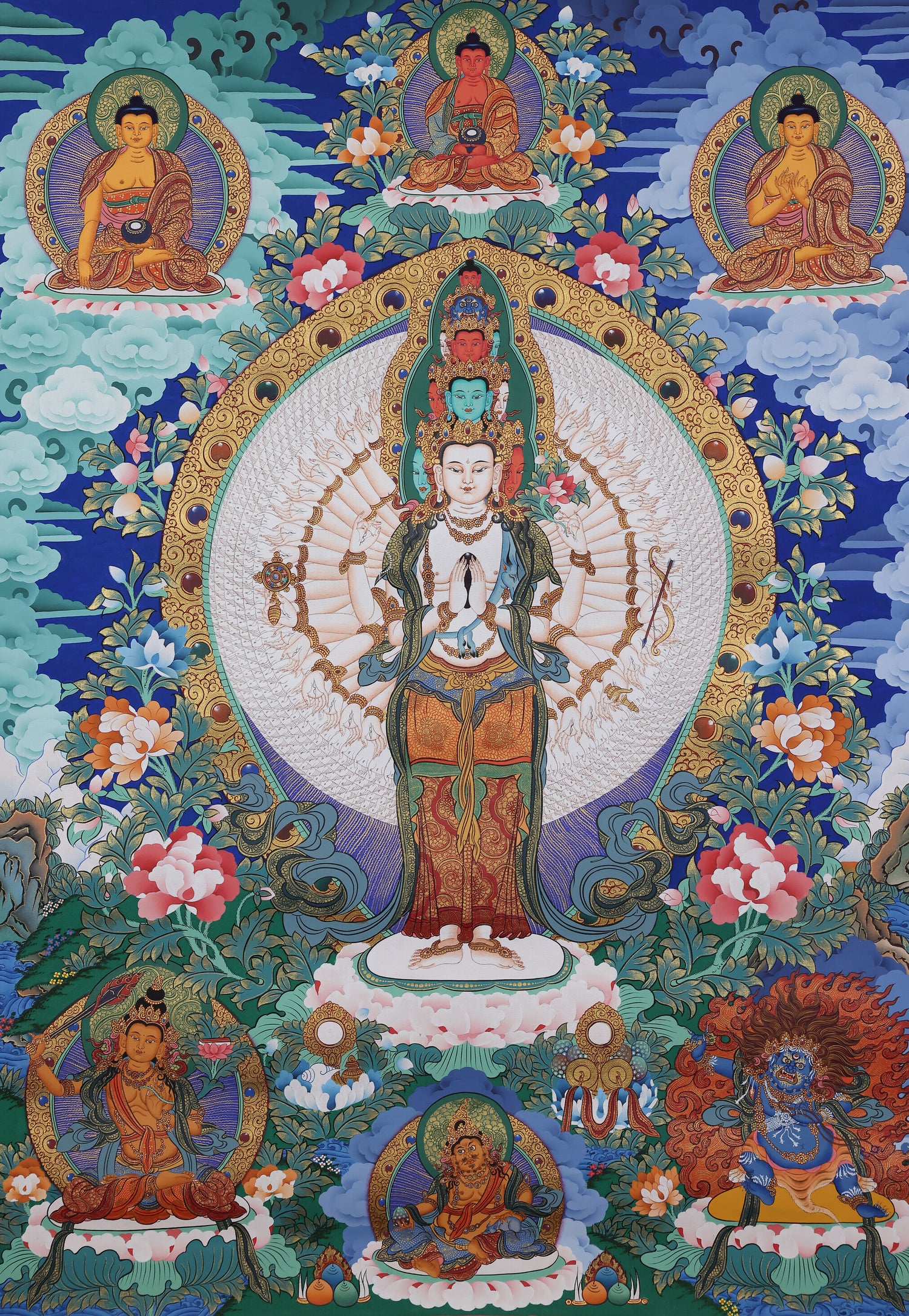
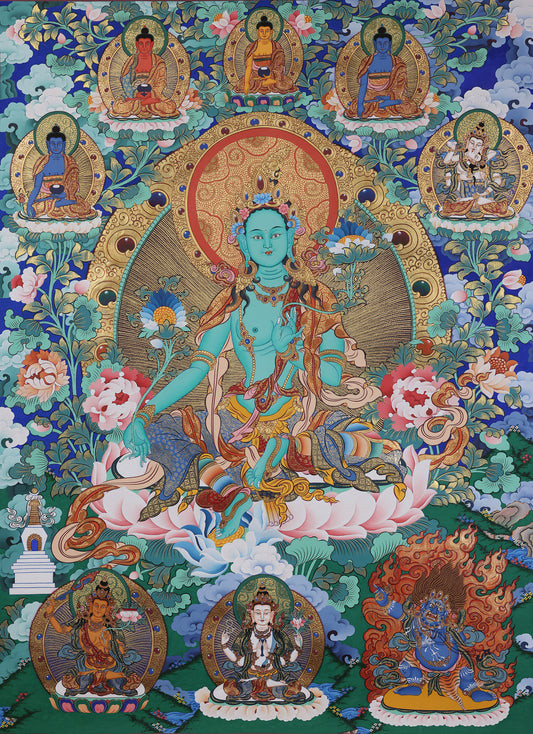
When a hand-painted Nepalese color thangka of White Tara unfurls, the 48×66cm cotton canvas bears not just hues blended from mineral pigments, but the embodied spirit of "unity of compassion and wisdom" in Tibetan Buddhism. As one of the "Three Longevity Deities" in Tibetan Buddhism, White Tara, rendered by Nepalese artisans, serves as a bridge between faith and art—and this work, painted with natural mineral pigments, is a classic example of "visualized faith" in the Himalayan cultural sphere.

I. Theme: A Visual Narrative of Tibetan Buddhist Compassionate Deliverance

The core theme of this thangka is the "Seven-Eyed Deliverance" and "Longevity Blessings" embodied by White Tara.

In the Tibetan Buddhist system, White Tara is the compassionate emanation of the left tear of Avalokiteshvara (the right tear becomes Green Tara), a central figure among the "Twenty-One Taras," and one of the "Three Longevity Deities" alongside Amitayus Buddha and Ushnisha Vijaya. Centered entirely on White Tara, this thangka conveys the most basic spiritual aspirations of Tibetan Buddhist devotees—warding off disasters, extending life, and fulfilling wishes—through the main deity’s posture, attendant configuration, and auspicious symbols.

White Tara’s "seven eyes" (on the forehead, palms, and soles) are the visual anchor of the theme: they symbolize "watching over suffering in all six realms," while elements like the lotus throne and vase implicitly align with the spiritual goal of "pure liberation." For Nepalese devotees, this thangka is not merely an object of worship, but a tangible spiritual anchor for daily prayers, making "compassion accessible."

II. Main Deity: The Symbolic Code of White Tara’s Iconographic Rules

Every detail of the thangka’s main deity strictly adheres to the Iconometric Sutras, holding the symbolic logic of Tibetan Buddhism:

1. Form: The Embodiment of Pure Compassion

  • Body Color & Countenance: Snow-white in hue, corresponding to "unstained compassionate intent and pure wisdom"; the face takes the form of a sixteen-year-old maiden, implying the longevity motif of "eternal youth," while the gentle expression conveys the 胸怀 of "unconditional great compassion."
  • Seven-Eyed Mark: The clearly visible third eye (on the brow) and palm eyes are White Tara’s signature symbols—seven eyes represent "unobstructed observation of sentient beings’ suffering," a concrete expression of her "swift deliverance."
  • Ornaments: Adorned with an Indian-style flower garland crown (distinct from Tibetan jewel crowns), paired with large earrings, necklaces, and celestial robes, it inherits Indian Buddhist iconographic traditions while using "worldly adornments" to metaphorize the doctrine of "upholding good intentions."

2. Posture & Implements: The Visualization of Aspirations

  • Seat & Lotus Throne: Seated in full lotus posture on a double lotus throne (the lower red lotus represents "rising unsoiled from mud," the upper white lotus represents "pure original mind"), the stable posture carries an undercurrent of "readiness to rise and deliver."
  • Mudra & Offerings: The right hand forms the "wish-fulfilling mudra" (palm downward), signifying "granting sentient beings’ good wishes"; the left hand holds a blue lotus (utpala), its stem curving to the ear (the bud 暗含 a vase of nectar), symbolizing "moistening afflictions with compassionate nectar."

III. Attendant Deities: Order and Function in the Sacred Space

The thangka’s attendant deities are not mere decorations, but key to constructing the "main deity-attendant-protector" system, reflecting the "clear hierarchy" of Nepalese thangka composition:

  • Left Attendant: A pale-yellow, reverently posed attendant bodhisattva (or emanation of Yellow Tara), whose function is to "assist the main deity in fulfilling wishes"; its attire echoes the main deity, enhancing the thangka’s coherence.
  • Right Protector: An indigo-blue wrathful deity (a "benevolent wrathful protector") standing with a vase—its wrathful form is not menacing, but represents "subduing obstacles with fierce power," echoing the Tibetan Buddhist tantric concept that "compassion and ferocity are non-dual."
  • Upper Emanation: A small red-bodied seated Buddha (Amitayus or Avalokiteshvara) at the top, White Tara’s "original deity," symbolizing "doctrinal lineage" and completing the faith cycle of "returning to the source."
  • Background Elements: Golden flowing cloud patterns (a signature motif of Nepalese thangkas) conceal golden dragons and birds, while stylized bodhi trees adorn the right side—these elements create an atmosphere of "sacred auspiciousness" and break the monotony of static composition with dynamic lines.

IV. Craftsmanship & Style: Tradition and Precision in Nepalese Color Thangkas

Half the value of this thangka lies in faith, the other in craftsmanship—as a hand-painted Nepalese color thangka, it carries the unique genes of regional art:

1. Materials & Pigments: The Timelessness of Natural Minerals

  • Canvas Preparation: Using white cotton as the base, simplified processes (gluing, sanding, whitening) (distinct from the multi-layered treatment of Tibetan thangkas) balance durability and paintability, suiting the practical needs of Nepalese household worship.
  • Mineral Pigments: Natural mineral pigments like lapis lazuli (blue), cinnabar (red), and ochre (yellow) yield saturated, century-resistant hues—lapis lazuli grindings produce calm blues, cinnabar blends create vibrant reds, and 24K gold powder outlines crisp, unostentatious lines, serving as a material vessel for "eternal faith."

2. Regional Style: Fusion of Indian Tradition and Himalayan Aesthetics

  • Composition Logic: Centered on the main deity with symmetrically arranged attendants, it strictly follows iconographic rules but adds dynamism with flowing clouds, distinguishing it from the "rigid symmetry" of Tibetan thangkas.
  • Lines & Colors: Soft, 舒展 figures (rounded shoulders on the main deity, natural postures of attendants) use warm tones (gold, red, orange) as the base, accented by cool tones (blue, green)—aligning with Nepalese color symbolism (red = prominence, yellow = brightness) while building a sacred atmosphere through layering.
  • Balance of Folk and Religious Qualities: Compared to the "dense detail" of Tibetan thangkas, this work has a simpler background that emphasizes the main deity—this is the practical aesthetics of Nepalese thangkas, adapted for household worship.

Conclusion: A Dual Heritage of Faith and Art

This 48×66cm Nepalese White Tara thangka is a "visual scripture" of Tibetan Buddhist compassionate faith and a living sample of Nepalese traditional craftsmanship. It carries spiritual heritage through the timelessness of mineral pigments and interprets religious rules through regional artistic characteristics—when we gaze at White Tara’s seven eyes in the painting, we see not just art, but the core spirit of Tibetan Buddhism: "watching over suffering with wisdom, practicing deliverance with compassion."

#NepaleseWhiteTaraThangka

#TibetanBuddhistThangkaAnalysis

#MineralPigmentThangkaCraft

#WhiteTaraIconographySymbolism

#NepaleseColorThangkaStyle

#TibetanBuddhistCompassionateFaith

#ThangkaAttendantDeities

#ThreeLongevityDeitiesThangka

#HimalayanArt

#ThangkaCollectionAppreciation
Discover the perfect Tibetan Buddhist Thangka that matches your wishes, lifestyle, and space. Each Thangka carries spiritual meaning and brings blessings when placed correctly.

1. Define Your Intention

Wealth & Success → Yellow Dzambhala (Wealth Deity)

Compassion & Peace → Avalokiteshvara, Green Tara

Wisdom & Learning → Manjushri

Health & Healing → Medicine Buddha

Longevity & Family Protection → White Tara

2. Choose by Identity

Entrepreneurs & Business Owners → Wealth Deities for prosperity.

Students & Scholars → Wisdom Deities for focus and clarity.

Healers & Yoga Practitioners → Medicine Buddha for energy and balance.

Families & Homemakers → Tara Deities for harmony and safety.

Collectors & Art Lovers → Rare Mandalas or Masterpiece Thangkas.

3. Match Your Space

Home Shrine / Meditation Room → Medium Thangkas (60–80 cm).

Office / Business Hall → Large Thangkas for prosperity and authority.

Living Room / Study → Decorative Thangkas for peace and beauty.

4. Authentic Craftsmanship

Hand-painted with natural mineral pigments and fine canvas, each Thangka reflects Tibetan artistry and spiritual power. Verified sources ensure quality and respect for tradition.

✨ Choose your Thangka with heart — it’s not just art, but a blessing for your life.

Different people have different needs, and choosing the right Thangka can provide spiritual support, protection, good fortune, and blessings. Below are Thangka recommendations for various roles:

1. Entrepreneurs

  • Needs: Wisdom, wealth, health, career success.
  • Recommended Thangkas:
    Manjushri: Enhances decision-making and business wisdom.
    Wealth Deity: Brings wealth and prosperity.
    Medicine Buddha: Supports health and reduces stress.
    Mahakala: Protects business from competition and challenges.

2. Successful Individuals

  • Needs: Inner peace, family harmony, longevity.
  • Recommended Thangkas:
    Amitabha Buddha: Brings inner peace and tranquility.
    Avalokiteshvara (Guanyin): Promotes family harmony and happiness.
    Amitayus (Long Life Buddha): Prays for good health and long life.
    Manjushri: Continues to enhance wisdom.

3. Housewives/Husbands

  • Needs: Family harmony, protection, health.
  • Recommended Thangkas:
    Avalokiteshvara: Increases family happiness and harmony.
    Protector Deities: Safeguards the family from external disturbances.
    White Tara: Blesses the family with health.

4. Students and Scholars

  • Needs: Wisdom, focus, academic success.
  • Recommended Thangkas:
    Manjushri: Boosts learning, memory, and wisdom.
    Sakyamuni Buddha: Helps with concentration and spiritual practice.
    Jixiang Tianmu: Brings academic good luck and exam success.

5. Artists and Creative Professionals

  • Needs: Inspiration, creativity, artistic achievement.
  • Recommended Thangkas:
    Manjushri: Stimulates creative thinking and inspiration.
    Vajrapani: Helps overcome creative blocks.
    Maitreya: Brings a relaxed and optimistic attitude, easing stress.

6. Travelers and Adventurers

  • Needs: Protection, good luck, success in adventures.
  • Recommended Thangkas:
    Hayagriva: Provides strong protection during travels and clears obstacles.
    Mahakala: Brings good fortune and protection, especially for adventurers.
    Vajrasattva: Helps overcome difficulties and challenges during the journey.

7. Elderly Individuals

  • Needs: Health, longevity, spiritual peace.
  • Recommended Thangkas:
    Amitayus: Prays for long life and good health.
    Medicine Buddha: Promotes healing and physical well-being.
    Avalokiteshvara: Brings compassion and inner peace in later years.

8. Corporate Executives

  • Needs: Leadership, wisdom, teamwork, and business success.
  • Recommended Thangkas:
    Manjushri: Enhances leadership skills and decision-making.
    Wealth Deity: Brings success and prosperity to the business and team.
    Avalokiteshvara: Promotes harmony and balance within the team.

9. Health and Fitness Enthusiasts

  • Needs: Good health, vitality, energy.
  • Recommended Thangkas:
    Medicine Buddha: Enhances physical health and vitality.
    White Tara: Brings health and rejuvenation.
    Vajrasattva: Clears health challenges and boosts energy.

10. Politicians

  • Needs: Leadership, wisdom, peace.
  • Recommended Thangkas:
    Manjushri: Enhances leadership abilities and decision-making.
    Vairocana Buddha: Helps maintain inner peace and wisdom.
    Avalokiteshvara: Promotes societal peace and family harmony.

For all orders exceeding a value of 100USD shipping is offered for free.

Returns will be accepted for up to 10 days of Customer’s receipt or tracking number on unworn items. You, as a Customer, are obliged to inform us via email before you return the item.

Otherwise, standard shipping charges apply. Check out our delivery Terms & Conditions for more details.

Returns will be accepted for up to 10 days of Customer’s receipt or tracking number on unworn items. You, as a Customer, are obliged to inform us via email before you return the item, only in the case of:

– Received the wrong item.
– Item arrived not as expected (ie. damaged packaging).
– Item had defects.
– Over delivery time.
– The shipper does not allow the goods to be inspected before payment.

The returned product(s) must be in the original packaging, safety wrapped, undamaged and unworn. This means that the item(s) must be safely packed in a carton box for protection during transport, possibly the same carton used to ship to you as a customer.

Recently Viewed

Don't forget! The products that you viewed. Add it to cart now.

Pairs well with

Enhance your selection with perfectly matched accessories and complementary products..

People Also Bought

Here’s some of our most similar products people are buying. Click to discover trending style.