Nepal Newari-Style Red Thangka: Decoding the 20×30cm Hand-Painted Green Tara & Its Himalayan Artistry

$499.00 USD
Thangka Name: Red Tang Green Tara
Size: 20cm×30cm
Origin: Nepal
Ask a Question

Hurry Up! Only 100 left in stock!

Estimate delivery times: 12-26 days (International), 3-6 days (United States).

Return within 45 days of purchase. Duties & taxes are non-refundable.

tibetan-buddhist-culture-red-thangka-green-tara-handpainted.jpg
Alt Text: “Hand-painted Red Thangka of Green Tara, Tibetan Buddhist sacred artwork, detailed traditional painting.”
Nepal Newari-Style Red Thangka: Decoding the 20×30cm Hand-Painted Green Tara & Its Himalayan Artistry
$499.00 USD
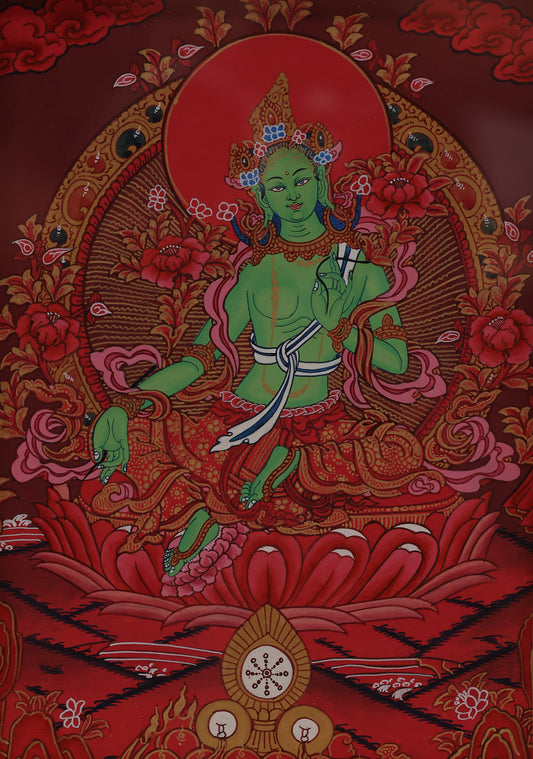
Nestled in the Himalayan crossroads of Nepal, the 20×30cm hand-painted Green Tara red thangka isn’t just a work of art—it’s a portable shrine, a vessel of compassionate energy, and a testament to centuries of Newari artistic legacy. Rooted in Tibetan Buddhist devotion yet steeped in Nepalese cultural identity, this small but profound piece encapsulates the essence of “swift liberation” (the core vow of Green Tara) while showcasing the meticulous craftsmanship of Kathmandu Valley’s master thangka painters.

Who is Green Tara? The Deity of Swift Rescue

At the heart of this thangka is Green Tara (Sanskrit: Sitātapatrā; Tibetan: Drolma), the most revered female bodhisattva in Tibetan Buddhism. Her origin story ties to Avalokiteshvara (the Bodhisattva of Compassion): legend holds that Green Tara emerged from a single tear of Avalokiteshvara as he grieved the suffering of sentient beings, vowing to remain in samsara (the cycle of rebirth) to offer immediate aid—earning her the title “Mother of Liberation” and “Swift-acting Savior.”

In practice, Green Tara is invoked to overcome the “Eight Great Fears” (lion, elephant, snake, thief, fire, water, demon, imprisonment) and to cultivate compassion, healing, and spiritual clarity. For Newari communities, she also bridges local goddess worship (e.g., Nepalese Durga traditions) with Buddhist devotion, making her a universal figure of protection across Himalayan cultures.

Iconography: Decoding the Symbols of the 20×30cm Thangka

Every detail of this thangka adheres to the Iconographic Canon of Tibetan Buddhism (based on texts like the Iconometry Sutra), while infusing Newari artistic flair:

  1. Green Skin & Form

    Tara’s 翡翠绿 (emerald green) complexion isn’t just aesthetic: in Tibetan Buddhist symbolism, green corresponds to the wind element (representing swift action) and vitality (symbolizing healing). Her “sixteen-year-old maiden form” (a standard for female bodhisattvas) balances divine serenity with youthful warmth—a hallmark of Newari portraiture, which softens rigid Tibetan iconography with human-like grace.
  2. Posture & Hand Gestures

    She sits in lalita asana (the “royal ease” pose): one leg folded, the other extended downward, foot resting on a lotus petal. This posture (unique to Tara) signifies she is always ready to rise to aid beings. Her right hand forms the Varada Mudra (the “Gesture of Granting Wishes”), palm outward to bestow blessings; her left hand holds a stem of the utpala (blue lotus), which blooms with buds, half-opened flowers, and full blossoms—symbolizing past, present, and future liberation.
  3. Ornaments & Backdrop

    She wears a five-jewel crown (representing the Five Dhyani Buddhas, whose wisdom she embodies) and “eight auspicious ornaments” (earrings, necklaces, armbands)—rendered with 24K gold gilding and mineral pigments (cinnabar for reds, malachite for greens) that catch light to mimic the luster of real jewels. Behind her, a red sunburst halo (a Newari twist on Tibetan aura iconography) frames her figure, while blooming red lotuses (a symbol of purified desire in Buddhism and a sacred flower of Nepal) surround the lotus throne.

Newari Craftsmanship: The Art of Hand-Painting a 20×30cm Thangka

This thangka is a product of the Newari Paubha tradition (the Nepalese term for thangka), a style distinguished by its intricate detail, vibrant mineral pigments, and fusion of Buddhist and Hindu artistic elements. Here’s how it’s made:

  1. Canvas Preparation

    The base is hand-woven Nepalese cotton, treated with a paste of yak bone glue and chalk powder (repeatedly applied and sanded to create a smooth, paper-like surface). This ensures the pigments adhere and resist fading—even after decades.
  2. Mineral & Earth Pigments

    Every color is derived from natural materials:
    • Green: Ground malachite (a copper carbonate mineral) mixed with bone glue;
    • Red: Cinnabar (mercury sulfide) for the backdrop (a Newari signature, symbolizing life force);
    • Gold: 24K gold leaf, ground into a paste and applied with fine squirrel-hair brushes for gilding (used for ornaments, halos, and sacred symbols like the dharma wheel at the base of the lotus throne).
  3. Linework & Detailing

    Newari painters use wolf-hair brushes (as thin as a single hair) to outline figures with “iron wire” precision, then layer pigments in translucent washes (a technique borrowed from Nepalese Malla-era court painting) to create soft, lifelike shading—unlike the flat, symbolic coloring of traditional Tibetan thangkas. The 20×30cm size demands extraordinary patience: a single thangka takes 2–3 weeks to complete, with each petal, jewel, and halo line painted by hand.

Why a Small Thangka? The Role of Portable Shrines in Himalayan Devotion

For Tibetan Buddhists and Newari practitioners alike, a 20×30cm thangka serves a practical spiritual purpose: it’s a traveling altar. Devotees carry such thangkas in ghau boxes (wooden shrine containers) during pilgrimages, place them on home altars for daily meditation, or gift them as blessings for births, marriages, or journeys. Its small size doesn’t diminish its power—in Himalayan traditions, intention (not scale) defines a sacred object’s efficacy.

Cultural Fusion: Newari Thangka as a Bridge Between Traditions

This thangka embodies the cultural syncretism of the Kathmandu Valley:

  • It follows Tibetan Buddhist iconography (e.g., the Five-Jewel Crown, Dharma Wheel) but softens it with Newari aesthetic sensibilities (e.g., lifelike portraiture, red-dominated backdrops);
  • It uses materials sacred to both Buddhism and Hinduism (cinnabar, gold, lotus flowers), reflecting Nepal’s pluralistic spiritual landscape;
  • It preserves a dying art: fewer than 50 master Newari thangka painters remain in Kathmandu, making pieces like this not just devotional objects, but cultural heritage.

Conclusion: More Than a Thangka—A Story of Compassion

This 20×30cm Green Tara red thangka is a microcosm of Himalayan spirituality: it tells the story of a bodhisattva’s vow to save beings, the legacy of Newari craftsmanship, and the fusion of cultures that defines Nepal. Whether displayed as art, used in meditation, or carried as a portable shrine, it reminds us that compassion—like the thangka itself—can be both small and infinitely powerful.

#GreenTaraThangka #NepalNewariArt #TibetanBuddhistArt #HandPaintedThangka #HimalayanCraftsmanship #GreenTaraMeaning #NewariPaubha #MineralPigmentThangka #PortableAltar #HimalayanSpirituality

Discover the perfect Tibetan Buddhist Thangka that matches your wishes, lifestyle, and space. Each Thangka carries spiritual meaning and brings blessings when placed correctly.

1. Define Your Intention

Wealth & Success → Yellow Dzambhala (Wealth Deity)

Compassion & Peace → Avalokiteshvara, Green Tara

Wisdom & Learning → Manjushri

Health & Healing → Medicine Buddha

Longevity & Family Protection → White Tara

2. Choose by Identity

Entrepreneurs & Business Owners → Wealth Deities for prosperity.

Students & Scholars → Wisdom Deities for focus and clarity.

Healers & Yoga Practitioners → Medicine Buddha for energy and balance.

Families & Homemakers → Tara Deities for harmony and safety.

Collectors & Art Lovers → Rare Mandalas or Masterpiece Thangkas.

3. Match Your Space

Home Shrine / Meditation Room → Medium Thangkas (60–80 cm).

Office / Business Hall → Large Thangkas for prosperity and authority.

Living Room / Study → Decorative Thangkas for peace and beauty.

4. Authentic Craftsmanship

Hand-painted with natural mineral pigments and fine canvas, each Thangka reflects Tibetan artistry and spiritual power. Verified sources ensure quality and respect for tradition.

✨ Choose your Thangka with heart — it’s not just art, but a blessing for your life.

Different people have different needs, and choosing the right Thangka can provide spiritual support, protection, good fortune, and blessings. Below are Thangka recommendations for various roles:

1. Entrepreneurs

  • Needs: Wisdom, wealth, health, career success.
  • Recommended Thangkas:
    Manjushri: Enhances decision-making and business wisdom.
    Wealth Deity: Brings wealth and prosperity.
    Medicine Buddha: Supports health and reduces stress.
    Mahakala: Protects business from competition and challenges.

2. Successful Individuals

  • Needs: Inner peace, family harmony, longevity.
  • Recommended Thangkas:
    Amitabha Buddha: Brings inner peace and tranquility.
    Avalokiteshvara (Guanyin): Promotes family harmony and happiness.
    Amitayus (Long Life Buddha): Prays for good health and long life.
    Manjushri: Continues to enhance wisdom.

3. Housewives/Husbands

  • Needs: Family harmony, protection, health.
  • Recommended Thangkas:
    Avalokiteshvara: Increases family happiness and harmony.
    Protector Deities: Safeguards the family from external disturbances.
    White Tara: Blesses the family with health.

4. Students and Scholars

  • Needs: Wisdom, focus, academic success.
  • Recommended Thangkas:
    Manjushri: Boosts learning, memory, and wisdom.
    Sakyamuni Buddha: Helps with concentration and spiritual practice.
    Jixiang Tianmu: Brings academic good luck and exam success.

5. Artists and Creative Professionals

  • Needs: Inspiration, creativity, artistic achievement.
  • Recommended Thangkas:
    Manjushri: Stimulates creative thinking and inspiration.
    Vajrapani: Helps overcome creative blocks.
    Maitreya: Brings a relaxed and optimistic attitude, easing stress.

6. Travelers and Adventurers

  • Needs: Protection, good luck, success in adventures.
  • Recommended Thangkas:
    Hayagriva: Provides strong protection during travels and clears obstacles.
    Mahakala: Brings good fortune and protection, especially for adventurers.
    Vajrasattva: Helps overcome difficulties and challenges during the journey.

7. Elderly Individuals

  • Needs: Health, longevity, spiritual peace.
  • Recommended Thangkas:
    Amitayus: Prays for long life and good health.
    Medicine Buddha: Promotes healing and physical well-being.
    Avalokiteshvara: Brings compassion and inner peace in later years.

8. Corporate Executives

  • Needs: Leadership, wisdom, teamwork, and business success.
  • Recommended Thangkas:
    Manjushri: Enhances leadership skills and decision-making.
    Wealth Deity: Brings success and prosperity to the business and team.
    Avalokiteshvara: Promotes harmony and balance within the team.

9. Health and Fitness Enthusiasts

  • Needs: Good health, vitality, energy.
  • Recommended Thangkas:
    Medicine Buddha: Enhances physical health and vitality.
    White Tara: Brings health and rejuvenation.
    Vajrasattva: Clears health challenges and boosts energy.

10. Politicians

  • Needs: Leadership, wisdom, peace.
  • Recommended Thangkas:
    Manjushri: Enhances leadership abilities and decision-making.
    Vairocana Buddha: Helps maintain inner peace and wisdom.
    Avalokiteshvara: Promotes societal peace and family harmony.

For all orders exceeding a value of 100USD shipping is offered for free.

Returns will be accepted for up to 10 days of Customer’s receipt or tracking number on unworn items. You, as a Customer, are obliged to inform us via email before you return the item.

Otherwise, standard shipping charges apply. Check out our delivery Terms & Conditions for more details.

Returns will be accepted for up to 10 days of Customer’s receipt or tracking number on unworn items. You, as a Customer, are obliged to inform us via email before you return the item, only in the case of:

– Received the wrong item.
– Item arrived not as expected (ie. damaged packaging).
– Item had defects.
– Over delivery time.
– The shipper does not allow the goods to be inspected before payment.

The returned product(s) must be in the original packaging, safety wrapped, undamaged and unworn. This means that the item(s) must be safely packed in a carton box for protection during transport, possibly the same carton used to ship to you as a customer.

Recently Viewed

Don't forget! The products that you viewed. Add it to cart now.

Pairs well with

Enhance your selection with perfectly matched accessories and complementary products..

People Also Bought

Here’s some of our most similar products people are buying. Click to discover trending style.