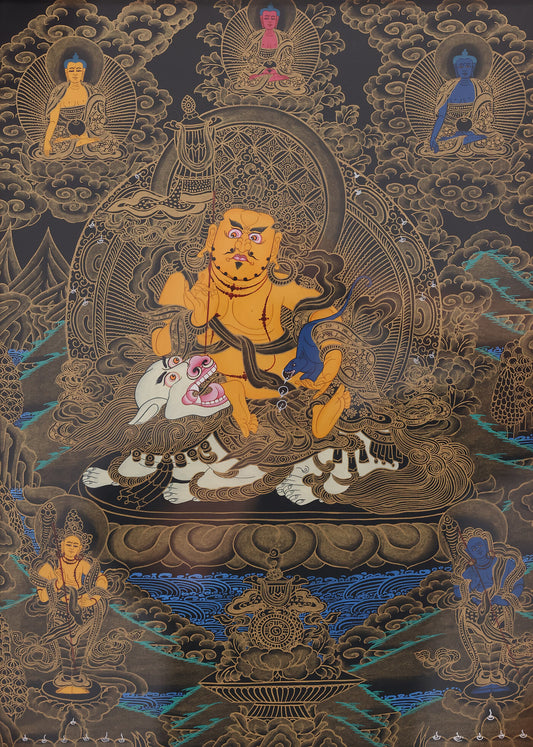
In the profound cultural and spiritual practice system of Tibetan Buddhism, a thangka is far more than a painting. It is a "portable temple," a visual meditation manual, and a sacred object that embodies faith, philosophy, history, and supreme artistry. This meticulously hand-painted Black and Gold Yellow Jambhala Thangka, with its deep cosmic black background, dazzling gold lines, and precise iconographic details, faithfully transmits a thousand-year-old Vajrayana tradition while achieving a perfect resonance of classical solemnity and modern aesthetics. What it carries is far beyond surface-level opulence; it is a complete teaching on wealth, wisdom, and ultimate liberation.
I. Core Theme: The "Prajna View of Wealth" That Transcends the Mundane
The core of this thangka lies in its visual explanation of Tibetan Buddhism's unique wisdom of "using wealth on the path" to enlightenment. The central deity, Yellow Jambhala (Tibetan: Dzam Bhala Ser Po; Sanskrit: Jambhala), is not a mundane god for praying for windfall gains. He is the foremost among the Five Wealth Deities, a wisdom Dharma protector (Dharmapala) of the transcendental realm, and the principal deity of the Northern Treasury.
His veneration traces back to the Prajnaparamita Sutras. It is recorded that when Shakyamuni Buddha was expounding the wisdom of emptiness, demons created obstacles. Yellow Jambhala manifested as a Dharma protector to disperse them. The Buddha then entrusted him with protecting the Dharma, specifically instructing him to aid those in poverty and practitioners. Therefore, the fundamental logic of Yellow Jambhala's practice is: using wealth as a "positive condition" and "provision" for spiritual practice, eliminating external obstacles like hunger and sickness, thereby allowing one to pursue liberation with undivided attention, and using resources for generous giving (dana) to benefit all beings.
The use of the black and gold color scheme, a highly advanced combination, is in itself a profound philosophical metaphor:
-
Black Background: Symbolizes the wisdom of emptiness (Shunyata)—the ultimate reality that all phenomena are empty of inherent existence, arising dependently, and not to be clung to. It signifies that true wealth must be founded upon the wisdom that realizes "selflessness" and "impermanence."
-
Gold Outlines: Represent merit, luminous clarity, and manifesting energy. Within the infinite potential of emptiness, blessings and resources manifest brilliantly like gold.
Together, they perfectly interpret the core of wealth in Tibetan Buddhism: to act from the wisdom of emptiness, to practice compassion with abundant means, transforming worldly wealth into a ladder towards awakening.
II. Deity Analysis: The Iconography, Attributes, and Esoteric Meaning of Yellow Jambhala
The form of Yellow Jambhala at the center strictly adheres to the tantric measurements outlined in the Treatise on Iconography (Sadhana). Every detail is a visual annotation of Dharma meaning:
-
Form and Color:
-
Bright Yellow Body: Corresponds to the "earth" element, symbolizing a stable, vast, and supportive foundation for wealth, and represents increase and prosperity.
-
Corpulent Body: This is not a sign of greed, but a display of perfect merit and immeasurable compassion, capable of encompassing the hopes of all beings.
-
Five-Buddha Crown: Represents the blessings and wisdom of the Five Dhyani Buddhas, indicating that his power originates from ultimate Buddhahood, sanctifying wealth and giving it an enlightened purpose.
-
Posture and Primary Attributes:
-
Royal Ease Posture (Lalitasana): His left leg is drawn in, while his right foot rests gently upon a white conch shell. The conch symbolizes "retrieving treasure from the ocean," meaning using wisdom to comprehend the deeper principles of wealth, not chasing it blindly.
-
Right Hand Holds a Wish-Fulfilling Jewel (Cintamani): The "wish-granting gem" that spontaneously fulfills all virtuous wishes of beings. This includes not just material abundance but also wisdom, health, peace, and other holistic blessings.
-
Left Arm Holds a Wealth-Emitted Mongoose: The mongoose spews an endless stream of jewels. This crucial symbol is not hoarding but signifies the joy of giving and the flow of wealth. It reveals a fundamental Vajrayana teaching: generosity (dana) is the true, inexhaustible source of wealth.
-
Mount and Throne:
-
White Lion (Snow Lion) Mount: The snow lion, an auspicious creature of the Himalayas, symbolizes fearlessness and majesty, capable of subduing all inner obscurations (like miserliness, greed) and outer obstacles that block wealth and practice.
-
Double-Lotus Throne: The lower lotus petals encase the seat, topped by a moon disc. This signifies that although he governs worldly wealth, his essence is pure and unstained, transcending the defilements of cyclic existence, abiding in wisdom and compassion.
III. The Retinue System: The Complete Cosmology of a Mandala
This thangka is not a single deity portrait but a miniature wealth mandala, embodying the complete system of a "main deity and retinue" constructing a sacred realm:
-
Wisdom Source Above: At the top are three Buddhas, a condensed representation of the Five Dhyani Buddhas (often featuring Vairocana, Akshobhya, and Amitabha). They declare that all of Yellow Jambhala's power ultimately stems from the wisdom and compassionate vows of the Buddhas, placing the wealth practice within the entire path to enlightenment.
-
Attending Deities on the Sides:
-
White Jambhala (on the left): One of the Five Wealth Deities, white as the moon, holding a victory banner. He specializes in purifying negative karma, eliminating suffering, especially poverty caused by past actions, representing the "pure cause" of wealth.
-
Vaishravana, King of the North (on the right): As a guardian of the north, he holds a victory banner/parasol and a wealth mongoose. He is the renowned Dharma protector who safeguards both the teachings and wealth, sharing a common origin with Yellow Jambhala, showcasing the vast vow to protect both Dharma and resources.
-
Source of Increase Below:
-
Vasudhara, Goddess of the Source of Wealth: Holding a vase brimming with treasures, symbolizing inexhaustible resources, she presides over the flourishing of all assets, grains, connections, and the very roots of prosperity.
This meticulous composition builds a complete cycle for practice and aspiration: Removing Obstacles (White Jambhala) -> Increasing Merit (Yellow Jambhala, Vasudhara) -> Wisdom Protection (Five Buddhas, Vaishravana).
IV. Artisan Craftsmanship: The Supreme Skill of Rebong Black and Gold Thangka
This piece belongs to the exceptionally rare category of "Black and Gold Thangka" (Nagthang) within the Rebong (Regong) artistic tradition. Its creation is itself an act of devout practice, time-consuming and representing the pinnacle of craftsmanship.
-
The Ground: Birth of the "Black Jade" Canvas
-
The canvas is premium cotton, undergoing a rigorous four-stage process of washing, stretching, priming, and polishing. A mixture of yak-hide glue and white clay is applied as a base, polished repeatedly until smooth as a mirror.
-
The black ground uses a traditional formula of Tibetan magnetite and deer antler ash, ground to an ultra-fine powder and mixed with aged glue. It requires hand application in over a dozen layers. Each layer is dried in shade and then meticulously polished with an agate stone, finally achieving a deep, warm, light-absorbing "black jade" texture—the perfect stage for the gold's brilliance.
-
Gold and Color: The Soul of "Flowing Light"
-
Gold: Entirely made from 24K pure gold leaf hand-ground into powder and mixed with glue. A trace of saffron infusion is added, not only to fix the color but to give the gold a warm, enduring luster that ages gracefully.
-
Application of the secret Rebong technique of "Raised Gold (Tseg Ser)": Using a special glue mixed with pure gold powder, lines are built up to create a subtle three-dimensional relief. After drying, they are polished again. This causes the gold lines to produce a shimmering,立体 effect under changing light, as if the deity is emerging from the darkness—a truly awe-inspiring visual experience.
-
Sparing Use of Color: Mineral pigments are applied only to key areas. For example, Yellow Jambhala's skin uses orpiment and gold powder, the white lion uses white clay and pearl powder, and background clouds have hints of lapis lazuli blue. This "gold dominant, color accent" approach highlights the solemnity and mystery of the black and gold palette to the extreme.
-
Consecration: The Transformation from Art to Sacred Object
Upon completion, the thangka must undergo a consecration ceremony (rab ne) performed by qualified lamas or monastic communities according to tantric tradition. Often, sacred seed syllables are inscribed in gold ink on the back of the canvas at points corresponding to the main deity's forehead, throat, and heart, accompanied by prayers and mantras. This ritual invites the wisdom and compassion of the Buddhas and deities to "abide" within the painting, transforming the thangka from an artwork into a true "support" (rten) for practice, imbuing it with spiritual significance.
V. Conclusion: A Mandala for Your Home, Wisdom Provisions for Your Soul
To invite this Black and Gold Yellow Jambhala Thangka is not merely to acquire a peerless piece of art; it is to establish within your living space or meditation area a sacred mandala that continuously radiates auspicious energy.
It serves as a daily reminder of Tibetan Buddhism's profound philosophy on wealth:
True abundance arises from an inner attitude of generosity (dana), integrity in action (sila), serenity in the face of gain and loss (abiding in the wisdom of emptiness), and the noble aim of using all resources for the benefit of oneself and others.
May this thangka, which embodies a millennium of faith, supreme artistry, and unsurpassed wisdom, become a visual mantra in your life. May it continually inspire the pursuit of material well-being alongside the cultivation of inner richness, ultimately guiding you towards a life of both fortune and wisdom, perfect freedom, and fulfillment.
#Thangka #YellowJambhala #HandPainted #24KGold #BuddhistArt
#RegongArt #TraditionalCraftsmanship #SacredArt
#MeditationArt #ConsecratedThangka #Vajrayana
#ZenDecor #AsianArt #SacredArt