In the spiritual landscape of Tibetan Buddhism, thangkas of Guru Rinpoche (Padmasambhava) are core spiritual carriers of the Nyingma (Red Hat) tradition; a hand-painted Nepalese thangka, meanwhile, holds the code to a millennium of Sino-Nepalese cultural exchange. Today, we deeply dissect this 25×35cm Guru Rinpoche thangka—from the ritual symbols of Tibetan Buddhism to the natural pigment techniques of the Newari school—to understand why it is both a "portable refuge field" and a living fossil of Sino-Nepalese art.
The core theme of this thangka is the "original form of Guru Rinpoche", rather than variant themes like the "Eight Manifestations of Guru Rinpoche."
Guru Rinpoche is revered in Tibetan Buddhism as the "Second Buddha": In the 8th century, he was invited to Tibet by King Trisong Detsen, subdued Bon deities with esoteric practices, and founded Samye Monastery, laying the foundation of Tibetan Buddhism. Thus, Guru Rinpoche thangkas serve as "refuge fields"—the primary focus for practitioners’ visualization and prayers, embodying the spiritual meaning of "removing obstacles and receiving blessings."
The 25×35cm size classifies it as a ga’u-style thangka (portable thangka) in Tibetan: it is convenient for practitioners to carry, or to enshrine in small altars, embodying the "practical spirituality" typical of Nepalese thangkas. The choice of the "original form" (rather than a wrathful manifestation) further positions it as a "daily disaster-averting and merit-increasing" thangka, suited to the devotional needs of ordinary practitioners.
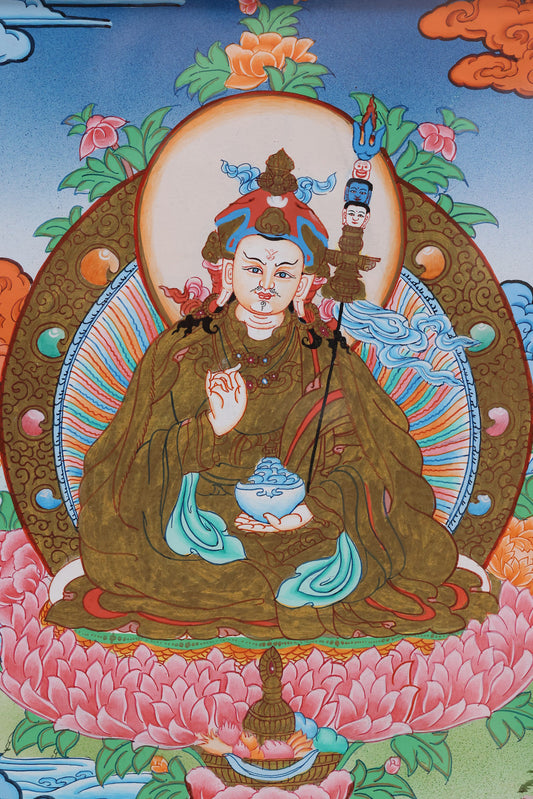
The central figure of Guru Rinpoche strictly adheres to the Iconographic Measurement Sutra, with every detail embodying esoteric Buddhist philosophy:
-
Form and Attire: The Synthesis of Secular and SacredThe main deity wears a lotus crown (topped with a vajra, symbolizing the blessings of all Buddhas), gold earrings, and coral-pearl ornaments—reflecting his secular identity as the "King of Oddiyana." Over his shoulders, a brown monastic robe (representing his religious identity as an ordained monk) is paired with cyan sashes (symbolizing the "blessings of dakinis" for esoteric practitioners). This "king-monk duality" embodies the esoteric concept of "synthesizing secular and sacred paths."
-
Implements and Mudras: The Materialization of Esoteric BlessingsHis right hand forms the varada mudra (thumb and index finger joined), 暗含 the subduing potential of the vajra mudra; his left hand holds a kapala (skull cup, filled with nectar and treasures, symbolizing the "immortal wisdom" of secret empowerment); his left elbow supports a khatvanga (skull-topped staff)—its trident and three skulls correspond to "overcoming the three poisons: greed, anger, and delusion."
-
Lotus Throne and Aura: Symbols of Wisdom and CompassionThe deity sits on a double lotus throne: the lower pink lotus symbolizes the "bodhicitta (enlightenment mind) untainted by defilement," while the upper sun-moon disc represents "the union of wisdom and compassion." The radiant aura behind him, dominated by gold, red, and blue, is framed by lotus vines—an allusion to the esoteric core of "samsara’s defilements as bodhi (enlightenment)."
Unlike Tibetan thangkas’ "crowded retinue layouts," this Nepalese thangka uses a "miniature retinue" design: atop the khatvanga, three small figures represent Tibetan Buddhism’s "Three Roots" (guru, yidam, and protector):
- Top: the blue Vajrapani (holding a vajra, symbolizing yidam blessings);
- Middle: the white Medicine Buddha (holding a medicine vase, symbolizing health and merit);
- Bottom: a female ** dakini** (symbolizing dakini protectors).
This design meets the Tibetan esoteric requirement of "complete Three Roots" while avoiding clutter in the small-format work—a hallmark of Nepalese "portable thangka" design logic.
The background’s orange peonies, pink lotuses, and auspicious clouds are not mere decoration: peonies represent "worldly merit," lotuses "transcendent wisdom," and auspicious clouds "the mounts of dakinis," collectively constructing the spiritual scene of "Guru Rinpoche abiding with protectors."
This thangka is a masterpiece of Nepal’s Newari school, blending ancient Indo-Nepalese traditions with Tibetan aesthetics:
-
Natural Mineral Pigments: A Timeless Spiritual CarrierThe artist used traditional Nepalese natural pigments: red from cinnabar, blue from lapis lazuli (ground to 2000 mesh), green from malachite, gold from 24K gold leaf (crushed into powder and mixed with 牛皮胶), and white from Nepal’s unique "Rinbung white clay."These pigments undergo three steps: grinding, settling, and mixing—for example, lapis lazuli is soaked for 7 days to remove impurities, then layered with a wheat-stalk brush. This technique ensures the thangka "does not fade for a century," aligning with Tibetan Buddhism’s view of thangkas as "eternal dharmakaya (truth body)."
-
Newari Style: Balancing Exquisiteness and SimplicityCompared to Tibetan thangkas, this work exhibits distinct Newari traits:
- Composition: Centered on the main deity, with retinues miniaturized to avoid "crowded complexity," suited to the visual needs of portable thangkas;
- Lines: Dominated by "iron-wire outlines," with delicate facial rendering (a "baby-like face" with concentrated features, symbolizing original purity), distinct from Tibetan thangkas’ "orchid-leaf outlines";
- Color: Warm tones (brown, pink, gold) paired with cool contrasts (blue, green), using "dot-dyeing" for layered hues;
- Decoration: Symmetrical lotus vines on the aura and throne reflect the Newari school’s "court style" (originating from the Kathmandu royal court).
However, the work also shares common Nepalese thangka traits: gold leaf detailing is less precise than in Tibetan thangkas, and facial "spirituality" is slightly weaker—this stems from most Nepalese artists being Hindus, who strictly follow rituals but lack the "faith-based visualization" of Tibetan artists.
This 25×35cm Nepalese thangka is a symbiosis of Tibetan Buddhist faith and Nepalese artistic tradition: it takes Tibetan religious rituals as its core, Newari school techniques as its form, and natural mineral pigments as its medium, ultimately becoming a "portable devotional artwork."
From the 7th-century marriage alliance between Tibet and Nepal to today’s Nepalese thangkas remaining key carriers of Tibetan Buddhism—this Guru Rinpoche thangka is a vivid footnote to a millennium of Sino-Nepalese cultural integration.
#NepaleseThangka #GuruRinpoche #TibetanBuddhistArt #NewariSchool #NaturalMineralPigmentThangka #PortableThangka #TibetanEsotericSymbols