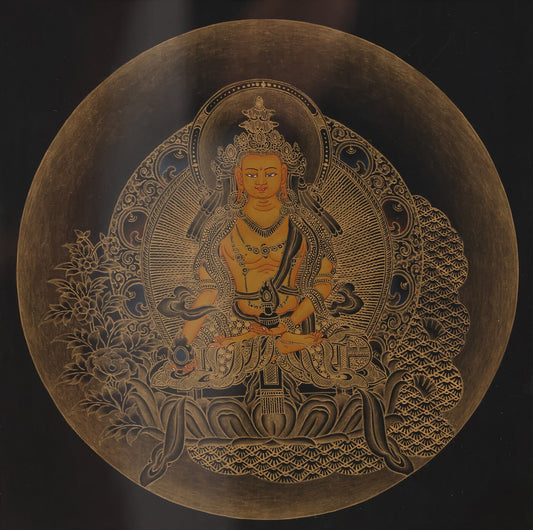
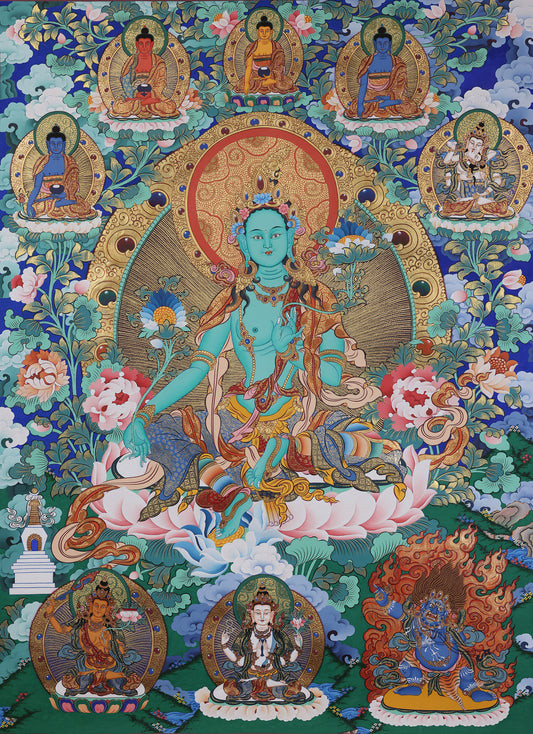
The central theme of this black-gold thangka is Yellow Manjushri Bodhisattva—a deity of immense practice value within the "Five Manjushris" tradition of Tibetan Buddhism, whose image encapsulates the essence of a thousand-year lineage of Buddhist wisdom. Within the vast pantheon of Tibetan Buddhism, Manjushri is revered as the "embodiment of the wisdom of all Buddhas." The visual elements of Yellow Manjushri—his body color, attributes, and posture—strictly adhere to the ritual guidelines found in Tantric scriptures such as the Manjushri Mula Tantra and the Treatise on Iconometry, forming a complete and profound symbolic system.
Body Color and Wisdom: The Philosophical Depth Behind Yellow
The golden body color of Yellow Manjushri is not an arbitrary choice. It corresponds to Buddha Ratnasambhava within the Buddhist cosmological system of the "Five Dhyani Buddhas." In Vajrayana doctrine, Ratnasambhava represents "the wisdom of equality"—the ultimate wisdom that transcends all dualities and perceives all phenomena as equal and undifferentiated. This wisdom is not mere intellectual accumulation but a direct insight into reality. The golden luster of the deity's body in the thangka, painted with pigments derived from saffron and rare minerals, shines like a lamp of wisdom against the black background, providing a direct visual interpretation of the core concept: "wisdom illuminates ignorance."
The Five-Pointed Crown: The Systematic Manifestation of Five Wisdoms
A closer look at the five-pointed crown (often ingeniously presented as "one topknot with five jewels") adorning the deity's head reveals it is not merely an ornament but a complete philosophical system of wisdom:
-
Mirror-like Wisdom: Reflecting all phenomena without discrimination, like a clear mirror.
-
Wisdom of Equality: Perceiving the fundamental equality of all things.
-
Discriminating Wisdom: Discerning the specific characteristics and interdependent origination of all phenomena.
-
All-accomplishing Wisdom: The application of wisdom to perfectly fulfill all enlightened activities for the benefit of beings.
-
Dharma-realm Wisdom: The wisdom of ultimate reality, transcending all conceptual limitations.
These five wisdoms constitute the ultimate goal of Buddhist practice, and Yellow Manjushri is the personified manifestation of these wisdoms.
Attributes and Posture: The Visual Expression of the Path of Practice
The deity's right hand gesture in this thangka typically manifests in two forms: either in the "fearlessness mudra" (abhaya mudra) granting peace to beings, or subtly concealed within the robe folds, symbolizing the "sword of wisdom" that "severs afflictions." The attributes held in the left hand constitute a complete metaphorical system for the path:
-
Lotus Stem by the Ear: Symbolizes "pure listening"—practice begins with correctly hearing the teachings.
-
Lotus Flower Level with the Ear: Represents "correct contemplation"—deep reflection on the meaning of the teachings heard.
-
Scripture on the Lotus: The volume resting on the lotus, often the Prajnaparamita Sutra in Eight Thousand Lines, symbolizes "actual practice and realization"—integrating wisdom into one's very being.
The deity's full lotus posture (vajrasana), stable like Mount Meru, is the perfect visual expression of "meditative realization." This threefold sequence of hearing, contemplation, and meditation is skillfully condensed into a single image, showcasing the thangka art's extraordinary ability to "embody the path through imagery."
Aureole and Ornamentation: The Symbolic Field of the Wisdom Realm
The radiant aureole behind the main deity is the essence of thangka art:
-
Head Halo and Body Halo: Layers of halos outlined in pure gold, symbolizing the infinite expansion of wisdom from the core into the dharma realm.
-
Flame Motifs: Golden flames encircling the aureole represent "wisdom blazing, consuming all ignorance and afflictions."
-
Scrollwork Patterns: Traditional motifs originating from ancient India, symbolizing in the Buddhist context the "unbroken continuity of the Dharma lineage."
-
Utpala Flowers: The stylized blue lotuses on either side represent the realm of pure wisdom, "unstained by the mud" of samsara.
These decorative elements together create a sacred visual field, guiding the viewer from ordinary space into a space of practice.
Part II: Black-Gold Thangka Craftsmanship: The Perfect Fusion of Religious Ritual and Artistic Excellence
This work belongs to the category of "Nagthang" in Tibetan thangka art—meaning black-ground, gold-painted thangka. This genre is considered the "king" of thangka arts, and its creation process is itself a complete practice.
Canvas Preparation: Transformation from Ordinary Cloth to Dharma Realm
The treatment of the canvas for a black-gold thangka embodies the spirit of ultimate craftsmanship:
The Three-Paste, Three-Polish Process:
-
Coarse Paste Filling: Using fine, tightly woven cotton cloth from the Tibetan Plateau, a first paste made from yak bone glue mixed with fine chalk is applied to fill all fabric pores.
-
Medium Paste Leveling: After the first layer is completely dry, a finer paste is applied for the second coating, beginning the initial polishing.
-
Fine Paste Polishing: The third paste is as smooth as silk. The artist must hand-polish the surface for over 45 days under specific humidity conditions until the canvas reaches a state "as smooth as an infant's skin to the touch, like a calm lake to the eye."
This lengthy preparation process is seen by traditional painters as a practice of mental refinement: the smoothness of the canvas symbolizes the purity of the mind, with each round of polishing removing the "rough habits" of the heart.
Black Ground: The Color Expression of Dharma Realm Nature
The black background of the thangka uses a unique formula:
-
Magnetite Powder: Natural mineral sourced from sacred mountains in Tibet, ground, settled, and selected to obtain the finest black powder.
-
Deer Antler Ash: A traditional secret additive to deepen the black hue and improve adhesion.
-
Yak Glue: Used as a binder, collected and prepared in specific seasons.
Black holds special philosophical meaning in Tibetan Buddhism: it does not represent darkness or ignorance but symbolizes the nature of the dharma realm—the primordial state of the universe, transcending all dualities like light/dark, good/evil. This aligns deeply with the Madhyamaka (Middle Way) philosophy of Manjushri's wisdom, which "does not fall into extremes."
Gold Outlining: Drawing Light with Light
The gold-line technique in black-gold thangka reaches the pinnacle of religious art:
The Ritual of Gold Preparation:
-
Timely Grinding: At dawn (known as "karma tsa" in Tibetan), utilizing the specific angle of the morning light, 24K pure gold leaf is ground on an agate stone slab.
-
Fineness Control: Adding water and a special bone glue, the grinding continues for 6-8 hours until the gold powder reaches a fineness exceeding 800 mesh.
-
Glue-Gold Ratio: A hereditary glue formula (containing yak glue, rock sugar, and Tibetan herbal juices) gives the gold paste the right fluidity and viscosity.
The Sanctity of the Raised Gold Technique:
-
Three-dimensional Outlining: Using a specially made brush (with hairs from the most resilient area of a plateau rodent) to "build up" the mixture of gold and glue into slightly raised lines.
-
Agate Burnishing: After drying, the lines are repeatedly polished with agate burnishers of various shapes, creating multi-layered luster on the gold lines, from matte to high gloss.
-
The Magic of Light and Shadow: The completed raised gold lines shimmer dynamically under different lighting, as if wisdom "instantaneously manifests" in the viewer's mind.
Sparing Use of Color: The Ultimate Expression of Tantric Aesthetics
Unlike the vibrant colors of traditional painted thangkas, black-gold thangkas adhere to a minimalist color philosophy:
-
Deity's Body Color: Only the deity's body is painted with the natural golden-yellow extracted from saffron, symbolizing the essence of wisdom.
-
Accent Colors: Key elements like lotus petals and the scripture volume may be touched with mineral colors like cinnabar or lapis lazuli, but their area is strictly controlled.
-
Extensive Use of Black Background: The black background is not "empty" but "full"—a visual expression of the infinite potential of the dharma realm.
This "less is more" technique resonates with the Zen aesthetic of simplicity and the Song/Yuan Dynasty ink wash painting concept of "using blank space as substance," creating a unique religious atmosphere that is ethereal yet majestic.
Iconometry: The Embodiment of Sacred Geometry
Thangka painting strictly follows the "Twelve-Finger Measure" system of the Treatise on Iconometry:
Mathematical Precision of Proportions:
-
Total Height of Main Deity = 12 finger-widths (approx. 30 cm, in perfect proportion to the thangka size).
-
Face Width = 3 finger-widths.
-
Eye Length = 1 finger-width.
-
Distance Between Eyebrows = Half a finger-width.
-
Even details like the number of lotus petals (usually 8) and the thickness of the scripture volume (1.5 finger-widths) are strictly prescribed.
This unwavering precision holds profound religious significance: it ensures the "purity" of the deity's form, preventing practitioners from experiencing "visual distortion" during meditation due to proportional errors, thereby guaranteeing the efficacy of the practice.
The Sacred Moment of "Eye-Opening":
When painting the final eyes, the artist undergoes a seven-day retreat:
-
First Three Days: Reciting Manjushri mantras to purify body, speech, and mind.
-
Middle Two Days: Consuming only pure vegetarian food to adjust physical and mental state.
-
Final Two Days: Painting the pupils with a "blessed gold needle," each stroke accompanied by corresponding mantras.
This process is called "giving life to the thangka." At the moment the eyes are painted, the entire thangka transforms from an "artwork" into a "support for practice."
Part III: Cultural Value: A Wisdom Implement Transcending Time and Space
Religious Dimension: The Body Support Among the Three Supports
In Tibetan Buddhist tradition, thangkas belong to the "Three Supports" (supports for body, speech, and mind) as the "Body Support":
-
Statues/Thangkas: Body Support, representing the Nirmanakaya (emanation body) of the Buddha.
-
Scriptures: Speech Support, representing the Buddha's teachings.
-
Stupas: Mind Support, representing the Buddha's wisdom.
Therefore, this black-gold thangka is not merely a decorative object but a tool for practice and a vehicle for blessings. Traditionally, a completed thangka requires a consecration ceremony by a high lama, endowing it with the power for the four enlightened activities: pacifying, increasing, magnetizing, and subduing.
Artistic Dimension: The Perfect Unity of Material and Spirit
From an art history perspective, this thangka embodies the fusion of multiple traditions:
-
Indian Origins: Iconometric measurements and symbolic attributes stem from Indian Tantric traditions.
-
Nepalese Influence: Gold-working techniques and decorative styles bear the imprint of Newar artisans.
-
Chinese Elements: Some compositional concepts resonate with the "ethereal artistic conception" of Song Dynasty Buddhist painting.
-
Tibetan Innovation: The black-gold technique and application of mineral pigments are unique contributions of the Tibetan people.
This cross-cultural synthesis created the unique art of thangka, unparalleled in world art history.
Timelessness: Material Witness Defying the Passage of Time
The choice of materials in black-gold thangka holds profound meaning:
-
Magnetite Black: Chemically stable, does not fade for millennia.
-
Pure Gold Lines: Never oxidize, shine eternally.
-
Mineral Pigments: More resistant to the ravages of time than plant-based pigments.
Just like the Ming Dynasty black-gold thangkas housed in the Palace Museum in Beijing, which remain as vibrant as new after six centuries, this "material timelessness" is a subtle metaphor for the "transcendence of time" inherent in Manjushri's wisdom.
Contemporary Significance: The Spiritual Resistance of Slow Craftsmanship
In a modern society that pursues speed in all things, the very process of creating this thangka is a powerful statement:
-
45 days of canvas polishing vs. second-generation in the digital age.
-
Hand-grinding gold powder to 800 mesh vs. industrialized mass production.
-
The ritual focus of the seven-day eye-opening vs. fragmented states of attention.
Every traditional thangka reminds us: some values require the sedimentation of time, and some wisdoms require the focus of the mind.
Conclusion: A Visual Portal into the Universe of Wisdom
This black-gold thangka Yellow Manjushri Bodhisattva is a multi-layered system for practice: from the philosophical depth of its visual symbolism to the mental cultivation of its crafting process; from the blessing power of a religious implement to the aesthetic awe of an artistic masterpiece.
When you contemplate this thangka, you are invited into an experience beyond mere viewing:
-
Visual Layer: Appreciate the contrast of black and gold, the flowing rhythm of the lines.
-
Symbolic Layer: Decipher the profound Buddhist philosophy behind each symbol.
-
Practice Layer: Utilize it as a focal object for visualization practice.
-
Spiritual Layer: Feel the spiritual transmission of a thousand-year wisdom tradition.
This thangka is not only a precious work of art from the snow-capped plateau but also a portal to the universe of wisdom, a teacher giving silent discourse, and an implement for purifying the mind. It awaits those with the affinity, in moments of stillness, to engage in a heart-to-heart dialogue across millennia with that shimmering golden light of wisdom.
#TibetanBuddhism #ThangkaArt #YellowManjushri #BuddhistArt #BlackGoldThangka #ManjushriBodhisattva #WisdomDeity #BuddhistWisdom #SacredArt #TibetanArt #SpiritualArt #MeditationArt #GoldPainting #HandmadeThangka #BuddhistPractice #MandalArt #HimalayanArt #ReligiousArt #BuddhistIconography #Enlightenment #InnerPeace #MindfulnessArt #TraditionalCraft #CulturalHeritage #ArtCollector