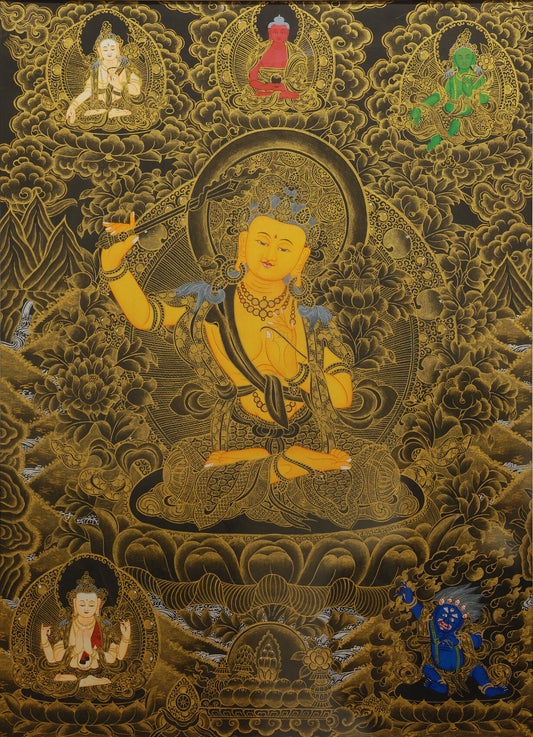
When a thangka woven with deep black background and brilliant gold lines unfolds before your eyes, what you see is far more than a hand-painted work—it is a tangible carrier of Tibetan Buddhist wisdom faith, a living heritage of the artistic genes of Nepal’s Malla Dynasty, and a perfect blend of natural mineral pigments and artisanal craftsmanship. Today, we will dive deep into this 45×60cm Nepalese hand-painted Black-Gold Manjushri Thangka: from the symbolic core of the main deity, to the dharma lineage system of attendant deities, to the details of traditional craftsmanship and stylistic traits, unlocking the visual language of "wisdom" in Tibetan Buddhist art.
I. Theme & Main Deity: Manjushri – The "Personification of Wisdom" in Tibetan Buddhism
The core theme of this thangka is "Manjushri’s wisdom enlightenment," and the main deity Manjushri is the personification of "supreme wisdom" in Tibetan Buddhism. Its image strictly adheres to the iconographic norms of Tibetan Buddhist statue measurements:
-
Physical Form & Posture: The orange-yellow body corresponds to "vast merits and complete wisdom"—it symbolizes the proliferative quality of autumn harvests, and metaphorizes the bright wisdom like the morning sun. Manjushri sits in the Vajra Lotus Position on a double-layered lotus moon disc: the lotus represents "pure wisdom growing from the mire of afflictions," while the moon disc signifies "unstained, unshakable mind-nature"—a classic symbol in esoteric iconography for "a sacred deity abiding in the pure dharma realm."
-
Symbolism of Ritual Implements: The right hand holds aloft the Prajna Wisdom Sword (wrapped in flickering flames)—not a secular weapon, but a symbol of "cutting through ignorance and dispelling wrong views." In Tibetan scriptures, Manjushri’s sword is called the "Prajna Sword," signifying the use of ultimate wisdom to sever all root afflictions such as "attachment to self" and "attachment to dharma." The painter’s strict attention to the sword’s straight edge and the flame’s tension aligns with the dharma meaning of "wisdom decisions brook no hesitation."
-
Ornamentation & Facial Expression: The main deity wears a Five-Buddha Crown, with five Buddhas atop corresponding to the "Five Buddha Wisdoms" (e.g., Vairocana Buddha’s Dharmadhatu Wisdom, Akshobhya Buddha’s Mirror-Like Wisdom), implying that Manjushri’s wisdom encompasses all Buddha wisdoms. The body is adorned with gold-threaded garlands and scarves featuring interwoven patterns, which not only conform to the "solemn appearance of a bodhisattva" but also metaphorize "the perfect entanglement of wisdom and compassion." Its serene, smiling expression—with slightly lowered eyes and soft lip lines—is a typical Tibetan iconographic expression of "the fusion of compassion and wisdom." Unlike the deterrence of wrathful deities, Manjushri’s serene appearance conveys the educational trait of "subduing sentient beings with wisdom."
II. Attendant Deities: The Symbiotic Dharma Lineage of Wisdom, Compassion, and Power
The attendant deities in the thangka are not mere decorations, but the materialization of Manjushri’s dharma lineage system of "wisdom-compassion-power," following the traditional Tibetan Buddhist structure of "Three Protectors + Guardian Deities":
-
Three Deities Above: Partial Manifestations of the Five Dhyani Buddhas: The three sacred images at the top are partial manifestations of the Five Dhyani Buddhas (core deities of the Buddha Family in esotericism):
- The red-bodied deity corresponds to Amitabha Buddha (lord of the Western Pure Land), symbolizing "the compassionate nature within wisdom," forming a "unity of compassion and wisdom" with Manjushri’s "wisdom."
- The green-bodied deity corresponds to Amoghasiddhi Buddha (lord of the Northern Buddha Field), symbolizing "the actionable power of wisdom," implying that wisdom must be translated into deeds that benefit sentient beings.
- The white-bodied deity corresponds to Vairocana Buddha (lord of the Central Dharma Realm), the core of the Five Dhyani Buddhas, symbolizing "Dharmadhatu Wisdom," metaphorizing that Manjushri’s wisdom originates from the essence of the dharma realm.
The presence of these three deities elevates Manjushri’s "individual wisdom" to "collective wisdom of all Buddhas."
-
Attendants Below: Protection from the Three Protectors and Guardians:
-
Four-Armed Avalokiteshvara (left deity below): As one of the "Three Protectors of the Snow Land," it appears with four arms holding lotuses and forming mudras, symbolizing "compassion." Together with Manjushri’s "wisdom" and Vajrapani’s "power," it forms the "iron triangle of protection" in Tibetan Buddhism, implying that "unity of compassion and wisdom" is the foundation of liberation.
-
Blue Guardian (right deity below): A serene manifestation of Mahakala, the "chief guardian" in Tibetan Buddhism. Its blue body symbolizes "deterring obstacles," and the ritual implement it holds (a 杵 is visible in the image) signifies "protecting Manjushri’s dharma lineage and eliminating ignorance obstacles in practice and daily life."
III. Craftsmanship: The Timeless Traditional Techniques of Nepalese Black-Gold Thangkas
This thangka employs the black-gold thangka techniques passed down from Nepal’s Malla Dynasty (13th–18th centuries), made entirely with natural mineral and plant pigments. Its rigorous processes are the core of its "enduring vitality":
-
Base & Canvas Preparation: First, white cotton cloth (commonly used in Nepalese thangkas for its finer texture, unlike linen) is used as the base. It undergoes multiple processes: boiling glue, stretching on a frame, and applying putty (gypsum + bone glue) to ensure the canvas is smooth and pore-free. Then, a black base is mixed with natural mineral pigments—usually graphite and indigo (plant-based) ground with bone glue, applied in 3–5 coats until the background is uniformly deep (black symbolizes "the profundity and inclusiveness of the dharma realm").
-
Gold Line Outlining & Polishing: The core of black-gold thangkas lies in the use of pure gold lines: the painter mixes 24K gold powder with ox bone glue in proportion, then uses an extremely fine wolf-hair brush to outline the contours and details of the main deity and attendants (lines as thin as hair, corresponding to "the subtlety and sharpness of wisdom"). After completion, the work is repeatedly polished with an agate pen—a unique process in Nepalese thangkas. The hardness of agate rubs the gold powder layer, giving the gold lines a "reserved yet lasting luster" that emanates sacredness even in dim environments.
-
Accents with Mineral Pigments: Though dominated by "black and gold," the main deity’s yellow body and the attendants’ red/green bodies are dyed with natural mineral pigments: yellow comes from orpiment and gold leaf fragments, red from cinnabar, green from malachite, and blue from lapis lazuli. These pigments are ground, sifted, and mixed with bone glue—they not only have rich colors but also achieve "centuries of non-fading" due to mineral stability, making the thangka a "transmissible ritual implement."
-
Functional Size: The 45×60cm medium-small size is a typical specification for "household worship + portable visualization" in Nepalese thangkas: it fits in a shrine for daily offerings and can be unfolded for visualization of Manjushri’s wisdom form during meditation, aligning with the Tibetan Buddhist practice tradition of "using images to carry dharma, using visualization to cultivate the mind."
IV. Style: The Aesthetic Genes of Nepal’s Malla Dynasty
This thangka inherits the artistic tradition of Nepal’s Malla Dynasty, forming an "allied yet distinct" aesthetic contrast with Tibetan thangkas:
-
Soft, Intricate Lines: Nepalese thangka lines emphasize "soft ornamentation": the main deity’s scarves and lotus petal edges are outlined with curves, weaving patterns like interwoven lotus and auspicious clouds—these patterns are not random: interwoven lotus symbolizes "pure, enduring wisdom," while auspicious clouds represent "an auspicious dharma realm atmosphere." Every line combines aesthetic and symbolic meaning, unlike the "vigorous structural lines" of Tibetan thangkas.
-
Rich, Layered Ornamentation: The background is filled with full spreads of golden auspicious clouds and interwoven lotus, creating a visually layered "dense yet not cluttered" effect. The contrast between the deep black base and bright gold lines highlights the sacredness of the main deity while creating a mysterious atmosphere of "wisdom enveloping the dharma realm"—a signature trait of Nepalese black-gold thangkas, distinct from the "breathable negative space" layout of Tibetan thangkas.
-
Secularly Approachable Facial Features: Nepalese thangka facial features have a more "secularly approachable feel": the facial proportions of the main deity and attendants are closer to human children (Malla Dynasty art was influenced by India’s Gupta style), with round eyes and soft lip lines, making the "wisdom deity" more accessible to believers—unlike the "sacred detachment" of Tibetan thangka iconography, reflecting the "humanistic" spread of Nepalese Buddhism.
Conclusion: More Than Art – A Living Carrier of Tibetan Wisdom
This Nepalese black-gold Manjushri thangka is both a visualization aid for Tibetan Buddhist believers to "disperse ignorance and grow wisdom" and a living heritage of Nepalese traditional craftsmanship—every gold line and mineral pigment patch carries the cultural genes of the Malla Dynasty to the present day. It is not a "displayed antique," but a "breathing faith and art."
Would you like me to compile a quick reference sheet of this thangka’s visualization symbolic elements to help you understand its usage in line with Tibetan Buddhist rituals?
#NepaleseBlackGoldManjushriThangka #TibetanBuddhistThangkaAnalysis #TraditionalNepaleseThangkaCraftsmanship #MallaDynastyThangkaStyle #ManjushriThangkaAttendantDeities #MineralPigmentThangka #HandPaintedNepaleseThangka #ManjushriBuddhistThangka #NaturalMineralPigmentThangka #TibetanBuddhistArtNepal #DevotionalThangkaForMeditation #MallaPeriodNepaleseArt #BlackAndGoldThangkaArt #TraditionalHimalayanThangkaCraftsmanship