When a vividly colored Nepalese hand-painted thangka unfolds, what you see is not just a painting—it is a practice mandala for "confessing karmic obstacles and returning to original purity" in esoteric Tibetan Buddhism.
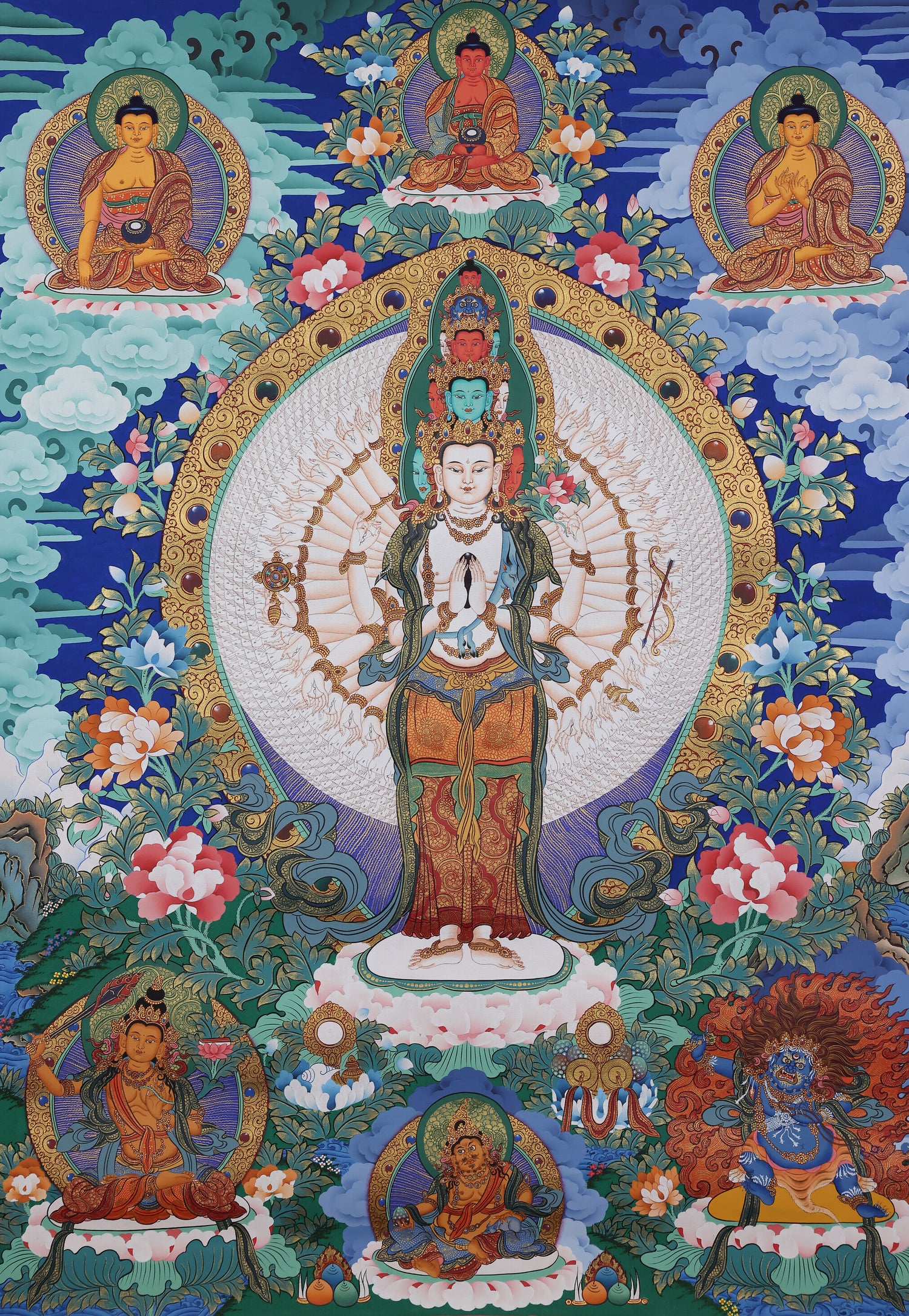
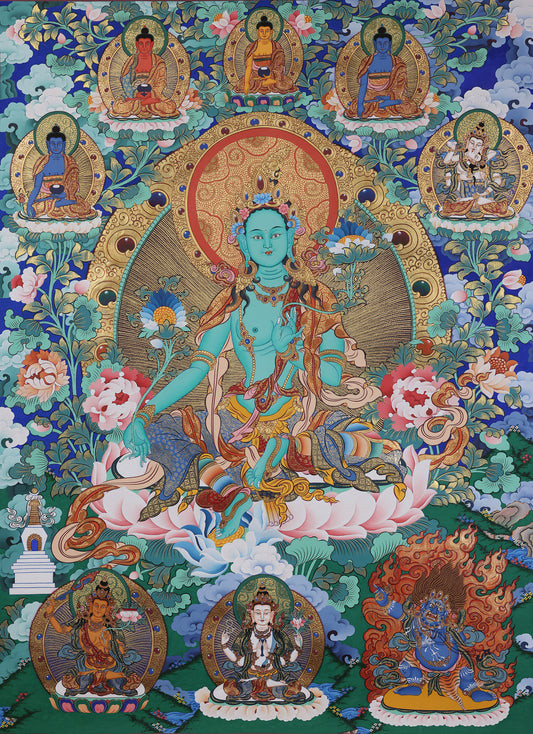
This 45×60cm hand-painted thangka centers on the esoteric practice of Vajrasattva purification. In the esoteric Tibetan Buddhist system, Vajrasattva (Sanskrit: Vajrasattva) is regarded as the "synthesis of all yidams": his "vajra" nature represents the unshakable essence of bodhicitta, embodying both the dharmakaya of Samantabhadra Buddha and the inherent Buddha-nature of all sentient beings. By choosing Vajrasattva as the main deity, Nepalese thangkas align with Tibetan Buddhism’s core focus on "purification as practice" while resonating with local spiritual needs for "purity and protection."
Unlike ordinary decorative art, this thangka’s mandala-style layout (main deity centered, attendants surrounding) materializes esoteric rituals: during visualization, practitioners can enter a state of "one’s mind as the mandala" through the imagery, achieving the religious function of "dissolving karmic obstacles and purifying the mind." This is the core distinction of thangkas from other art forms: they are "visual texts for practice."
The central deity in the painting is a standard sambhogakaya Vajrasattva in Tibetan thangkas, with each detail carrying deep esoteric meaning:
-
Body Color and Posture: His 通体 white form corresponds to "unstained mind"; he sits in the vajra cross-legged position (Vajrasana), symbolizing "transcending the extremes of samsara and nirvana"; he wears the "thirteen sambhogakaya adornments" (five-Buddha crown, jewelry, scarves, etc.), embodying both the compassion of a bodhisattva and the majesty of a vajra—this is a visual expression of "uniting compassion and wisdom."
-
Mudra and Implements: His right hand holds a five-pronged vajra at his heart (the five prongs represent the Five Buddhas; the vajra symbolizes "indestructible skillful means of the ultimate truth," capable of destroying ten afflictions); his left hand holds a vajra bell at his waist (the bell represents "prajna wisdom," rousing sentient beings with its dharma sound). The "combined vajra and bell" is Vajrasattva’s iconic symbol, signifying the esoteric core of "non-duality of wisdom and skillful means."
-
Aura and Lotus Seat: The nimbus (circular head halo) and body aura (radiating light) represent "original wisdom illuminating all directions"; the double lotus seat (pink lotus symbolizes freedom from afflictions, white lotus platform symbolizes inherent purity) is a classic symbol of "a sacred deity untainted by the mundane."
The attendant deities surrounding the main deity are not arranged randomly but form a functional hierarchy corresponding to different practice meanings:
-
Upper Attendants: Source of the Dharma and Compassionate Protection
The red-bodied deity at the top center is
Shakyamuni Buddha (or Amitabha Buddha), representing the "root of the dharma"; the white and green-bodied deities on either side are
White Tara (relieving suffering) and Green Tara (increasing merit and wisdom)—this combination reinforces the theme of "compassionate protection" while aligning with the folk tradition of "Tara veneration" in Nepalese thangkas.
-
Lower Attendants: Balance of Serene and Wrathful Forms
The four-armed white-bodied deity at the bottom left is
Four-Armed Avalokiteshvara, holding a lotus and scripture scroll, corresponding to "liberating sentient beings from suffering"; the blue-bodied wrathful deity at the bottom right is
Vajrapani, wreathed in flames (burning afflictions) and holding implements (subduing obstacles). The "serene + wrathful" combination reflects esoteric Tibetan Buddhism’s approach of "using both gentleness and subjugation," echoing the doctrine that "afflictions are Buddha-nature."
-
Bottom Symbols: The Ultimate Goal of Practice
The "dharma wheel" (eight spokes represent the Eightfold Path) and "lotus" beneath the main deity’s lotus seat unify the thangka’s meaning: the dharma wheel symbolizes the spread of the dharma, and the lotus symbolizes a pure mind—these are the ultimate states practitioners strive to attain.
The "texture" of this thangka stems from the combination of traditional Nepalese craftsmanship and natural materials:
-
Canvas Base: Fine white cotton cloth is treated through three steps—"applying plant glue → smearing lime paste → repeated polishing"—to create a smooth, seamless surface. This is a typical Nepalese thangka practice of "light base, heavy color," distinct from the thick bases of Tibetan thangkas.
-
Mineral Pigment System: White comes from white clay or mica; red from cinnabar or red earth; blue from lapis lazuli; green from malachite; yellow from realgar or Rohitaka grass. These pigments require "grinding with an agate pestle → mixing with bone glue," a process that takes months but results in colors that endure (e.g., the deep blue of lapis lazuli and vibrant green of malachite cannot be replicated by synthetic pigments).
-
Painting Process: Strictly follows the steps: "marking positioning lines → sketching with charcoal → outlining with ink → layering colors → gilding with 24K gold powder → opening the face (painting facial features) on an auspicious day." "Opening the face" is the core step: the artist uses a fine brush to paint the main deity’s half-open eyes, symbolizing "watching over sentient beings"—this is a Nepalese artist’s "master skill," directly determining the thangka’s "spiritual essence."
The "distinctiveness" of this thangka comes from the softening of Tibetan thangka conventions by Nepalese regional style:
-
Color Aesthetics: Characterized by "high saturation and strong contrast"—the white of the main deity, gold of the aura, blue of the background, and pink of the lotus create a striking visual impact, aligning with Nepalese folk preference for "bright hues" and differing from the subdued tones of Tibetan thangkas.
-
Lines and Form: Lines are soft and fluid, with decorative curves for scarves and lotus petals; figures have slender proportions and rounded faces (large eyes, prominent noses)—unlike the strict proportions of Tibetan thangkas (governed by the Iconometry Sutra), this style has the vitality of folk art.
-
Gilding Craft: 24K gold powder is used to decorate auras and implements through a combination of "flat gilding and line outlining." While less intricate than the "hairline gilding" of Tibetan thangkas, the 厚重感 (heaviness) of the gold powder (which shines after polishing with an agate brush) lends the thangka a magnificent appearance.
This Nepalese Vajrasattva thangka is a synthesis of "esoteric meaning, craftsmanship, and regional aesthetics": it is both a Tibetan Buddhist practice tool (for visualization and confession) and an expression of Nepalese culture (fusing traditional craft with folk aesthetics). Its 45×60cm size makes it suitable for household shrine worship and easy for practitioners to carry— it is a product of cross-regional exchange in the Himalayan cultural sphere, and a vivid example of "visualized faith."
# Nepalese Hand-Painted Thangka #Vajrasattva Thangka #Esoteric Tibetan Buddhist Art #Natural Mineral Pigment Thangka #Thangka Deity Analysis #Nepalese Thangka Craft #Tibetan Thangka Style #Purification Esoteric Thangka #Himalayan Cultural Art #Handmade Thangka Collection