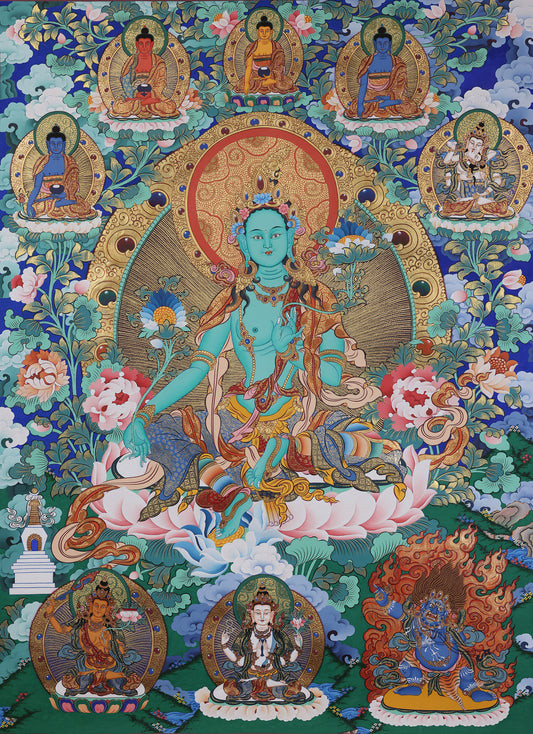
When a vividly colored Tibetan thangka unfolds before you—its central four-faced, eight-armed white Dharmakāya Buddha seated on a lotus throne, draped in turquoise and blue celestial robes, palms holding a Dharma wheel; flanked by red-bodied and blue-bodied Buddhas and attendant bodhisattvas, set against a backdrop of swirling blue clouds and blooming pink lotuses—you are looking at Vairocana (Sanskrit for "all-pervading light," known in Tibetan as Gönpo Nampar), the symbol of "absolute truth" in Tibetan Buddhism. Unlike the vague understanding of "Vairocana" in Han Chinese exoteric Buddhism, in the Tibetan esoteric (Vajrayāna) tradition, this "all-pervading light" Buddha is the core hub connecting the ultimate reality of the Dharma realm, the Buddha-nature of all beings, and spiritual practice.
In Tibetan Buddhist cosmology, a Buddha manifests in three bodies: the Dharmakāya (the ultimate reality of truth), the Sambhogakāya (the bliss-body visible to bodhisattvas), and the Nirmāṇakāya (the emanation-body visible to ordinary beings). Vairocana is the personification of the Dharmakāya—he is not merely one Buddha, but "the essence of all Buddhas," the concrete form of "the true nature of all phenomena."
The Mahāvairocana Tantra (translated into Tibetan as The Sūtra of the Great Vairocana’s Awakening, Divine Transformation, and Empowerment) states: "Vairocana is the Buddha-nature inherent in all sentient beings." In the Tibetan Five Dhyani Buddhas system, he resides at the center, representing the Dharmadhātu wisdom (wisdom of the true nature of reality), corresponding to his pure white form (like the main figure in the thangka). The other four Buddhas—Aksobhya (East), Ratnasambhava (South), Amitābha (West), and Amoghasiddhi (North)—are manifestations of his "differentiated wisdom."
This status as the "embodiment of Dharmakāya" elevates Vairocana beyond ordinary Buddhas: he is the theoretical foundation for "enlightenment in this lifetime" (a core goal of Vajrayāna practice)—since all beings inherently possess the same Buddha-nature as Vairocana, they need only "awaken" this innate light through specific rituals.
Tibetan thangkas are never just "paintings"—they are mobile mandalas that condense doctrinal meaning. Every detail of Vairocana in this thangka carries esoteric symbolism:
The central figure in the thangka appears with four faces (known in Tibetan as Vairocana the All-Luminous), corresponding to the four directions, Four Noble Truths, and Four Wisdoms; the eight arms symbolize the Noble Eightfold Path and the transformation of the eight consciousnesses into wisdom. Unlike the Thai "Four-Faced Buddha" (Brahma), these four faces all bear compassionate expressions, embodying the esoteric idea that "one ultimate reality unifies all phenomena."
The Dharma wheel held in the Buddha’s palms is a variation of the "Turning the Dharma Wheel Mudrā," symbolizing "preaching esoteric Dharma and shattering ignorance." The eight-petaled lotus throne he sits on (corresponding to the "Central Eight-Petal Court" in the Womb Realm Mandala) represents "the eight-petaled bodhicitta inherent in all beings."
The red-bodied Buddha (symbolizing "pacifying afflictions") and blue-bodied Buddha (symbolizing "increasing blessings") around the main figure, along with the attendant bodhisattvas below, form Vairocana’s "retinue mandala." In esoteric practice, practitioners visualize themselves merging into this mandala, achieving Threefold Mystical Union (body in mudrā, mouth reciting mantras, mind in visualization) with Vairocana.
The blue clouds in the backdrop symbolize "emptiness," while the pink lotuses represent "purity arising from afflictions"—a visual expression of Tibetan Buddhism’s core teaching that "afflictions are identical to enlightenment."
Veneration of Vairocana in Tibetan Buddhism is always tied to practical rituals. In traditions like Sakya and Nyingma, the "Vairocana Ritual" is a core practice, with a logic entirely distinct from exoteric Buddhism:
The Mahāvairocana Tantra outlines the three foundational principles: "Bodhicitta as the cause, great compassion as the root, skillful means as the culmination." To practice Vairocana, one must base themselves on the "innate bodhicitta of all beings," be motivated by "great compassion to liberate sentient beings," and use "esoteric rituals" as the method—ultimately achieving "enlightenment in this lifetime."
In the Sakya tradition’s Ritual of Vairocana the All-Luminous, this practice is specifically used to "liberate beings in the lower realms": practitioners visualize Vairocana emitting white light that illuminates the bardo (the state between death and rebirth), freeing beings from suffering—an expression of Vairocana’s compassionate nature as "all-pervading light."
Tibetan practitioners of Vairocana first receive the "Vairocana Initiation" (transmitted by a guru), then:
-
Body Mystery: Form the "Dharma Realm Seal" (palms upward, stacked, placed below the navel);
-
Mouth Mystery: Recite Vairocana’s heart mantra ("Oṃ A Vairocana Hūṃ Khaṃ");
-
Mind Mystery: Visualize their own body transforming into Vairocana, merging with the main figure in the thangka.
This Threefold Mystical Union is the key to "enlightenment in this lifetime" in Vajrayāna: through ritual, practitioners do not "worship" Vairocana—they "become" Vairocana, as they share the same inherent Buddha-nature.
Many wonder: Vairocana also exists in Han Chinese exoteric Buddhism, so why are his form and practices so different in Tibetan Buddhism? The core distinction lies in:
-
Exoteric Buddhism: Vairocana is regarded as the Dharmakāya of Śākyamuni, venerated only as a concept, with no dedicated rituals;
-
Tibetan Esoteric Buddhism: He is seen as the "embodiment of Dharmakāya," and practitioners achieve "union with the Dharmakāya" through mandalas and rituals.
Exoteric traditions hold that enlightenment requires "three countless eons," while Tibetan Vajrayāna teaches that "sharp-witted practitioners can attain enlightenment in one lifetime" through practices like Vairocana—this difference reflects the contrast between "gradual cultivation" and "sudden realization."
For modern people, Vairocana’s "all-pervading light" is not an abstract doctrine, but a spiritual attitude:
-
Embrace Imperfection: Like the "lotus growing from afflictions" in the thangka, Vairocana’s teaching reminds us that suffering and afflictions are the "raw materials" of purity;
-
Seek Light Within: "Vairocana is the Buddha-nature in one’s own mind" means there is no need to seek externally—everyone has the "light to illuminate themselves";
-
Compassionate Action: The teaching that "great compassion is the root" reminds us to care for others while growing ourselves—this is the modern interpretation of "all-pervading light."
When we gaze at this thangka of Vairocana, we see more than a Buddha’s image: we see Tibetan Buddhism’s answer to "the nature of life": we all inherently possess the same light as Vairocana—we need only let that light shine through wisdom and compassion.
#TibetanBuddhism #VairocanaBuddha #ThangkaArt #VajrayanaPractice #FiveDhyaniBuddhas #Dharmakaya #MahavairocanaTantra #Mandala #EnlightenmentInThisLifetime #BuddhistCulture