The Wealth Code in Tibetan Thangkas: The Belief and Spiritual Core of Jambhala (Yellow Wealth Deity) and the Five Directions Wealth Deities in Tibetan Buddhism

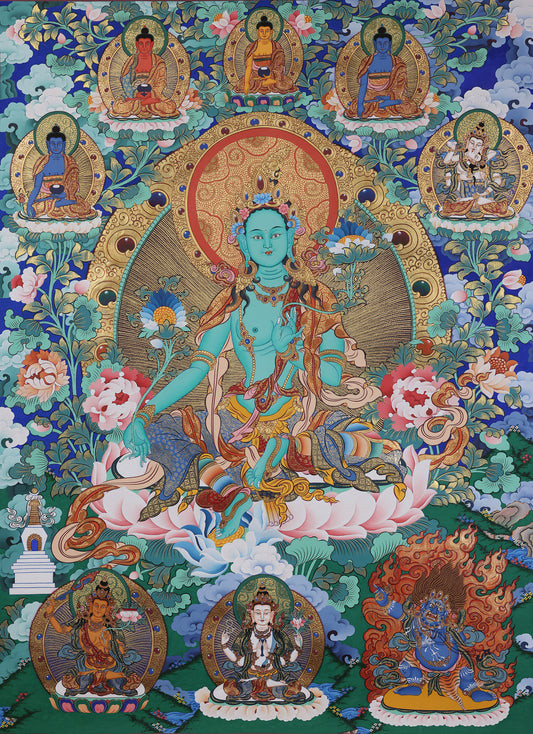
When a vivid, intricately lined Tibetan color thangka unfolds before your eyes—with the central yellow-golden main deity gazing fiercely yet compassionately, right hand holding a cintāmaṇi (wish-fulfilling gem) in the Varada Mudra (gesture of granting wishes), left hand leading a "treasure-spitting mink" (Nepali weasel), right foot stepping on a white conch, surrounded by four guardians of different shapes (red, white, green, black), with a treasure vase brimming and auspicious clouds lingering under the lotus seat... This is the thangka of Jambhala (as the main deity) and the Five Directions Wealth Deities in Tibetan Buddhism. This work, which embodies Tibetan religious art and spiritual belief, is not only a visual feast but also a concrete code of Tibetan wealth deity beliefs.
I. Thangka Code: The Matrix of the Five Directions Wealth Deities in Pigments
Every color and ritual object in a Tibetan thangka is not randomly painted; it carries strict religious rituals and symbolic meanings. Taking this Jambhala-centered thangka as an example, its visual elements themselves form a "language of merit":
- Main Deity Jambhala: His body is bright yellow (corresponding to the central direction and the "earth" element in the Five Elements, symbolizing broad and stable merit like the earth), wears a Five-Buddha Crown (representing the wisdom blessing of the Five Dhyani Buddhas), and a Padma rosary around his neck. His large belly and small frame (not a sign of gluttony, but a compassionate heart that embraces the poor and suffering) are distinctive. His right hand forms the Varada Mudra and holds a cintāmaṇi (implying satisfying sentient beings’ reasonable wishes), his left hand leads the treasure-spitting mink (spitting treasures, symbolizing that wealth comes from giving rather than hoarding), his right foot steps on a white conch (hinting at "retrieving treasures from the sea," using wisdom to understand the laws of wealth), and he sits peacefully on a lotus seat paved with jewels (the lotus represents liberation from afflictions, and jewels symbolize the perfection of spiritual resources).
-
Surrounding Four Wealth Deities:
- Red Wealth Deity (South): Scarlet body, holding a treasure banner and a treasure-spitting mink. He is the manifestation of Amitābha Buddha, presiding over "popularity and growth," symbolizing career expansion and resource connection;
- White Wealth Deity (West): Milky-white body, holding a silver pot and a lasso. He is the compassionate manifestation of Avalokiteśvara, presiding over "pure wealth," implying gaining wealth with good intentions and staying away from afflictions;
- Green Wealth Deity (East): Emerald-green body, holding an auspicious scepter and a treasure vase. He is the manifestation of Amoghasiddhi Buddha, presiding over "career growth," corresponding to the vitality of the east, helping to improve skills;
- Black Wealth Deity (North): Deep-black body, holding a vajra and a treasure vase. He is the manifestation of Aksobhya Buddha, presiding over "protection and obstacle removal," capable of breaking barriers to wealth accumulation, especially protecting lower- and middle-class believers.
The treasure vase, jewel pile, and auspicious clouds at the bottom of the thangka further strengthen the imagery of "perfection of internal and external spiritual resources"—and the "fierce expressions" of the deities (such as the Black Wealth Deity’s majestic demeanor) are actually symbols of "subduing greed with power," which do not conflict with their compassionate core.
II. Jambhala: From Guardian Deity to "Lord of Merit"—His Origin
In the deity system of Tibetan Buddhism, Jambhala is not merely a "god of wealth" but a core figure with dual attributes of guardian deity and lord of merit. His origin story implies the profound meaning of "using wealth to protect the path":
According to the Dhāraṇī Sūtra of Jambhala, when Sakyamuni Buddha preached the Mahāprajñāpāramitā Sūtra at Gridhrakuta Hill, demons from all directions came to obstruct, causing mountains to collapse and the earth to crack. In the crisis, Jambhala (then a fully realized bodhisattva) stepped forward to protect the monks, allowing them to listen to the Dharma safely. Grateful for his merit, the Buddha instructed him to take refuge in Buddhism and rescue the poor and suffering as a guardian deity. Since then, Jambhala has become the "great guardian deity specializing in bestowing blessings and attracting wealth."
In the cognition of various Tibetan Buddhist sects, Jambhala is also the manifestation of Ratnasambhava Buddha—one of the Five Dhyani Buddhas in Esoteric Buddhism, representing "equality wisdom," symbolizing nourishing sentient beings with merit and freeing them from scarcity. This positioning as a "manifestation of Buddha or Bodhisattva" determines Jambhala’s core meaning: "perfecting spiritual resources," which includes both material tools supporting practice and life ("external wealth") and spiritual qualities such as compassion and diligence ("internal wealth").
This is why Tibetan believers do not simply pray for material wealth when worshiping Jambhala: the Sakya Sect includes him in the "Eight Great Practice" guardian system, the Gelug Sect monasteries often enshrine his statues, and believers recite Jambhala’s heart mantra ("Om Dzambhala Zaleng Zalye Soha") to pray for "no economic worries, so they can focus on the path." The prerequisite for practicing Jambhala’s Dharma is "generating the supreme bodhicitta and diligently practicing giving": if one is stingy and greedy, not only will they fail to receive blessings, but they will also give rise to afflictions.
III. The Five Directions Wealth Deities: A Cluster of Merit Energy Manifested by the Five Dhyani Buddhas
The "Five Directions Wealth Deities" (also known as the "Five-Name Wealth Deities") in Tibetan Buddhism are not five independent deities, but a "merit energy collection" centered on Jambhala and corresponding to the Five Dhyani Buddhas. The formation of this system is deeply bound to the integrated concept of the "Five Dhyani Buddhas" in Tibetan Esotericism:
The Five Directions Wealth Deities correspond to the center (Jambhala - Ratnasambhava Buddha), east (Green Wealth Deity - Amoghasiddhi Buddha), south (Red Wealth Deity - Amitābha Buddha), west (White Wealth Deity - Avalokiteśvara), and north (Black Wealth Deity - Aksobhya Buddha), representing the Five Dhyani Buddhas’ skillful means to protect sentient beings’ merit needs.
Each wealth deity’s attributes correspond to a "different dimension of wealth":
- Jambhala (Center): Presides over "overall merit," as the core of the Five Directions Wealth Deities, integrating the energy of the other four directions, symbolizing the perfection of spiritual resources in all aspects;
- Green Wealth Deity (East): Presides over "career vitality," helping to improve skills and expand careers, suitable for professionals and entrepreneurs to pray;
- Red Wealth Deity (South): Presides over "popularity growth," promoting interpersonal harmony and resource connection, beneficial for business and team collaboration;
- White Wealth Deity (West): Presides over "pure wealth," gaining wealth with a compassionate heart, avoiding afflictions and attachments brought by wealth;
- Black Wealth Deity (North): Presides over "protection and obstacle removal," breaking poverty and wealth barriers, especially protecting ordinary believers.
This "five-direction correspondence" design reflects Tibetan Buddhism’s definition of "abundance": true wealth is not a single accumulation of material goods, but a state of perfection covering multiple dimensions such as career, interpersonal relationships, and spiritual well-being.
IV. Beyond "Seeking Wealth": The Spiritual Core of the Five Directions Wealth Deities in Tibetan Buddhism
To simplify the belief in the Five Directions Wealth Deities in Tibetan Buddhism as "seeking secular wealth" is to narrow its spiritual connotation. In the context of Tibetan Buddhism, "wealth" is a "favorable condition for practice," and the essence of the Five Directions Wealth Deities’ belief is "using merit resources to support spiritual growth":
- "Wealth" as "Spiritual Resources": Tibetan Buddhism divides "spiritual resources" into "merit resources" and "wisdom resources." What the Five Directions Wealth Deities bestow is merit resources that allow sentient beings to practice peacefully and benefit others—without basic material security, sentient beings easily fall into scarcity and afflictions; with material wealth but no spiritual qualities, they easily fall into greed and attachment.
- "Worship" as "Spiritual Practice": When Tibetan believers enshrine the thangka of the Five Directions Wealth Deities, they often use it as an "object of visualization": visualizing that the wealth given by the deities is used to benefit sentient beings, not to satisfy personal desires; at the same time, they are grateful for the blessings of sentient beings and the Three Jewels. This visualization itself is a practice of "giving" and "compassion."
- "Fierce Expressions" as "Breaking Attachments": The majestic demeanor of the wealth deities is a warning against "greed"—wealth is a "tool" rather than a "goal"; if one becomes attached to wealth, it will become the root of afflictions. The "fierce appearance" of the Five Directions Wealth Deities helps sentient beings eliminate this attachment.
V. Tibetan Wealth Deity Culture: From Monastery Dharma Assemblies to Folk Life
The belief in the Five Directions Wealth Deities has long been integrated into the religious and folk fabric of Tibet, becoming an important symbol of Tibetan culture:
- Monastery Dharma Assemblies: In Labrang Monastery’s annual "Mönlam Chenmo" (Great Prayer Festival), the eighth day (also known as the "Wealth Deity Festival") is the most special—monks enshrine the thangka of Vaishravana (Treasure King), release livestock tied with five-colored streamers, implying "accumulating merit by compassionately protecting life"; Xi’an Guangren Monastery’s Zangbala Thousand Buddha Hall holds the "Jambhala Dharma Assembly" during the Spring Festival, praying for economic prosperity and people’s well-being.
- Folk Practices: Most Tibetan families enshrine the thangka of the Five Directions Wealth Deities in their home shrines; during Losar (Tibetan New Year), housewives offer butter sculptures and barley wine in front of the wealth deities’ statues; at Lhasa’s Zhaibung Monastery (a famous Tibetan wealth deity temple), believers bring liquor and khata (white scarves) to worship every Wednesday, praying for favorable conditions.
- Practice Traditions: According to Tibetan Buddhist rituals, practicing the Five Directions Wealth Deities requires empowerment and guidance from a qualified guru, avoiding greed caused by improper practice—this reflects the "strictness and compassion" of Tibetan beliefs.
VI. Modern Perspective: Contemporary Enlightenment from the Five Directions Wealth Deities Belief
In modern society with increasingly abundant material life, the belief in the Five Directions Wealth Deities in Tibetan Buddhism is not "outdated superstition" but a cultural resource that can provide spiritual enlightenment for modern people:
- Redefine "Abundance": The "multi-dimensional wealth" represented by the Five Directions Wealth Deities reminds modern people that true happiness is not only material but also includes a healthy body and mind, harmonious relationships, and a growing career;
- Practice "Generosity and Gratitude": The symbol of the "treasure-spitting mink" corresponds to the modern spirit of "sharing" and "public welfare"—treating wealth as a tool to help others can reduce attachment and gain deeper satisfaction in benefiting others;
- Break "Scarcity Mindset": Much of modern people’s anxiety stems from the scarcity mindset of "insufficient wealth," while the belief in the Five Directions Wealth Deities reminds us that scarcity is not material shortage but spiritual attachment—viewing wealth with a pure heart, striving to create while knowing contentment, can free us from afflictions.
From the gold powder lines of the thangka to the incense smoke lingering in Tibet, the belief in Jambhala (as the main deity) and the Five Directions Wealth Deities has never been a "spell for seeking wealth" but a "mirror for spiritual practice"—it reflects our perception of wealth and our true desire for happiness: not the accumulation of gold and jewels, but peace of body and mind, perfection of spiritual resources, and mutual assistance among sentient beings.
#Jambhala Tibetan Buddhism #Five Directions Wealth Deities Thangka #Tibetan Five Wealth Deities #Tibetan Wealth Deity Belief #Jambhala as Main Deity Five Wealth Deities #Tibetan Thangka Art #Spiritual Wealth Meaning #Tibetan Buddhist Symbols #Jambhala Mantra #Tibetan Folk Religion Practices
Tags:
Previous
Yellow Dzambhala as the Main Deity: The Five Directions Wealth Deities in Tibetan Buddhism – Origins, Symbolism, and Spiritual Connotations
Next
The Blessing Code in Tibetan Colored Thangka: An Analysis of the Yellow Jambhala & Five-Direction Wealth Deity System in Tibetan Buddhism