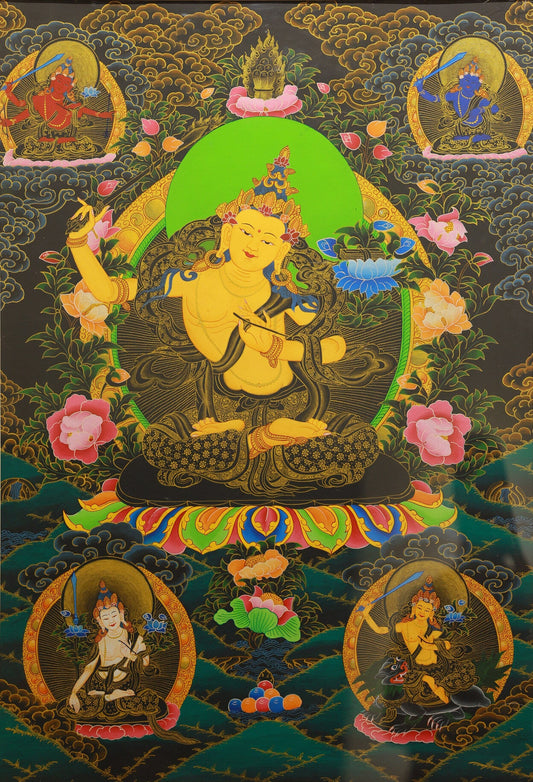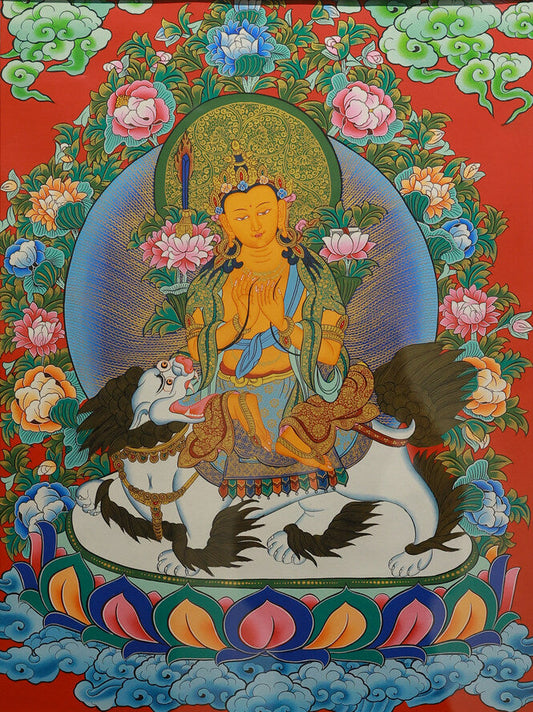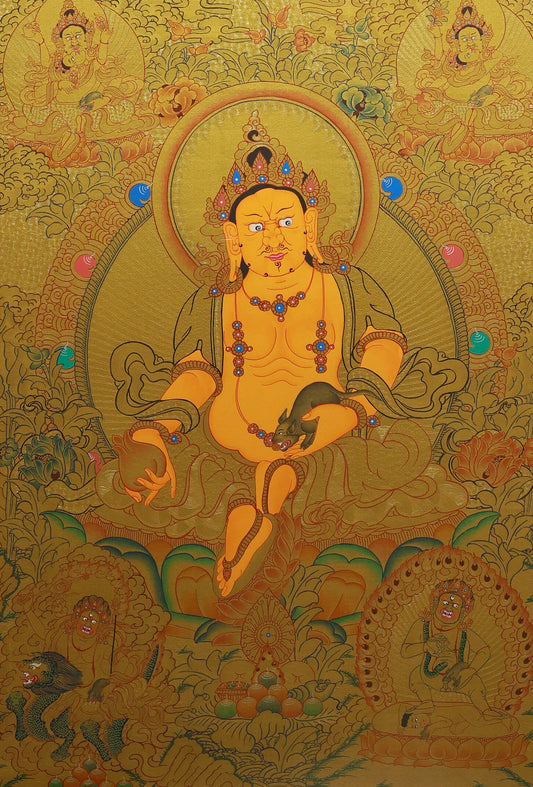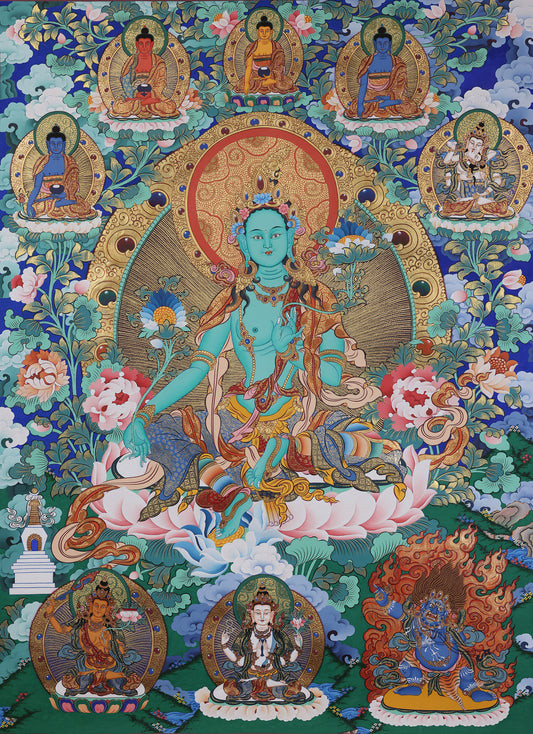
Pure Hand-Painted Tibetan Thangka: The Faith Dimensions and Artistic Texture of Padmasambhava’s Refuge Field

Tibetan Thangka is more than just an art piece; it is a visual embodiment of faith. Among the Nyingma tradition (Red School), the Padmasambhava Refuge Field Thangka is one of the most iconic representations of the “Guru as the Source of All Refuge.” This article delves into the faith dimensions and artistic textures of this hand-painted Thangka from five perspectives: thematic core, principal deity iconography, attendant deities, painting techniques, and cultural significance.
I. Thematic Core: The Nyingma “Total Refuge” as a Faith Convergence
The Padmasambhava Refuge Field Thangka centralizes the “Three Jewels, lineage masters, principal deities, dakas and dakinis, and protective deities” into a single composition—a complete “Field of Merit.” Rather than depicting a single deity, it functions as a meditative field allowing practitioners to seamlessly connect body, speech, and mind with the lineage system, thereby receiving collective blessings.
Historically, in the 8th century, Padmasambhava entered Tibet, subjugated local Bon deities, and integrated Sutra and Tantra teachings to establish Samye Monastery and ordain the Seven Wisdom Masters, laying the foundation for Tibetan Buddhism. This Refuge Field Thangka visually represents the “three-fold blessing of body, speech, and mind” of Padmasambhava. Contemplating this field equates to taking refuge simultaneously in the Three Jewels, Guru, principal deity, dakas and dakinis, and protective deities—a preparatory practice for Dzogchen, embodying the wisdom of “encompassing all phenomena in a single field.”
II. Principal Deity: Padmasambhava’s Iconography and Symbolic System
1. Physical Appearance and Attire
At the center of the painting is Padmasambhava, painted strictly according to the Measurement Sutra of Iconography and Nyingma Padmasambhava rituals. He wears the Ushnisha lotus hat, symbolizing his name “Lotus-Born” and the awakened mind arising from worldly mud. His inner cross-collared monastic robe signifies adherence to Sutra vows, while the outer brocade cloak in red-brown and royal blue represents wrathful force overcoming obstacles (red) and compassionate absorption (blue), reflecting the tantric principle of “union of compassion and wisdom.” His fair-red complexion, slightly furrowed brows, and serene yet authoritative expression convey a balance of majesty and benevolence.
2. Ritual Implements and Mudras
-
Left hand holding a kapala bowl: Filled with the “nectar of immortal wisdom,” the bowl is decorated with vajra patterns, symbolizing the use of emptiness wisdom to overcome attachment to samsara and to stabilize the bodhicitta.
-
Left elbow holding the khatvanga (staff): Composed of a cross vajra, vase, three human heads, and triple flaming prongs, symbolizing the five elements, complete nectar, elimination of the three poisons, unity of trikaya (three bodies), and destruction of all obstacles.
-
Right hand forming the granting wish mudra: Palm outward, fingers slightly curved, representing fulfillment of all sentient beings’ aspirations, forming a complementary wisdom-compassion combination with the kapala bowl.
3. Lotus Throne and Halo
Padmasambhava sits in the “Royal Dancer Posture” (half-lotus) on a two-tiered lotus throne. The bottom deep-pink lotus symbolizes the pristine mind emerging from mud; the upper white lotus represents the purity of enlightenment. Beneath the throne, a sun-moon cushion symbolizes the dispelling of ignorance with sunlight and pacifying afflictions with moonlight. The halo and body aura, painted with gold leaf and mineral pigments, feature an inner red flame motif representing wisdom burning away afflictions, outer seven-colored auspicious clouds representing the celestial realm, and gold borders accentuating divinity.
III. Attendant Deities: Lineage and Faith Network
The surrounding deities form the Nyingma lineage and protective network:
-
Above the principal deity: Small image of Amitabha Buddha, representing Padmasambhava’s Dharmakaya source and ultimate enlightened essence, illustrating the transmission from Dharmakaya to Nirmanakaya.
-
Side attendants: Left side is Master Shingmin (Jikhu), symbolizing the Sutra lineage; right side is Yeshe Tsogyal, the main disciple and consort, representing tantric practice methods and the origin of the terma (hidden treasure) lineage.
-
Below the throne: Offerings and wrathful protective deities (such as Vajrakilaya) symbolize worldly and transcendental support, safeguarding practice from obstacles and ensuring the efficacy of faith.
IV. Painting Techniques: A Fusion of Newar and Menri Styles
1. Canvas Preparation
High-quality white cotton canvas undergoes six traditional processes: washing, stretching, applying animal glue, layering chalk base, coarse sanding, and fine sanding. Each step requires air-drying. Fine sanding is repeated 3-5 times to achieve a surface as smooth as paper, reflecting the artist’s merit accumulation, integrating craftsmanship and devotional practice.
2. Pigments and Colors
Mineral pigments, including lapis lazuli, malachite, cinnabar, and gold leaf, are used throughout. Lapis lazuli and malachite undergo triple purification for depth; cinnabar is wet-ground for purity; gold leaf is mixed with gum and saffron, applied to ritual implements and garments, and polished for enduring brilliance. These natural pigments are believed to carry spiritual blessings, making the Thangka a bridge between the mundane and sacred.
3. Line Work and Shading
-
Lines: Iron-line and fine-line techniques depict garments and implements with continuous strokes; background clouds and floral motifs employ delicate fine lines.
-
Shading: Combination of dry and wet techniques creates smooth skin tones and rich fabric gradations, enhancing the solemnity and vitality of the figures.
-
Opening the Eyes: The final ritual involves consecration by the artist or lama, bathing, incense, and a ceremonial dot on the eyes, transforming the Thangka from art to a spiritually efficacious object.
V. Cultural Significance: A Living Codex of Faith and Art
The Padmasambhava Refuge Field Thangka not only documents the Nyingma lineage, practices, and teachings but also serves as a living cultural codex. Its composition “full yet balanced,” mineral-gold color system, and iron-fine line technique exemplify the fusion of Newar and Menri painting schools. For practitioners, it is a tool for visualization and receiving blessings; for art lovers, it is a testament to millennia of craft and color mastery. Today, it embodies living cultural heritage, visually conveying the tantric principle of “union of compassion and wisdom,” exemplifying the symbiosis of faith, art, and culture.
Conclusion
The Padmasambhava Refuge Field Thangka is more than a hand-painted artwork—it is a visual encapsulation of the Nyingma faith system. Contemplating this Thangka not only grants spiritual blessings but also reveals the profound philosophy and cultural wisdom of Tibetan Buddhism. It is a living testament to Tibetan culture and Buddhist art, serving as a bridge between spiritual practice, artistic appreciation, and cultural heritage.
#Padmasambhava #TibetanThangka #NyingmaThangka #RefugeFieldThangka #HandPaintedThangka #BuddhistArt #TantricDeities #TibetanBuddhism #SacredArt #SpiritualPractice #MeditationArt #BuddhistCulture #ArtCollectors #ReligiousArt #CulturalHeritage
Tags:
Previous
Hand-Painted Tibetan Buddhist Thangka: Guru Rinpoche’s Refuge Mandala – Faith Narrative and Artistic Expression
Next
White Tara: The Seven-Eyed Mother of Compassion in Tibetan Buddhism, the Pure Light Incarnation of Mercy and Longevity