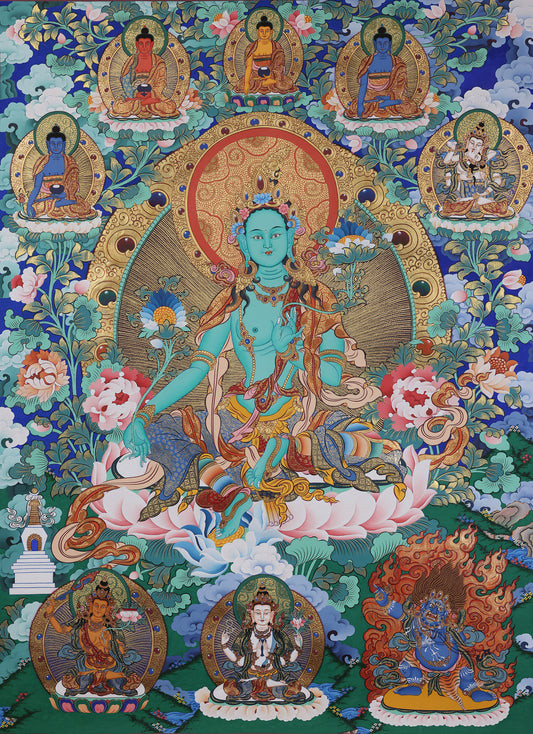

When you gaze at a Tibetan Buddhist mandala thangka, your eyes are inevitably drawn to its nested geometric structures, rich vivid colors, and intricate symbols—this is no ordinary decorative painting. It is a "visual manual" of Tibetan Buddhist cosmology, a spiritual coordinate for practitioners during meditation, and even "cosmic order" frozen in color.
1. Mandala: Not a "Painting," but a "Model of the Universe"
In Tibetan Buddhism, the "mandala" (Sanskrit: Mandala; Tibetan: "Kyilkhor") is essentially a visual carrier of Buddhist cosmology. It is not a two-dimensional work of art, but a "miniature universe": the center represents the core of the cosmos (such as the Buddha’s Dharmakāya), the outwardly nested geometric structures correspond to the layers of the world, and the surrounding symbols, divine beasts, and scriptures are the "code" of cosmic order.
In terms of form, a typical mandala takes a "square mandala" as its core (symbolizing the solid order of the secular world), wrapped in a circular structure (symbolizing the infinite emptiness of the universe), and bounded by multiple decorative rings (such as lotus rings and flame rings) that separate the "sacred space" from the "secular space." Taking the mandala in the opening image as an example:
- The central square "Mount Meru mandala," nested with multiple corridors, corresponds to the layers of the Buddhist "Mount Meru world";
- The four gates of the square mandala are often painted with divine beasts (such as the white lions in this mandala), representing the power that guards the sacred space;
- The outer circular belt, covered with Tibetan scriptures and auspicious symbols (such as the Dharma wheel and lotus), is a carrier of "spiritual power" and "blessings."
For Tibetan Buddhist practitioners, the mandala is not a "sight to behold," but a tool for meditative visualization: by recreating the mandala’s structure, colors, and symbols in their minds, practitioners can "enter" this miniature universe, achieve spiritual connection with the Buddha, and ultimately reach the state of "unity between body, mind, and cosmic order."
2. Mandala Colors: Every Hue is a "Spiritual Code"
The colors of Tibetan Buddhist mandalas are never random decorative matches—they carry clear religious meanings. Each hue is a "code" that helps practitioners understand "emptiness" and "wisdom."
Take the common colors in traditional mandalas as examples:
- Blue: Represents "emptiness" and "calmness," the original background color of the universe (such as the outer belt of this mandala);
- Red: Symbolizes "vitality" and "compassion," corresponding to the Buddha’s "Sambhogakāya" (such as the red decorations in the inner corridors);
- Yellow/Gold: Implies "wisdom" and "light," a symbol of Buddha-nature (the golden structure at the mandala’s center);
- White: Stands for "purity" and "liberation," commonly seen in the decorations of divine beasts and scriptures (such as the white lions at the four gates).
The combination of these colors is essentially "expressing the Dharma through forms": through the visual color hierarchy, practitioners are guided from "secular concreteness" (such as the vitality of red) to gradually understand "sacred abstraction" (such as the emptiness of blue), and finally break through "attachment to form" to realize the true meaning of "the emptiness of all phenomena."
3. The "Life" of a Mandala: A Spiritual Closed Loop from Creation to Dissolution
In Tibetan Buddhism, the "value" of a mandala lies not only in its "existence" but also in its "disappearance"—the process from creation to dissolution is itself a complete spiritual practice.
The traditional sand mandala (a mandala drawn with colored sand) is the ultimate embodiment of this "life loop":
- Creation: Several monks may spend days or even months stacking colored sand with needle-like precision, maintaining extreme focus and piety throughout (each grain of sand is a carrier of "thought");
- Enshrinement: The completed sand mandala serves as the core of the Dharma assembly, bearing the prayers and visualizations of believers;
- Dissolution: After the Dharma assembly ends, monks sweep up the sand of the mandala—half is offered to Buddhas and Bodhisattvas, and the other half is scattered into rivers. This is not "destruction," but a way of "returning the sand to flowing water" to symbolize the truth of "anicca (impermanence of all phenomena)," and to spread the mandala’s "blessings" to the world.
Even mandalas in thangka form (such as the work in this article) carry the same logic: they are "movable sacred spaces" that can be used for long-term visualization by practitioners, and can also allow more people to access Tibetan Buddhist cosmology through circulation—their "life" lies in "being understood, visualized, and passed on."
4. Mandala: A "Spiritual Gift" from Tibetan Buddhism to the World
In the contemporary era, the mandala has long transcended its nature as a religious tool and become a "business card" for the external communication of Tibetan Buddhist culture. Through its visual form, it allows people from different cultural backgrounds to touch the core ideas of Tibetan Buddhism:
- From an artistic perspective, the intricate structure and color aesthetics of mandalas have inspired contemporary design, architecture, and even digital art (for example, many modern installation artworks draw on the nested structure of mandalas);
- From a spiritual perspective, the mandala’s thinking of "expressing the infinite through the finite" makes people rethink "the relationship between the individual and the world"—we are both a symbol in the "mandala" and a part of the "cosmic order";
- From a cultural perspective, the "creation-dissolution" logic of the mandala conveys the wisdom of "impermanence" and "compassion": beauty does not need to be attached to "eternal existence," but lies in "having once conveyed kindness."
The next time you see a mandala, take a moment to slow down: it is not a "complicated painting," but a "cosmic diary" written by Tibetan Buddhist practitioners with colors and lines—inside it are their understanding of the world, their pursuit of wisdom, and their blessings for all living beings in the world.
#TibetanBuddhistCulture #MeaningOfMandala #BuddhistArt #MandalaExplained #TibetanBuddhistCosmology #TibetanThangkaArt #MandalaMeditationPractice #TibetanSpiritualSymbols #TraditionalTibetanArtForms #CosmicSymbolismInBuddhism
Explore Ritual Offering Objects for Practice Spaces
Recommended pieces and collections
Tags:
Previous
Tibetan Buddhist Mandala: A Visual Poem of Cosmic Order, the Enlightenment Code Hidden in Geometry
Next
Cai Tang Vaishravana: The Guardian of Wealth in Tibetan Buddhism, The Golden Faith in Thangka Art